Last updated: February 2026 · Reviewed for: legal accuracy, platform Terms of Service currency, and enterprise risk applicability
Executive Summary
Why This Matters for a Regulated Organization
A marketing designer opens a free image generator, pastes an unreleased product render into the prompt box, and publishes the result on a landing page. That single action can touch data classification policy, vendor contracting, advertising review, and intellectual property law at once. No model validation memo. No prompt log. No owner.
That is the practical reason a "creative" question belongs in a governance discussion.
Artificial intelligence has moved from a theoretical research field into a working pillar of modern visual production. Creative studios, in-house brand teams, and commercial enterprises deploy generative tools to streamline visual asset production, accelerate concept design, and test directions that used to need a full photoshoot. Integrating those technologies responsibly requires clear answers to five questions: what AI art is, how generative architectures operate, who holds authorship, how commercial licenses function under current legal frameworks, and which internal controls keep synthetic media auditable.
This guide is written for the person who has to sign off, not only for the person who clicks generate.
What Is AI Art? Definition and Meaning
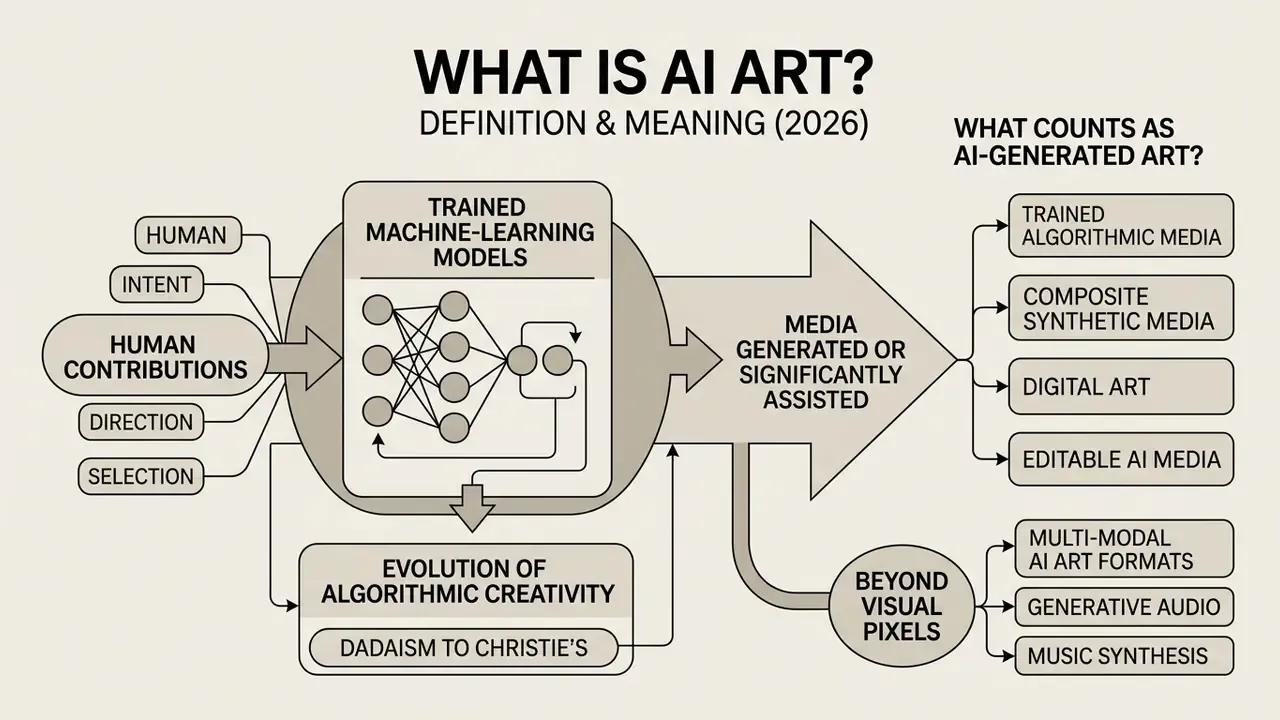
Short answer: AI art is media generated or significantly assisted by trained machine-learning models, where the human contributes intent, direction, and selection. It is a distinct branch of digital art defined by delegated execution, not delegated authorship.
AI art refers to visual media generated or significantly assisted by artificial intelligence algorithms, primarily deep neural networks trained on existing image datasets, which translate inputs such as text prompts into new visual compositions. The modern definition of AI art centers on delegating pixel-level execution to a statistical model while relying on human guidance for artistic vision, prompt engineering, selection, and post-generation refinement.
When establishing an ai art definition, it is essential to recognize that artificial intelligence does not possess consciousness or artistic intent. It processes human input through probabilistic models to synthesize novel visual outputs. Understanding ai art meaning requires looking at both the technical output and the human process behind it. So, what is ai art? It is a collaborative medium where human creativity sets the constraints and direction, while machine learning algorithms generate the visual material. Ask it more casually, whats ai art or what's ai art, and the answer does not change: intent stays human, execution goes to the model.
That finding matters commercially. If trained human observers cannot reliably distinguish synthetic from hand-made imagery, provenance metadata, not visual inspection, becomes the only defensible audit control. Eyeballing an asset is not a control. It is a hope.
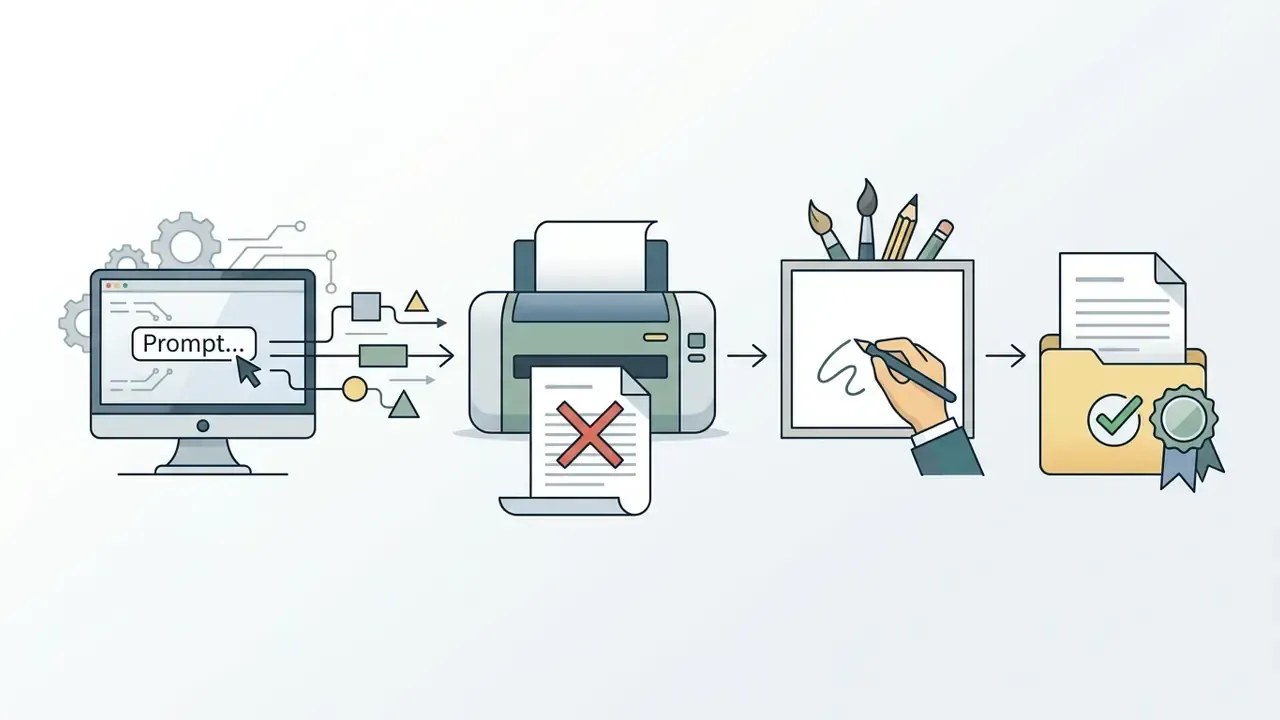
To define ai art accurately, regulatory authorities and legal bodies distinguish between machine assistance and machine autonomy. The official definition of ai art in legal contexts, such as guidance from the U.S. Copyright Office (2025), emphasizes that purely machine-generated outputs lacking human expressive control are treated as public domain material, whereas hybrid works involving substantial human arrangement, selection, or post-editing qualify for protection.
«Copyright protects original expression created by a human author; outputs where AI determines the expressive elements are not human-authored.»
«Fully machine-generated content should remain outside copyright; AI-assisted works may qualify only where human control and creative choices are substantial.» - European Parliament Research Service, Generative AI and Copyright (2025).
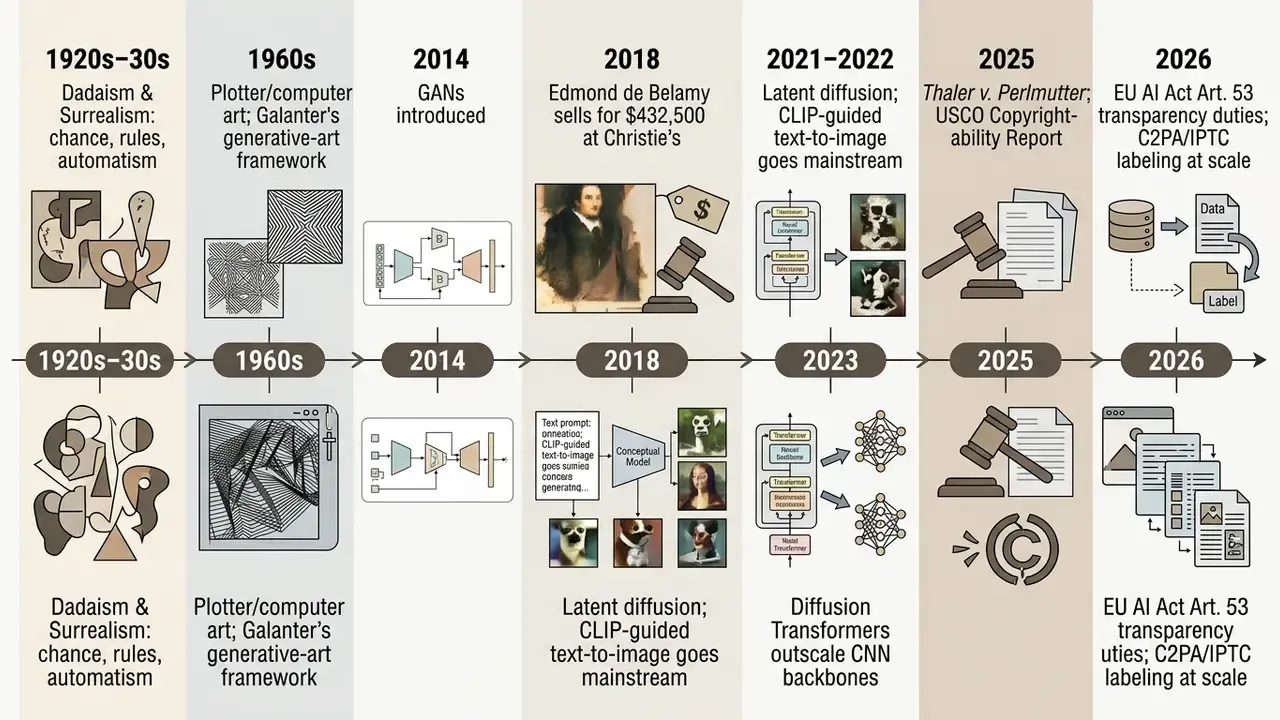
The Evolution of Algorithmic Creativity: From Dadaism to Christie's
While modern AI art relies on deep neural networks, procedural asset generation roots back to 1920s Dadaism and Surrealism, which leveraged chance operations, algorithmic rules, and automated composition as deliberate artistic strategies (Christie's Fine Art Review). Cut-up techniques, exquisite-corpse drawing games, and automatic writing all separated the artist's hand from the final composition. Generative models make the same conceptual move, only at industrial scale.
The movement transitioned into digital space during the 1960s, when plotter-driven computer art experiments by early algorithmic artists formalized the idea that a rule set could be the artwork. Philip Galanter's canonical definition of generative art, art in which the artist uses a system set into motion with some degree of autonomy that contributes to the finished work, remains the clearest bridge between procedural art and today's foundation-model pipelines.
The historic market milestone arrived in 2018. The AI-generated portrait Edmond de Belamy, produced with a generative adversarial network, sold at Christie's auction for $432,500, vastly exceeding its pre-sale estimate. That sale established generative algorithms not merely as technical curiosities but as recognized forces in the global art market, and it triggered the first serious institutional debates about authorship of machine-assisted works.
What counts as AI-generated art?
AI-generated art encompasses any visual content produced through algorithmic inference, including text-to-image synthesis, image-to-image transformations, and composite synthetic media. That covers completely synthetic renders generated from scratch, localized modifications made via inpainting, and hybrid digital compositions where AI-generated elements are integrated with photographic or hand-drawn media. If you are asking what is ai generated art in operational terms, the honest test is simple: did a trained model decide any visible detail?
Under media provenance standards established by the International Press Telecommunications Council (IPTC), the ai generated art definition and its classification rely on technical origin labels. These are the same labels that AI image detectors and downstream provenance tooling read programmatically:
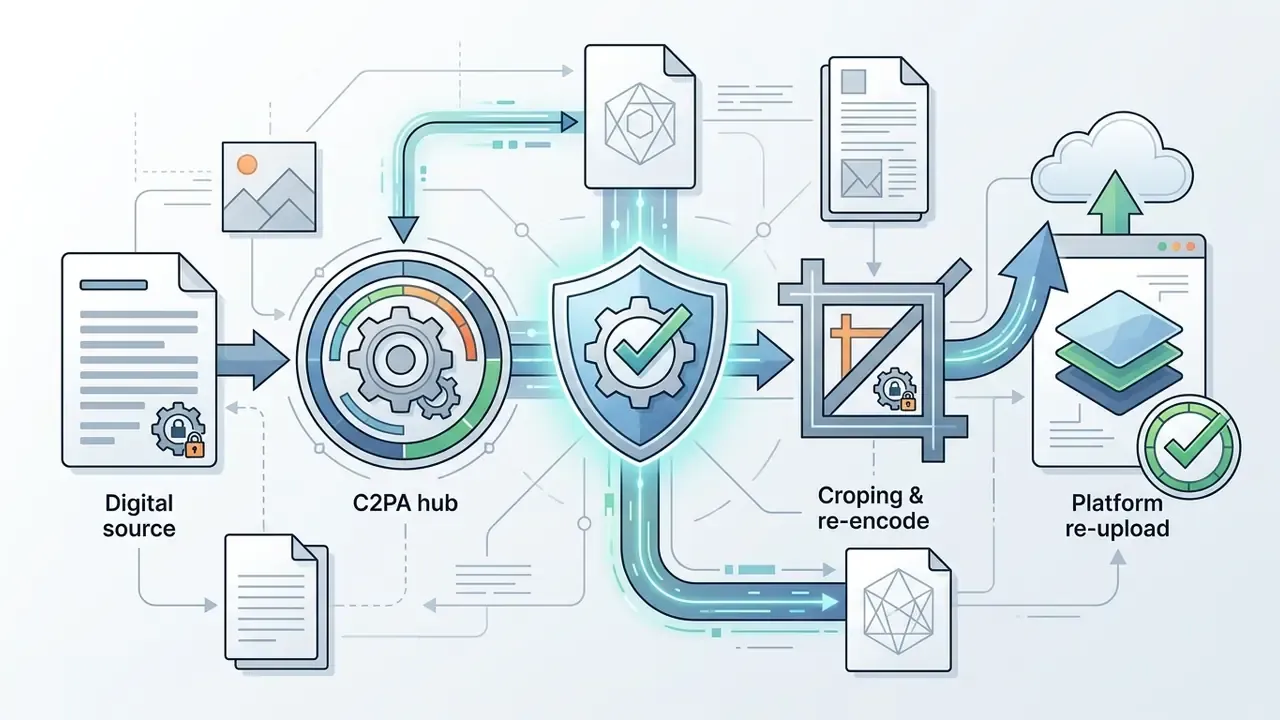
Alongside IPTC labels, the C2PA (Coalition for Content Provenance and Authenticity) Content Credentials specification attaches a cryptographically signed manifest recording the generating model, edit history, and asserting organization. For regulated industries, C2PA manifests plus IPTC digital-source-type fields form the minimum viable provenance stack. Anything less and your ai art information trail ends at the file itself.
Beyond visual pixels: multi-modal AI art formats
AI art extends beyond static images into a multi-sensory generative ecosystem:
Is AI art the same as digital art?
No. AI art is not identical to traditional digital art, though it sits inside the broader digital art ecosystem as a specialized branch. Traditional digital art relies on software like Adobe Photoshop or Illustrator as digital tools that execute direct human keystrokes, vector paths, and brushstrokes, keeping the human artist as the direct operator of every composition decision. The software renders commands. It does not make content decisions.
In contrast, generative ai art meaning introduces model autonomy into the workflow. The creator shifts from direct manual execution to high-level directional oversight: curating outputs, refining prompts, and setting boundary constraints. While traditional digital tools execute explicit procedural commands, generative AI tools evaluate multi-dimensional vector spaces to infer visual structures, delegating pixel synthesis to neural network parameters.
«AI turns the artist into a "prompt engineer": instead of a brush, a phrase; instead of imagination, the statistics of a trained model.»
The governance consequence is concrete. Because the model, not the operator, determines many expressive details, oversight frameworks such as the NIST AI Risk Management Framework require that human-AI configurations explicitly define and differentiate roles and responsibilities. In practice that means naming an accountable human reviewer for every synthetic asset that reaches publication, a requirement that simply does not exist when a designer draws a vector logo by hand. Teams comparing manual and generative pipelines side by side often start with our photo editor guide to map which stages remain fully human.
How Does AI Art Work?
Short answer: A text encoder converts the prompt into embeddings, a diffusion network iteratively removes noise from a latent representation conditioned on those embeddings, and a decoder converts the final latent into visible pixels.
AI art works by running input data through deep neural networks, such as latent diffusion models or generative adversarial networks, that have learned statistical relationships between visual features and text descriptions from multi-billion-image datasets. The neural network accepts conditioning inputs, such as text prompts or reference images, and systematically converts random numerical noise into a structured, high-resolution image.
«Generative AI is a class of tools that learn statistical patterns from vast corpora of human-created works.»
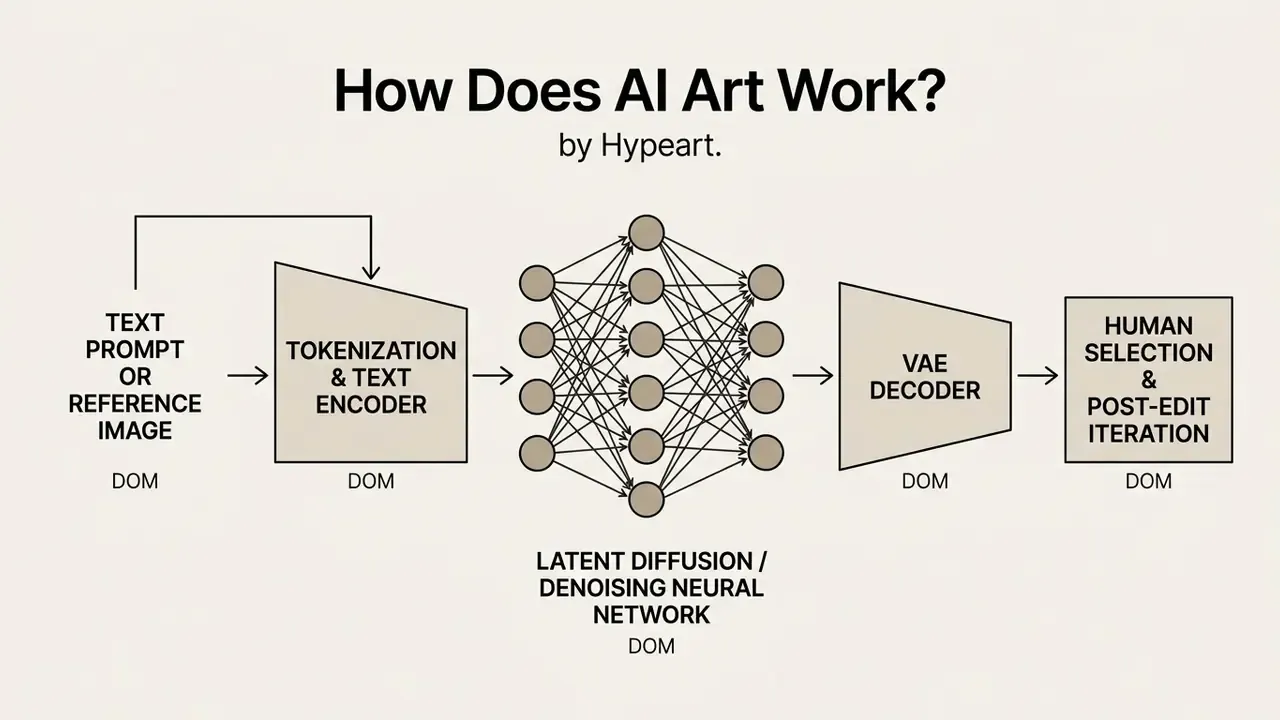
- Step 1, input processing
- the user provides a text prompt or reference image into the interface.
- Step 2, tokenization and encoding
- a text encoder (such as CLIP or T5) converts words into high-dimensional mathematical embeddings.
- Step 3, latent denoising
- the core diffusion transformer (DiT) or U-Net model iteratively removes Gaussian noise from a latent vector space conditioned on the text embeddings.
- Step 4, decoding
- a Variational Autoencoder (VAE) decodes the latent representation into a visible pixel image.
- Step 5, human review and refinement
- the user evaluates the candidate output, adjusting parameters, prompts, or localized masks for further generation cycles.
Explainability limitation, material for model-risk teams: latent diffusion spaces are not human-interpretable. There is no feature-attribution report explaining why a given seed produced a given composition, which means visual generative systems cannot be validated with the same explainability evidence expected of credit or pricing models. Control therefore shifts from explaining the model to constraining and logging the workflow: fixed seeds, versioned prompts, negative-prompt libraries, documented human sign-off. Not elegant. Defensible, though.
From text prompts to generated images
The transition from text prompts to generated images relies on cross-attention mechanisms that pair textual tokens with visual feature maps inside the neural network. When a user submits a prompt specifying scene composition, lighting, and style parameters, a text encoder parses the phrasing into semantic vectors.
During generation, the diffusion algorithm begins with a latent canvas filled with random Gaussian noise. Over multiple denoising steps, typically 20 to 50 iterations, the network predicts and subtracts noise patterns that do not align with the mathematical representation of the prompt. Expect several rounds before you generate new variants worth keeping.
«Prompt artists build queries from reusable "blocks," experimenting with word order across iterative evaluation cycles.»
For technical applications requiring precise architectural layouts, specialized models like an ai architecture generator apply additional spatial constraints so that structural proportions match physical building standards.
Training data, neural networks and generative models
Generative models rely on massive training datasets containing millions or billions of image-text pairs, such as LAION or curated internal repositories, to learn visual styles, object shapes, and spatial relationships. The underlying architecture determines how the model processes those datasets:
- Diffusion models and Diffusion Transformers (DiTs): modern state-of-the-art systems add noise to training images in a forward process and train neural networks to reverse this transformation. Research from UC Berkeley indicates that replacing traditional Convolutional Neural Networks (CNNs) with Transformer backbones inside diffusion pipelines yields superior image synthesis scalability and fidelity.
«Replacing CNNs with transformer backbones in diffusion pipelines delivers superior image-synthesis scalability.» - UC Berkeley EECS Technical Report UCB/EECS-2023-108 (2023). https://www2.eecs.berkeley.edu/Pubs/TechRpts/2023/EECS-2023-108.html
- Generative Adversarial Networks (GANs): introduced by Goodfellow et al. (2014), GANs use two competing networks, a generator that produces synthetic images and a discriminator that evaluates whether the image is real or fake. The generative adversarial network approach remains highly effective for low-latency real-time video and localized image transformation tasks, and GAN-derived work, including Edmond de Belamy, defined the first commercial wave of AI art.
- Training dataset impact: a model's ability to produce images with detailed lighting, composition, and realistic textures is bound by the scale, diversity, and filtering quality of its training data. Published diffusion and GAN benchmarks report results on CIFAR-10, CelebA, STL-10, LSUN, FFHQ, ImageNet, and LAION-scale corpora, with preprocessing steps such as normalization, augmentation, random cropping, rotation, colour jittering, and edge detection applied before training.
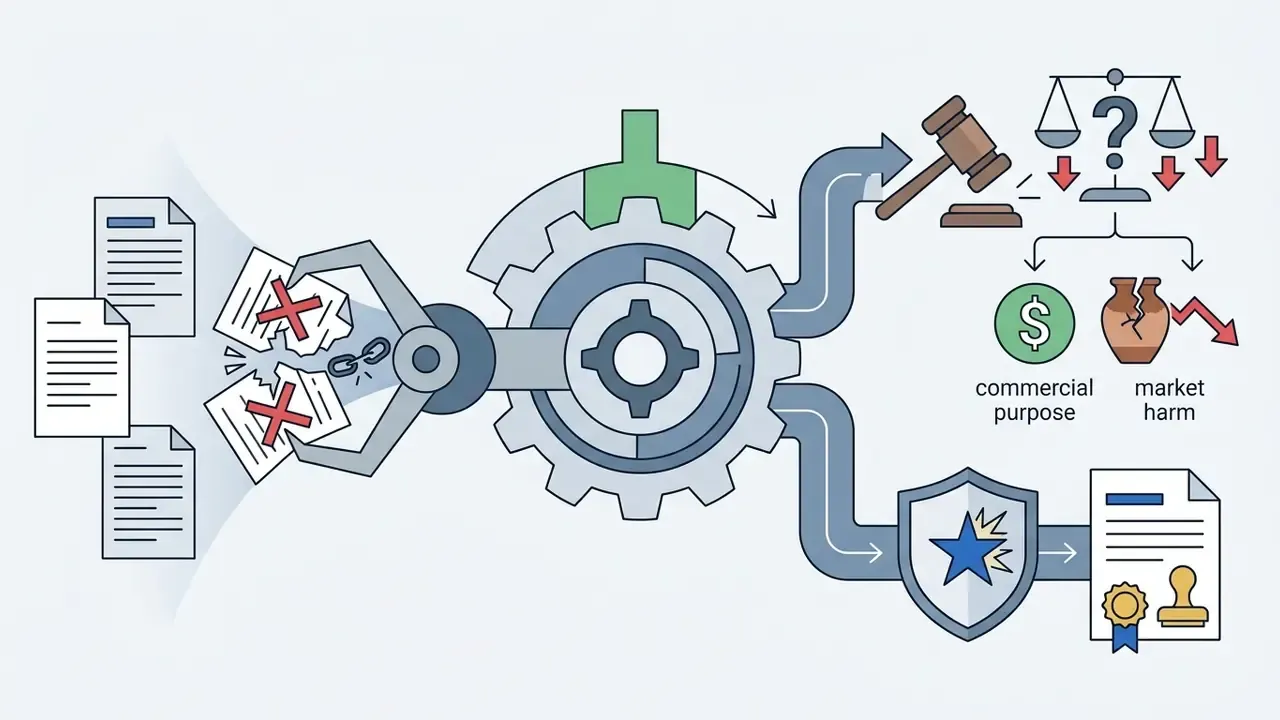
- Dataset provenance as a legal variable: under Article 4 of EU Directive 2019/790, text-and-data mining is permitted only for lawfully accessible content and only where rightsholders have not reserved their rights. Article 53 of the EU AI Act additionally obliges general-purpose AI providers to maintain a copyright-compliance policy and publish a sufficiently detailed summary of training content. That makes dataset provenance a procurement question, not just a research question.
What Is an AI Art Generator?
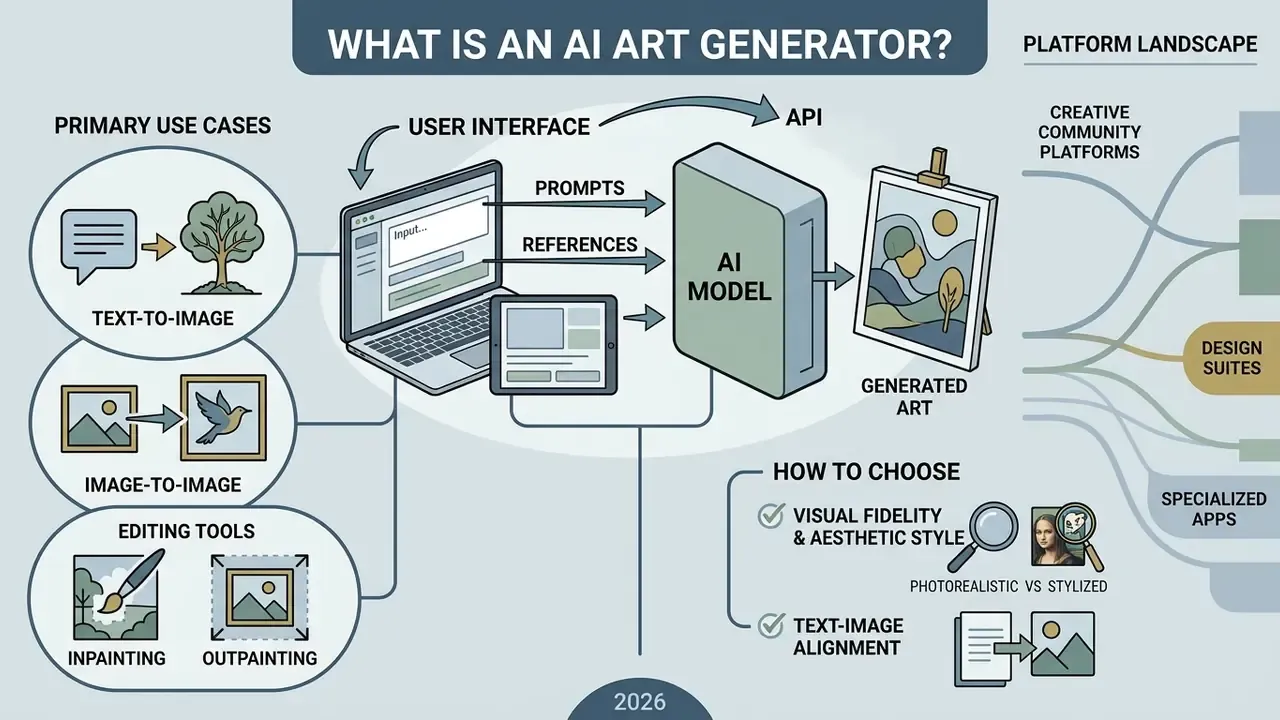
Short answer: An AI art generator is the interface layer, web app, desktop tool, or API, that exposes a trained generative model to a user through prompts, references, masks, and parameters.
An AI art generator is a software application, web platform, or API service that leverages trained machine learning models to synthesize, edit, or transform visual media from user-supplied instructions. These tools convert complex machine learning pipelines into intuitive graphical interfaces or programmatic endpoints accessible to designers, developers, and commercial enterprises.
Understanding what is ai art generator functionality involves recognizing the tool's interaction modes. A modern ai art generator acts as a production engine capable of generating photorealistic imagery, vector graphics, concept sketches, and stylized art from text descriptions or base images. Buyers typically shortlist the best AI image generators against their own quality and licensing thresholds. Enterprise organizations frequently deploy these ai tools to accelerate visual asset pipelines and lower initial prototyping costs.
Platform landscape by primary use case
| Platform | Architecture class | Primary strength | Typical deployment |
|---|---|---|---|
| Midjourney | Proprietary diffusion | Aesthetic composition, stylized and painterly output | Hosted web / Discord |
| Stable Diffusion (Stability AI) | Open-weight latent diffusion | Fine-tuning, LoRA training, private self-hosting | Local, VPC, or API |
| DALL·E 3 (OpenAI) | Proprietary diffusion plus LLM prompt rewriting | Strict prompt adherence, conversational iteration | API / ChatGPT product surface |
| Adobe Firefly | Proprietary model trained on licensed stock and public domain | Commercially safer sourcing, enterprise indemnification | Creative Cloud / Firefly web |
| Flux | Rectified-flow transformer | Photorealism, product imagery, fast API throughput | API or local |
Text-to-image, image-to-image and editing tools
Modern generative platforms provide three primary operational workflows:
- Text-to-image (T2I) generates new images from scratch based purely on descriptive text prompts.
- Image-to-image (I2I) uses an existing photograph or drawing as a structural base, transforming its style, lighting, or details according to prompt instructions. This image based mechanic sits behind most image-to-image generators.
- Inpainting and outpainting localized editing functions that let users select specific image regions (inpainting) to replace content, or expand a canvas beyond its original borders (outpainting).
For creators requiring specialized content workflows, niche platforms offer tailored parameter tuning, ranging from commercial asset generation to aesthetic-specific interfaces such as an ai art ai tool.
| Functional workflow | Technical description | Primary production use case |
|---|---|---|
| Inpainting | Regenerates masked image sub-regions using targeted prompt conditioning; surrounding pixels are preserved. | Fixing anatomical bugs, swapping background elements, removing objects. |
| Outpainting (canvas expansion) | Synthesizes new visual structure outside the original image frame. | Adapting visual assets across multi-platform aspect ratios (1:1 to 16:9), see AI outpainting tools. |
| Realtime latent canvas | Renders immediate diffusion feedback as the user draws vector brushstrokes. | Rapid conceptual prototyping, live storyboard ideation. |
| Style and pose transfer (ControlNet) | Maps structural edge maps, depth maps, or human poses directly onto synthetic targets. | Maintaining strict character consistency across multi-frame campaign assets. |
| Universal upscaling | Super-resolution regeneration that raises pixel density while re-synthesizing fine texture. | Print production, large-format display, high-fidelity delivery. |
How to choose an AI art generator for your goal
Selecting an appropriate generator means aligning tool capabilities with production requirements. Creative teams should evaluate platforms across six operational criteria:
- Visual fidelity and aesthetic stylemodels like Midjourney and Flux excel in artistic composition and photorealism, whereas DALL·E 3 prioritizes strict prompt adherence.
- Text-image alignmentacademic evaluation frameworks score alignment (does the output match the prompt?) separately from fidelity (does it look real?) and aesthetics (is it appealing?). Commercial teams should test all three, plus text rendering if assets contain typography.
- Commercial licensing and safetyAdobe Firefly is trained on licensed Adobe Stock and public domain content, offering enterprise indemnification against copyright claims.
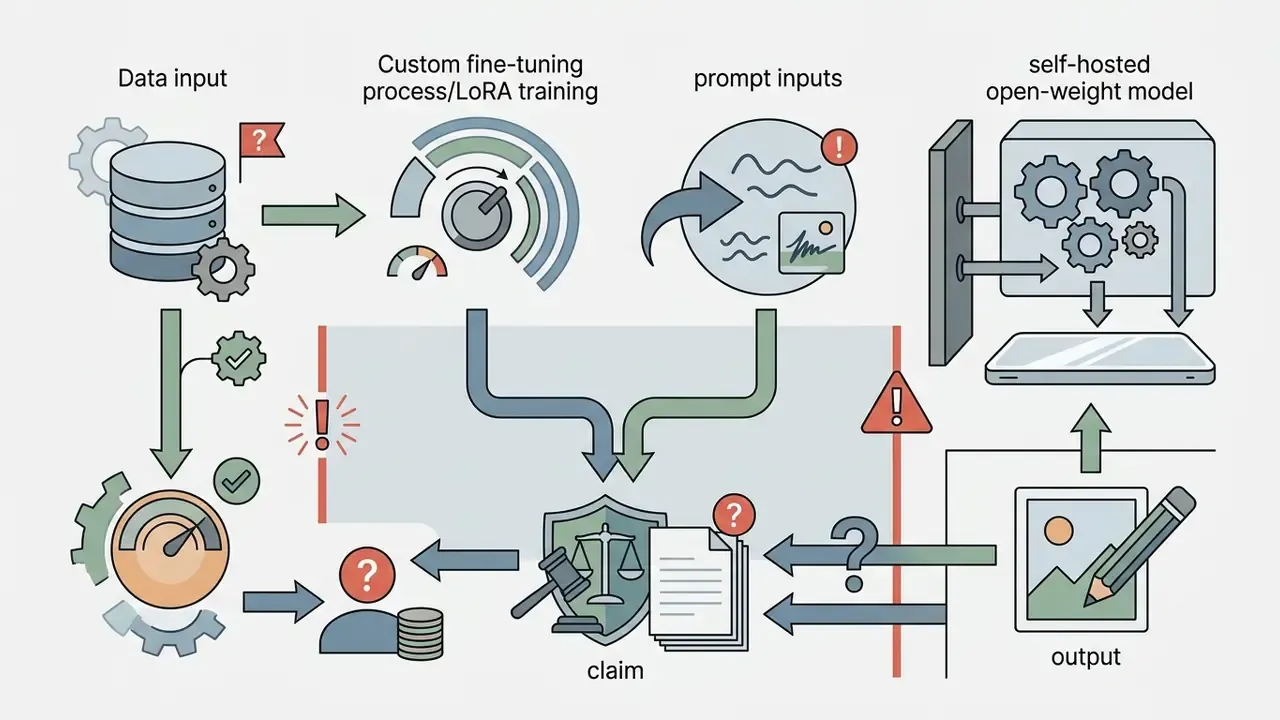
- Customization and local controlopen-weight architectures like Stable Diffusion permit self-hosting, fine-tuning via LoRAs, and private deployment behind corporate firewalls.
- Brand and product preservationfor e-commerce and apparel, check whether the model preserves product attributes, logos, and material texture across edits rather than hallucinating substitutes.
- Integration and API accessteams building custom automation workflows need robust API access. Reviewing AI Media Comparison Matrices helps identify platforms that match enterprise throughput requirements, and our api reference section covers endpoint-level constraints.
Enterprise decision framework:
- If your annual gross revenue exceeds $1,000,000 USD and you deploy Stable Diffusion, you must procure an enterprise commercial license.
- If you require contractual copyright indemnification, deploy Adobe Firefly under enterprise Creative Cloud terms.
- If maximum photorealistic rendering and composition control are required, use Midjourney Pro/Mega tiers with private generation parameters (
--no publish/ Stealth Mode). - If no customer or confidential data may leave your network, self-host open-weight models inside a VPC or on-premise GPU cluster. Public SaaS endpoints are out of scope.
- If you need full prompt-and-seed audit trails, prefer API deployment over consumer UI, since API logs are retainable in your own systems.
Free plans, paid features and usage limits
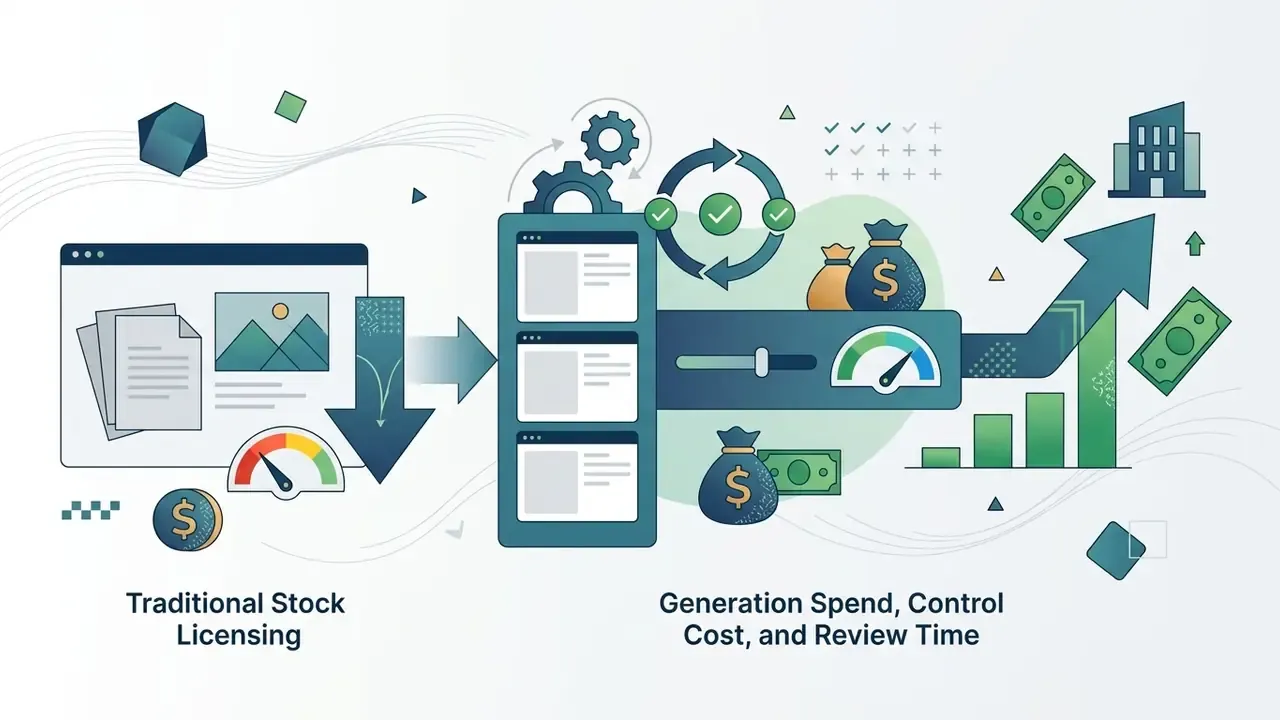
Pricing models across generative AI platforms generally fall into three tiers: free AI image generators and free access levels, fixed monthly subscriptions, and consumption-based API billing. Comparing them early keeps cost control credible when finance asks. Reported free-tier limits in 2026 range from roughly 10 images per day to token-metered allowances of about 150 tokens per day, while entry paid plans commonly move users into the range of about 200 images per month or unmetered relaxed-mode generation. Teams modelling total spend against traditional stock budgets can run the numbers through our calculators.
To review complete pricing structures and enterprise licensing tiers across major platforms, consult our comprehensive AI Media Pricing Guides.
What Is AI Art Used For?
Short answer: AI art is used for concept ideation, marketing and social assets, web and UI design, product prototyping, and entertainment production, primarily to compress the distance between an idea and a viewable visual.
AI art is used extensively across media, commercial design, digital marketing, gaming, and entertainment. By reducing the time required to convert visual ideas into visible concepts, generative tools let creative teams prototype assets, explore visual directions, and scale content production.
Knowing what is ai art used for helps organizations integrate these technologies into existing design workflows responsibly. Rather than replacing creative oversight, generative models serve as speed multipliers during ideation and visual communication.
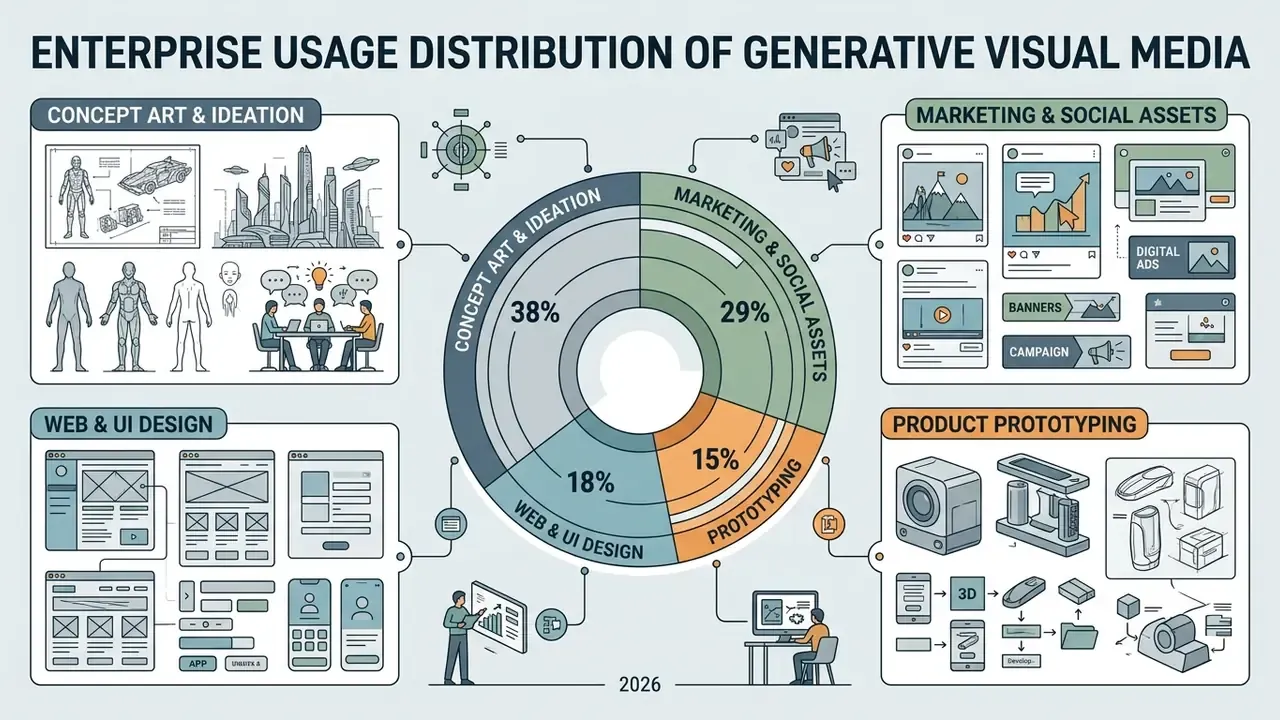
Documented applied domains span album covers and book illustration, concept art for film and video games, social advertising and branding campaigns, fashion pattern and textile design, logo exploration and website illustration, architectural and interior visualization, plus educational material for teaching design technique. Fine art remains a live market segment. AI-generated works are exhibited in galleries and sold at auction, and Edmond de Belamy is still the reference price point for institutional coverage.
AI art for artists, designers and creative exploration
For professional artists and designers, generative AI acts as an interactive brainstorming partner. During early project phases, designers use text-to-image models to build rapid mood boards, test lighting configurations, and explore colour palettes before any manual work begins. New ideas arrive cheaply here, which is most of the value.
Academic literature describes this interaction pattern as Mixed-Initiative Co-Creation.
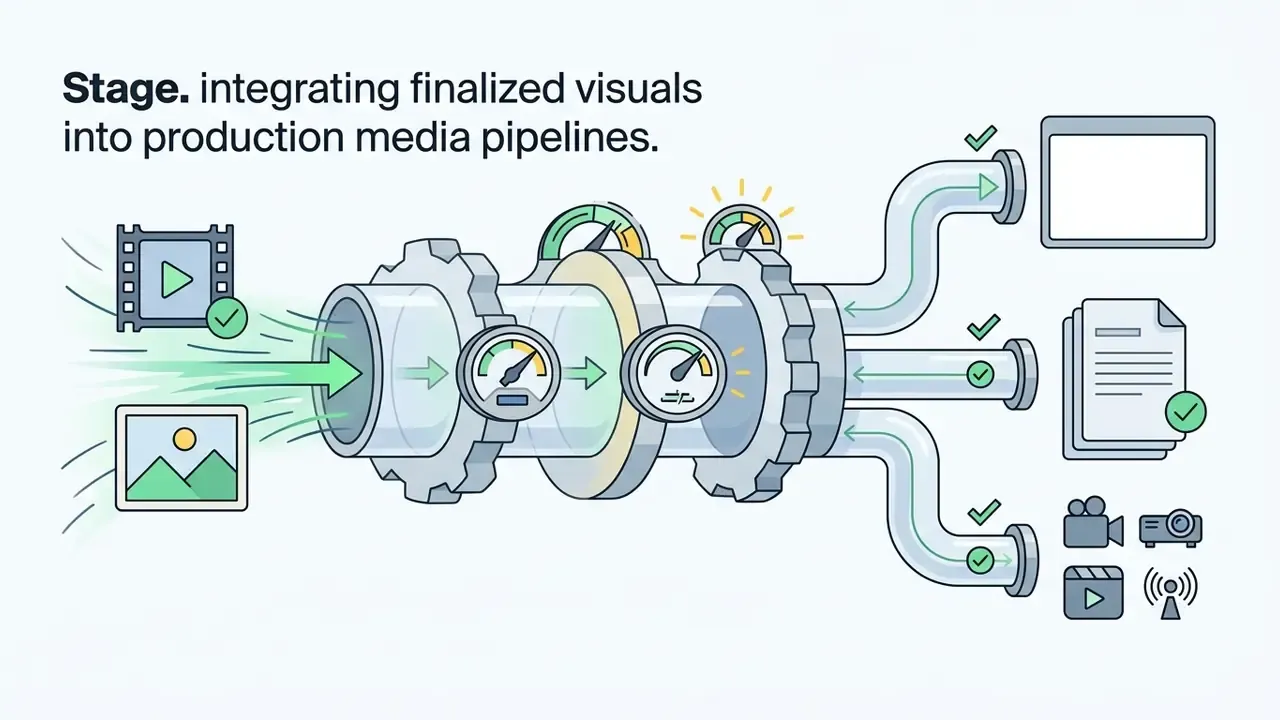
«The review describes a four-stage cycle, Sense → Sample → Shape → Stage, as the model for engaging GenAI in creative projects.»
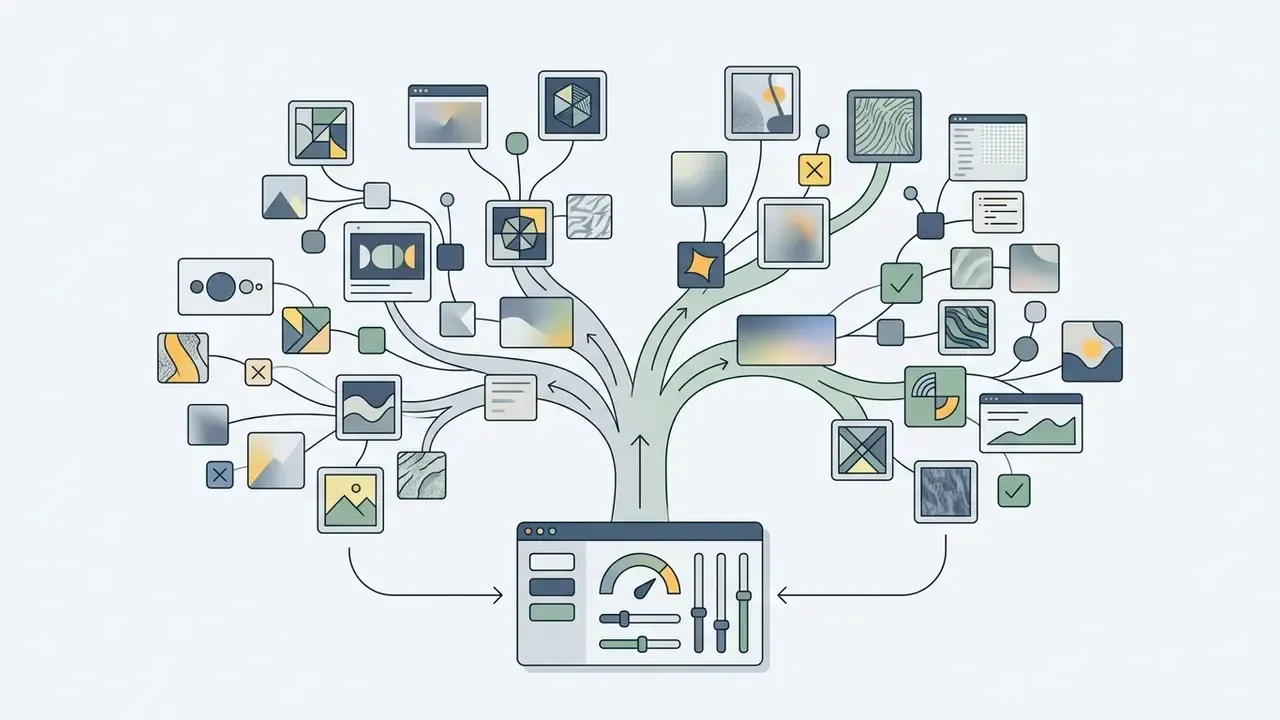
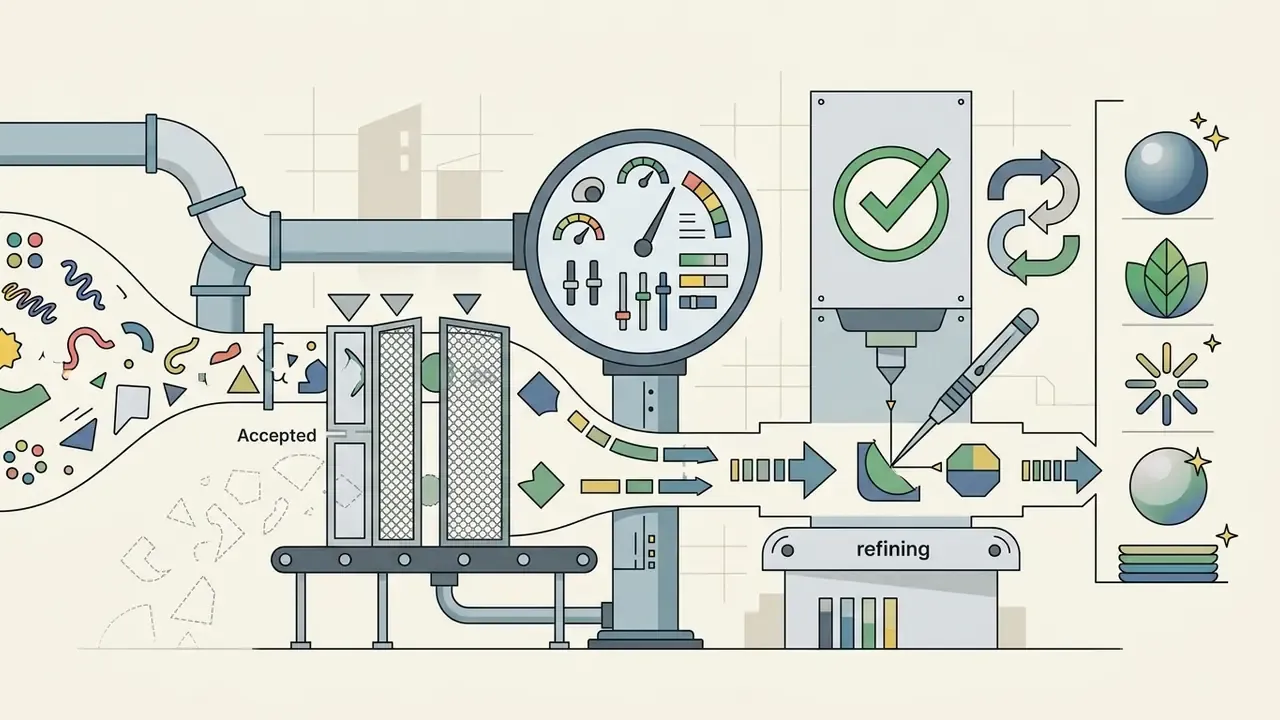
Creative workflows follow that four-stage progression:
Adoption, however, remains selectively bounded. Many senior practitioners use generative tools for exploration but hesitate to rely on them for final production, citing ethical and creative concerns.
«Twenty-two professional entertainment-industry artists described AI art as "soulless" and lacking human expression and genuine authorship.»
Designers seeking unrestricted creative sandboxes during early concept development sometimes explore ai apps with no filter to test raw aesthetic prompts before refining assets for public client delivery. Worth saying plainly: that exploration belongs on sanctioned, non-confidential material only.
AI-generated images for content and visual communication
Digital publishers, marketing agencies, and corporate communications teams use AI image generators for commercial use to create campaign visuals, blog illustrations, and social media content. Synthetic imagery lets teams produce context-specific generated content without leaning on generic stock libraries.
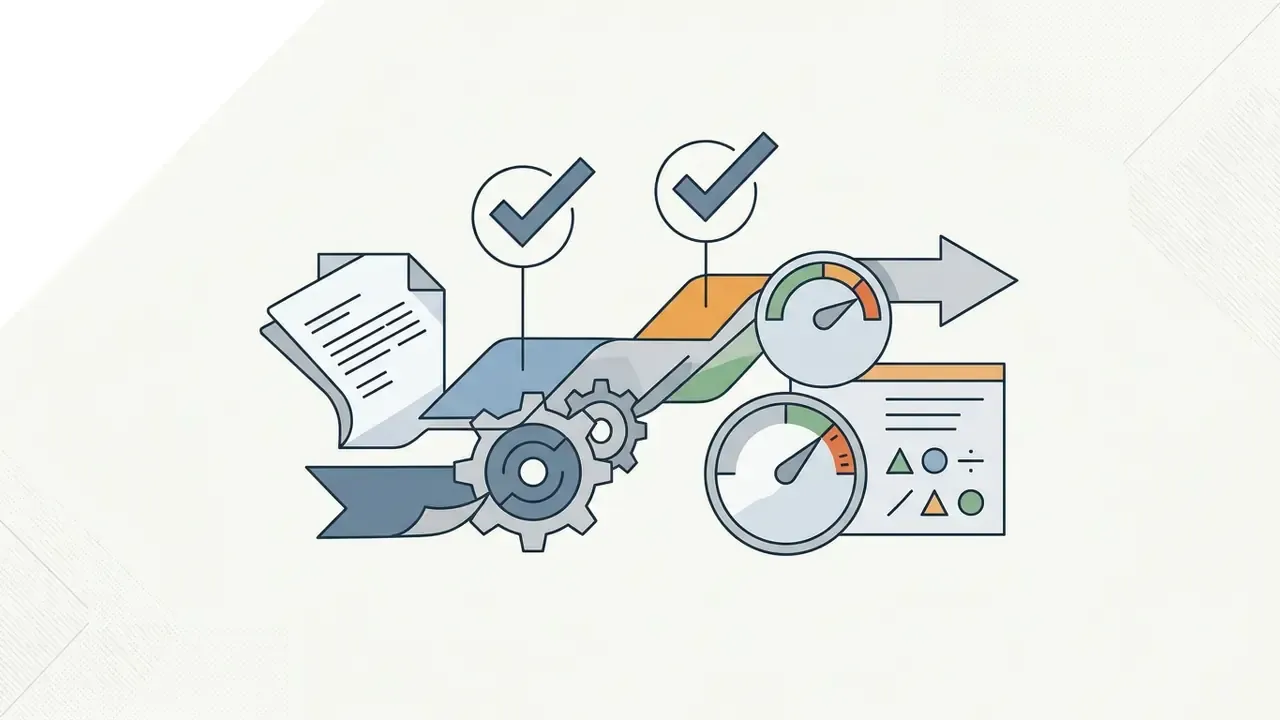
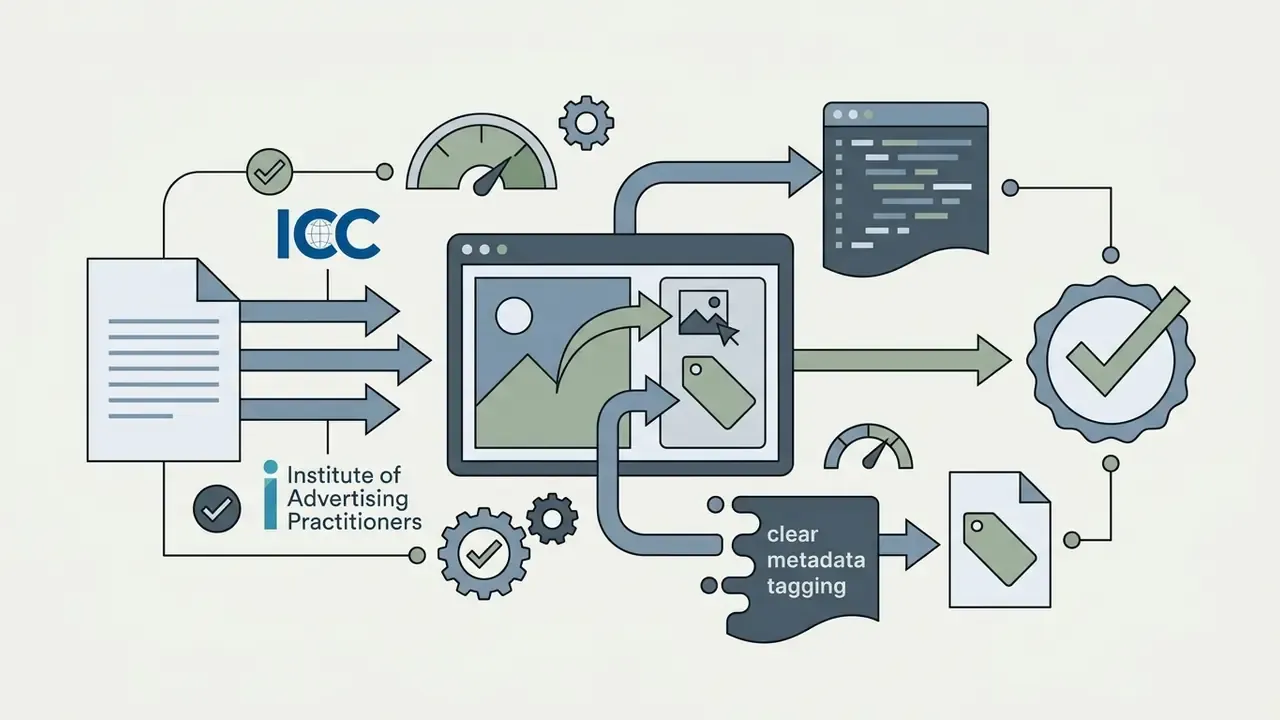
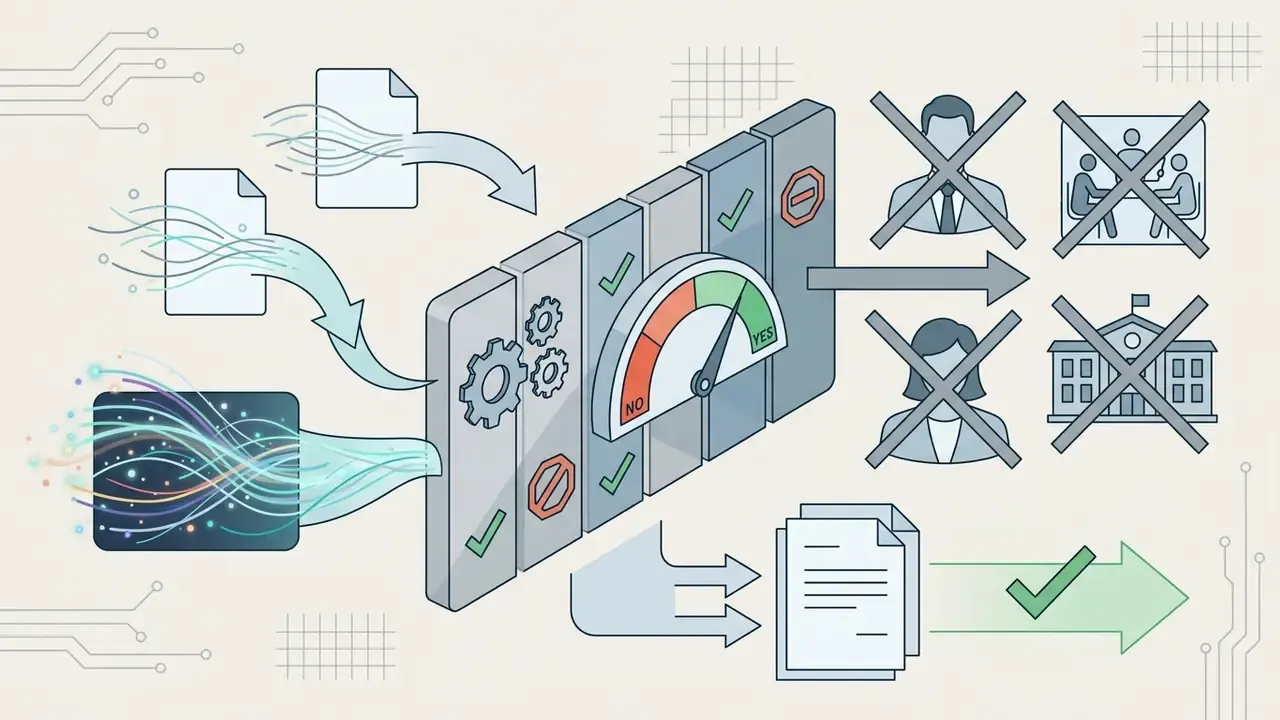
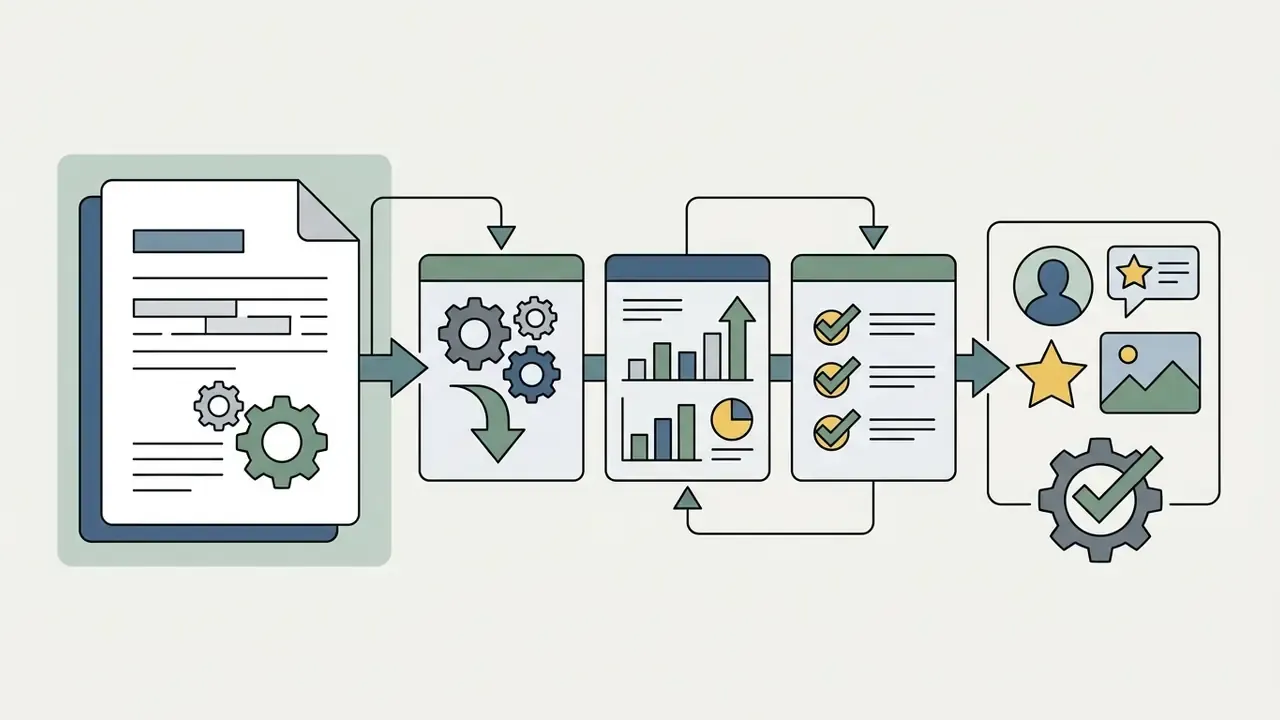
Deploying that generated content in public communications still requires strict governance:
How to Create AI Art: A Practical Workflow
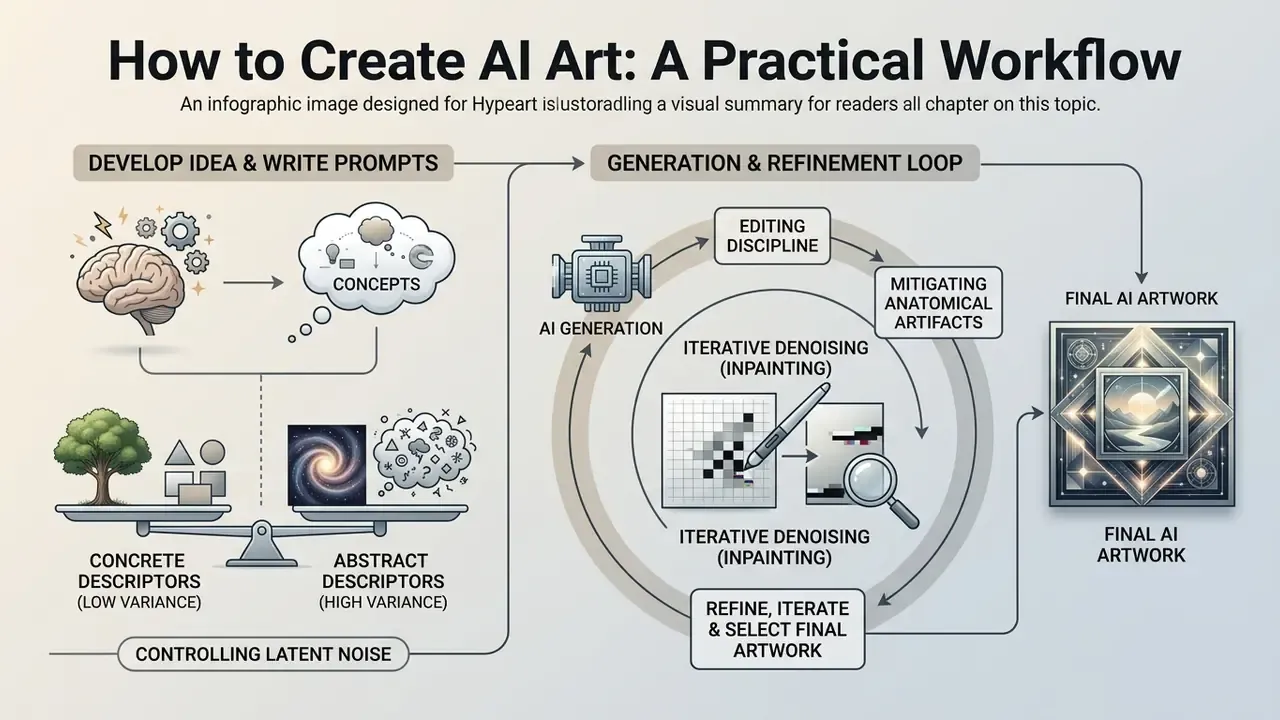
Short answer: Define the concept, write a structured prompt, configure parameters, generate batches, refine through inpainting and upscaling, then audit rights before release.
Creating high-quality AI art requires a structured approach to ideation, prompt structure, parameter tuning, and post-generation refinement. Single, unguided prompts rarely yield production-ready commercial assets. They yield screenshots.
- Define the visual concept and art directionestablish explicit guidelines for subject matter, lighting, mood, spatial composition, and medium (editorial photography, oil painting, 3D render).
- Construct structured promptsbuild text prompts using a modular formula, subject + environment + art medium + lighting/camera angle + stylistic modifiers. Apply negative prompts to exclude unwanted artifacts.
- Configure generation parametersset aspect ratios, sampling steps, guidance scale (CFG), and random seed numbers in your generator settings.
- Render and evaluate iterationsgenerate initial candidate batches of 4 to 8 renders. Evaluate outputs for prompt adherence, anatomical correctness, and visual flaws.
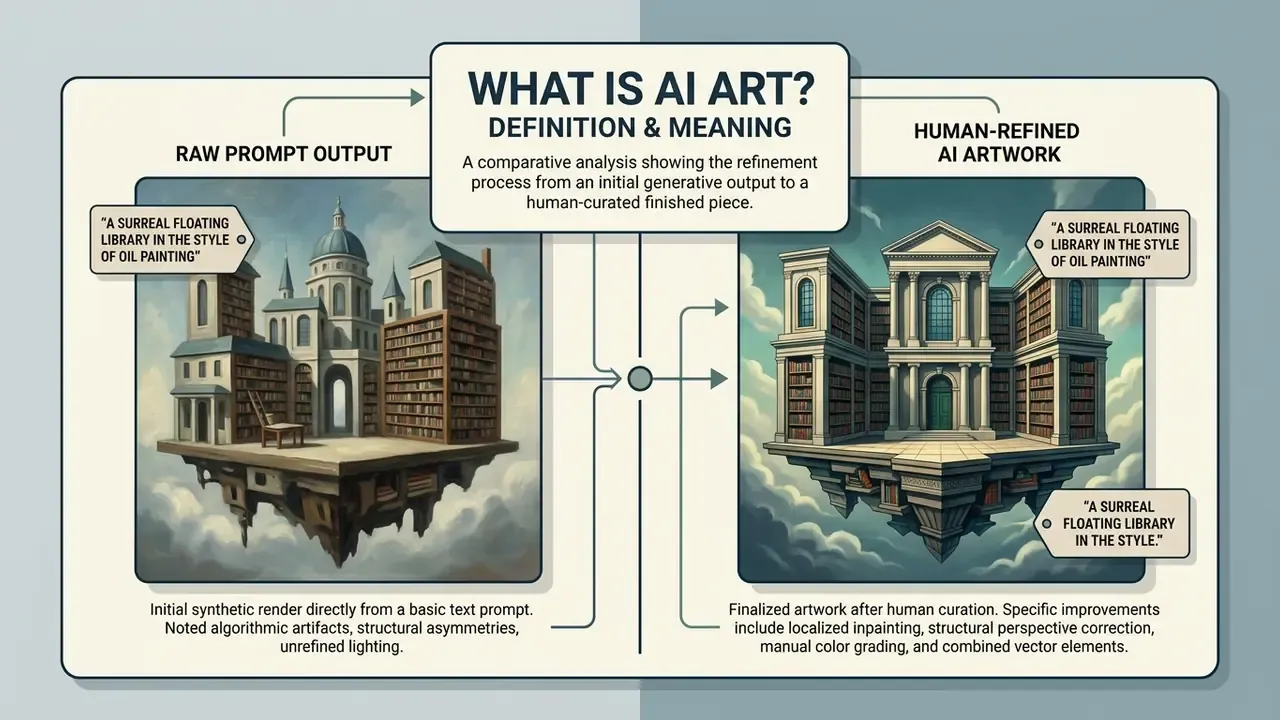
- Apply refinement and inpaintinguse image-to-image or targeted inpainting to correct details, upscale resolution via spatial diffusion models, and finish with manual post-editing.
- Audit usage rightsconfirm commercial licensing permissions and log prompt parameters for copyright disclosure records before distribution.
- Attach provenance metadataembed IPTC digital-source-type values and, where supported, a signed C2PA manifest before the asset enters your DAM or CMS.
Develop an idea and write effective prompts
Writing effective prompts requires precise language and structural clarity. Modern text encoders process explicit descriptive terminology far more effectively than subjective metaphor. Order matters too: keywords placed at the beginning of a prompt carry higher weight during latent denoising.
A proven prompt formula for commercial visual assets follows a four-part structure:
[Subject & primary action] + [context & environment] + [aesthetic style & camera settings] + [lighting & colour palette]
- Example prompt: "A senior risk analyst evaluating digital dashboards in a modern glass office, high-detail editorial photography, 85mm lens, natural daylight from side window, muted corporate colour palette --ar 16:9 --no blur, distortion, saturation."
Controlling latent noise: concrete vs. abstract vocabulary
To minimize random variance during denoising, prompt construction should prioritize concrete physical nouns over subjective abstractions:
- Abstract descriptors (high variance) terms like "emotional fantasy", "pure happiness", or "surreal beauty" push the model to sample widely disparate latent vectors, often yielding inconsistent compositions and structural distortion. Two runs of the same abstract prompt can return visually unrelated images.
- Concrete descriptors (low variance) specific terms like "weathered oak table", "85mm focal length", "side-lit rim light", or "ripe tomato" anchor the cross-attention layers to explicit visual features, narrowing output spread and making batches comparable.
- Editing discipline when modifying an existing image rather than generating a new one, state both the change and the preservation rule, for example "change only the sky; keep everything else the same", because prompt-based editing pipelines otherwise re-synthesize unrelated regions.
Mitigating anatomical artifacts: generative architectures frequently struggle with complex spatial geometry, especially human hands. A single prompt can return one image with a correctly rendered five-fingered hand holding a cup and a second image, from the identical prompt, showing two oddly coloured or fused fingers. Creators mitigate these bugs by embedding explicit structural constraints into negative prompts (--no extra fingers, mutated hands, missing limbs, fused digits) and running localized secondary inpainting passes over focal regions. Use direct wording and common vocabulary; peer-reviewed prompt guidance recommends avoiding metaphor where a literal noun exists.
When evaluating output quality or seeking objective critique on complex compositions, creators often lean on automated evaluation frameworks or an ai art critic tool to analyze style consistency and composition balance.
Refine, iterate and select the final AI artwork
Initial outputs from generative models frequently require refinement to resolve visual flaws, such as asymmetrical features or unnatural textures. Professional workflows rely on iterative generation loops to bring candidate images up to publication standards.
«Text-to-image users apply "Overview + Details" and "word block" strategies, repeatedly adjusting prompts to reach the intended result.»
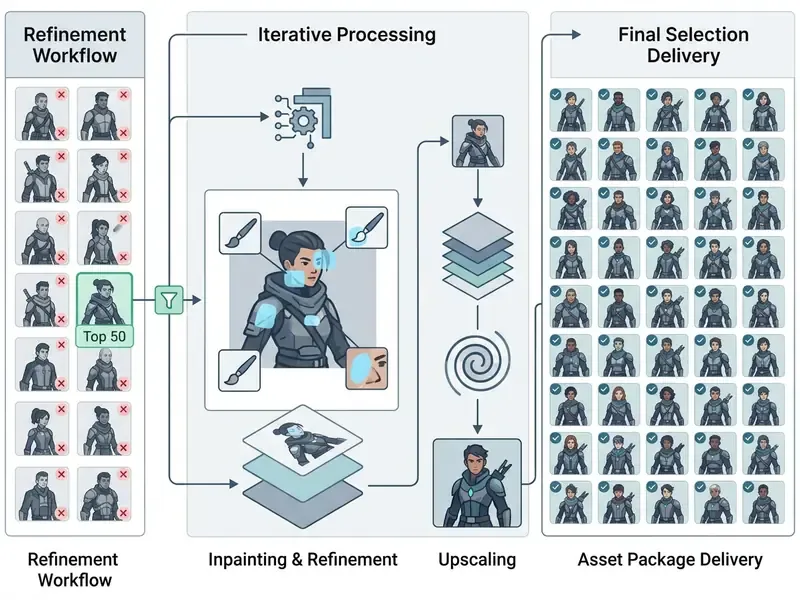
Refinement techniques rely on multi-pass processing:
What Is an AI Artist and What Is Their Role?
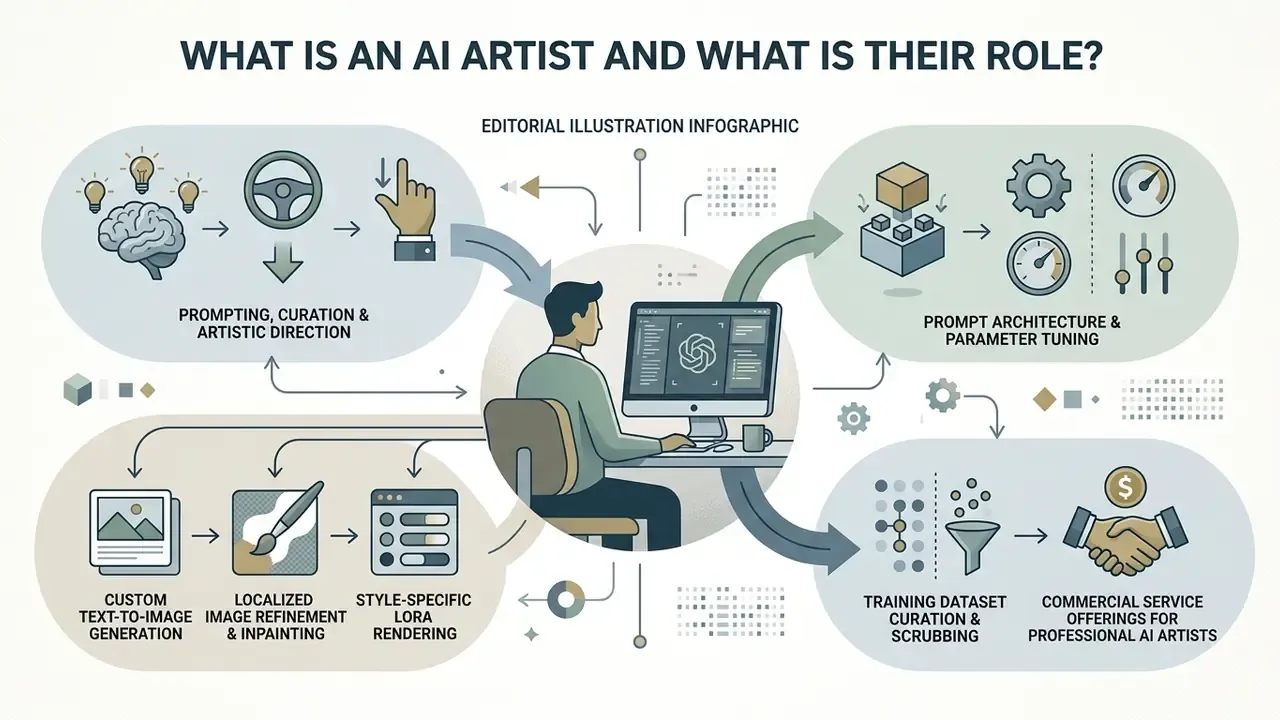
Short answer: An AI artist is a human creator who supplies concept, prompt architecture, curation, and post-processing, the contributions that carry both the artistic value and the legal authorship.
An AI artist, frequently called a prompt engineer, generative artist, or digital art director, is a human creator who uses artificial intelligence tools to realize visual concepts. The AI artist works as creative director: controlling tool inputs, guiding prompt logic, selecting candidate outputs, and executing post-generation edits.
Answering what is a ai artist or what is an ai artist requires examining where human effort is actually spent. Traditional painters express intent through physical brushstrokes; an ai artist exercises intentionality through vocabulary selection, parameter choices, curation, and critical evaluation. Asking what's an ai artist, or whats an ai artist in shorthand, reveals a professional who bridges technical parameter tuning with aesthetic art direction. Reported measurements of human share in generative workflows place concept development at roughly 78.5% human contribution and dataset preparation at roughly 64.7%. The creative labour has shifted stage, not disappeared.
Commercial service offerings for professional AI artists
Enterprises and creative agencies commission specialized AI artists across five core commercial vectors:
- Custom text-to-image generationdesigning bespoke campaign visuals and brand assets aligned with strict visual guidelines.
- Localized image refinement and inpaintingretouching synthetic outputs, correcting anatomical flaws such as extra or malformed fingers, and restoring pixel fidelity in Photoshop, Firefly, or equivalent tooling.
- Style-specific LoRA renderingtraining and deploying low-rank adaptation (LoRA) models on proprietary client portfolios to maintain aesthetic brand continuity across campaigns.
- Prompt architecture and parameter tuningwriting, testing, and delivering production-ready prompt scripts and negative-prompt libraries for enterprise automation.
- Training dataset curation and scrubbingsourcing, tagging, and filtering ethically compliant training media to build custom, non-infringing internal generative models.
Demand concentrates in marketing, gaming, publishing, and e-commerce, where clients commission social graphics, concept art, product imagery, and campaign key visuals. Freelancers positioned across these five vectors typically bundle a licensing statement with delivery, since clients increasingly require written confirmation of usage rights alongside the files.
Prompting, curation and artistic direction
The operational responsibilities of an AI artist span four core functions:
- Artistic directionestablishing visual style guidelines, composition bounds, colour harmonies, and mood constraints.
- Prompt engineeringwriting, testing, and optimizing multi-layered prompt scripts, negative keywords, and technical parameters (CFG scale, sampling methods).
- Curationfiltering hundreds of latent model outputs to select candidates that align precisely with creative and brand objectives.
- Post-processing and retouchingfixing anatomical anomalies, applying localized inpainting, upscaling resolution, and integrating synthetic renders into broader design layouts.
Research from the Oxford Internet Institute highlights that output curation, the filtering of latent-space results, is an essential human artistic activity that separates random generation from structured creative output.
«Governing generative AI in creative work requires clear consent, credit, and curation practices as core elements of authorship.»
Human-AI collaboration in the art world
Contemporary art theory increasingly views AI art through the lens of human-machine collaboration. In that framework, authorship is distributed across a network involving the human prompt author, model developers, dataset creators, and the neural network architecture (Ethical Dilemmas in AI-Generated Art, 2026). Goodfellow's 2024 account of distributed authorship places AI works mid-spectrum, neither purely human nor autonomously machine-made.
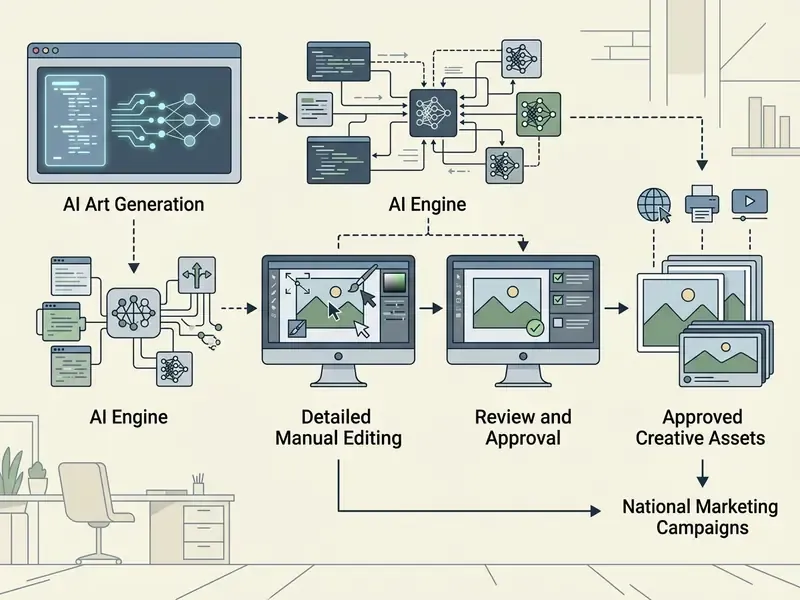
Legal frameworks, however, keep a strict distinction between theoretical distributed authorship and statutory copyright eligibility. Guidance from the U.S. Copyright Office (2023-2025) emphasizes that copyright protection requires human authorship. An AI model cannot be registered as an author or co-author; applicants must disclose AI-generated content and claim only human-authored contributions. The 2025 Part 2 report adds that AI output cannot form a joint work between a user and an AI system, although joint-authorship analysis remains a useful analogy for weighing human expressive contribution.
Can You Use, Sell or License AI Art Commercially?
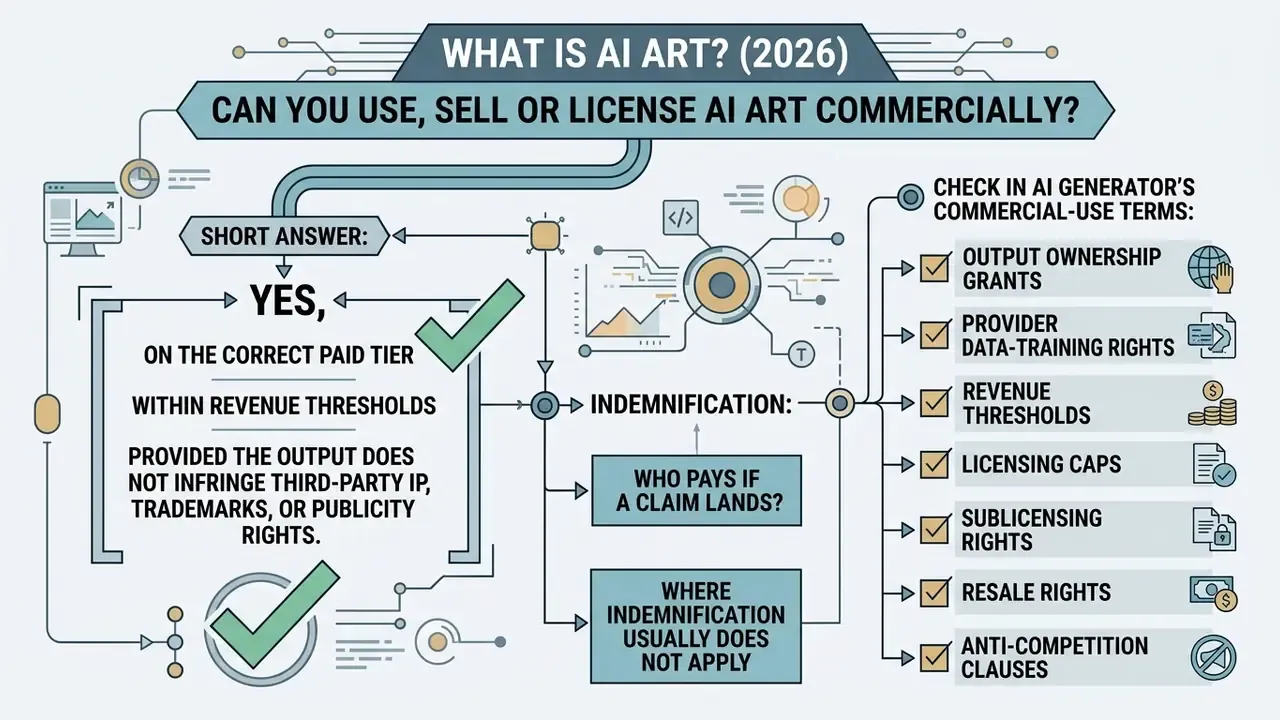
Short answer: Yes, on the correct paid tier, within revenue thresholds, and provided the output does not infringe third-party IP, trademarks, or publicity rights.
Yes, you can use, sell, or license AI art commercially, provided you comply with the Terms of Service of the generator platform used, maintain the required paid subscription tier, and ensure the content does not infringe third-party trademarks, copyrights, or publicity rights.
A sound commercial-use decision means evaluating platform terms, corporate revenue limits, and copyright eligibility before you offer assets for sale or client licensing. Many teams begin by benchmarking the best AI art generators against their licensing needs.
| Platform | Commercial rights included? | Account / tier requirement | Attribution required? | Primary usage restrictions |
|---|---|---|---|---|
| Midjourney image generation | Yes (paid tiers) | Basic ($10/mo) or higher. Pro/Mega required if annual revenue >$1M USD. | No | Free and trial outputs carry no commercial rights; provider retains a broad license to inputs and outputs. |
| Adobe Firefly | Yes | Paid Firefly or Creative Cloud plan. | No | Inputs must not violate third-party IP or trademarks. |
| Stable Diffusion | Yes (under $1M revenue) | Free Community License under $1M gross annual revenue. Paid license above $1M. | No | Enterprise licensing contract mandatory over the $1M revenue threshold. |
| DALL·E 3 (OpenAI) | Yes | Paid ChatGPT Plus, Team, Enterprise, or API credit account. | No | Usage must comply with OpenAI Terms of Service and content policy; no standalone consumer licence page. |
| ElevenLabs (generative audio) | Paid tiers only | Free tier is non-commercial. | Yes on free tier | Attribution mandatory on free tier; commercial rights tied to paid usage terms. |
Read the table as a shortlist filter, not a legal opinion. Each cell reflects terms verified in February 2026, and each of these providers revises terms more often than most procurement cycles run.
Indemnification: who pays if a claim lands?
Licensing permission and legal indemnification are separate commitments, and enterprises routinely confuse them. A platform can grant you the right to use an output while disclaiming all liability if that output is later alleged to infringe.
- Contractual indemnification, offered by several enterprise vendors (notably Adobe for Firefly under enterprise terms, plus comparable programs from major cloud AI providers), means the vendor commits to defend and cover specified third-party IP claims arising from the generated output, subject to conditions.
- Typical conditions include use of the vendor's own model rather than a customer fine-tune, no disabling of built-in content filters, no prompts targeting known third-party IP, and compliance with acceptable-use policy.
For regulated procurement, the correct question is not "may we use this commercially?" but "who bears the defence cost, up to what cap, and under which exclusions?"
What to check in an AI generator's commercial-use terms
Before commercializing synthetic images, legal and operations teams should verify seven contractual provisions in the platform's user agreement:
- Output ownership grantsconfirm that the platform explicitly transfers or grants exclusive commercial exploitation rights for generated outputs.
- Provider data-training rightscheck whether the platform retains rights to use your input prompts or uploaded reference images to train future public models. Some consumer terms grant the provider a perpetual, worldwide, royalty-free licence over both inputs and outputs.
- Revenue thresholds and licensing capsverify whether commercial rights are contingent on corporate size, for example Stability AI's $1M revenue threshold.
- Sublicensing and resale rightsensure the terms allow you to sub-license or transfer final visual assets to external clients.
- Anti-competition clausesreview clauses restricting the use of outputs to train competing machine learning models, standard in Google and OpenAI terms.
- Usage and generation rate limitsconfirm monthly credit allocations and API rate limits to prevent workflow interruptions.
- Jurisdiction and dispute clausesnote the governing jurisdiction and arbitration mandates. Some enterprise AI terms grant only a non-exclusive, non-transferable right to use outputs for internal business purposes only, a restriction that silently invalidates client-facing delivery.
One more habit worth building: re-verify the live terms page on the day you sign, because the version you screenshotted last quarter may already be superseded.
«Humans and LLM-based systems can reconstruct hidden prompts from published images, casting doubt on prompts as protectable intellectual property.»
That result has a direct commercial implication. Treating a proprietary prompt library as a trade secret requires access controls and contractual confidentiality, because publishing the output can leak the input.
To explore detailed legal and commercial guidelines across tool categories, review our central AI Media Commercial-Use Hub, or examine platform-level terms in the Canva AI Generator overview and the Microsoft AI Image Generator overview.
Copyright, attribution and risks of existing images
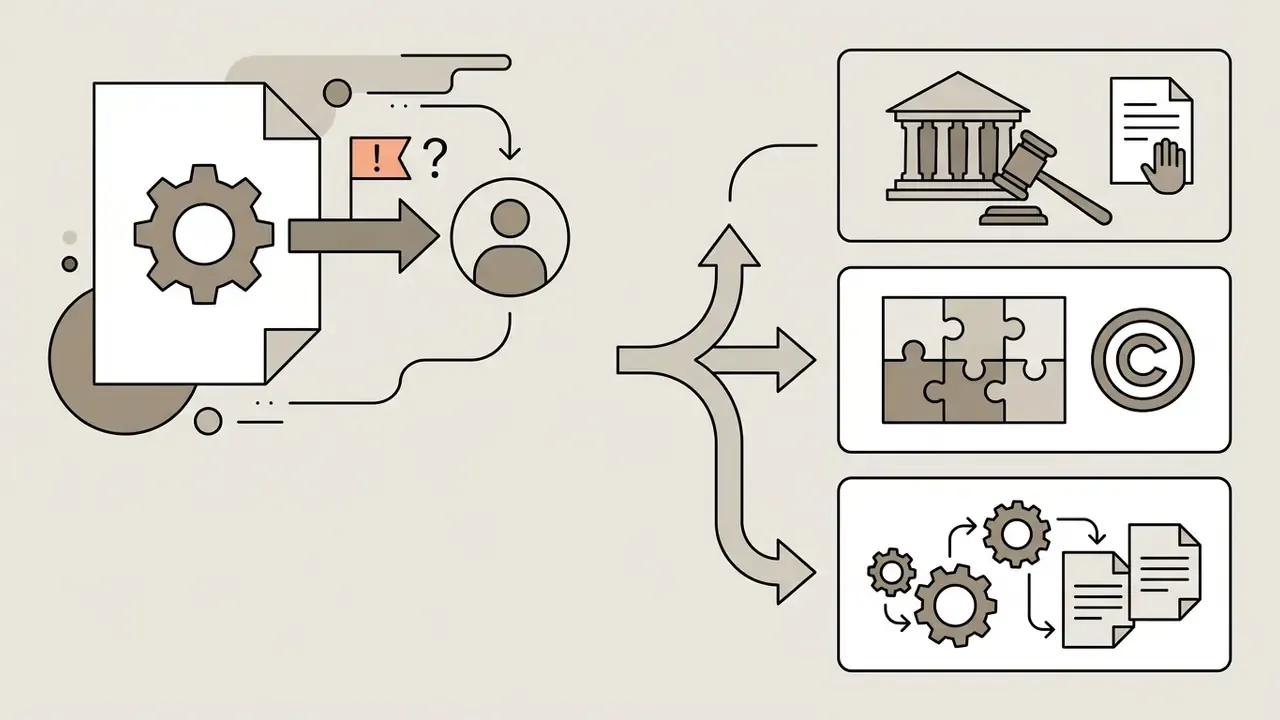
Commercializing AI-generated artwork carries distinct legal risks that need proactive management. This information is general in nature and does not substitute for professional advice.
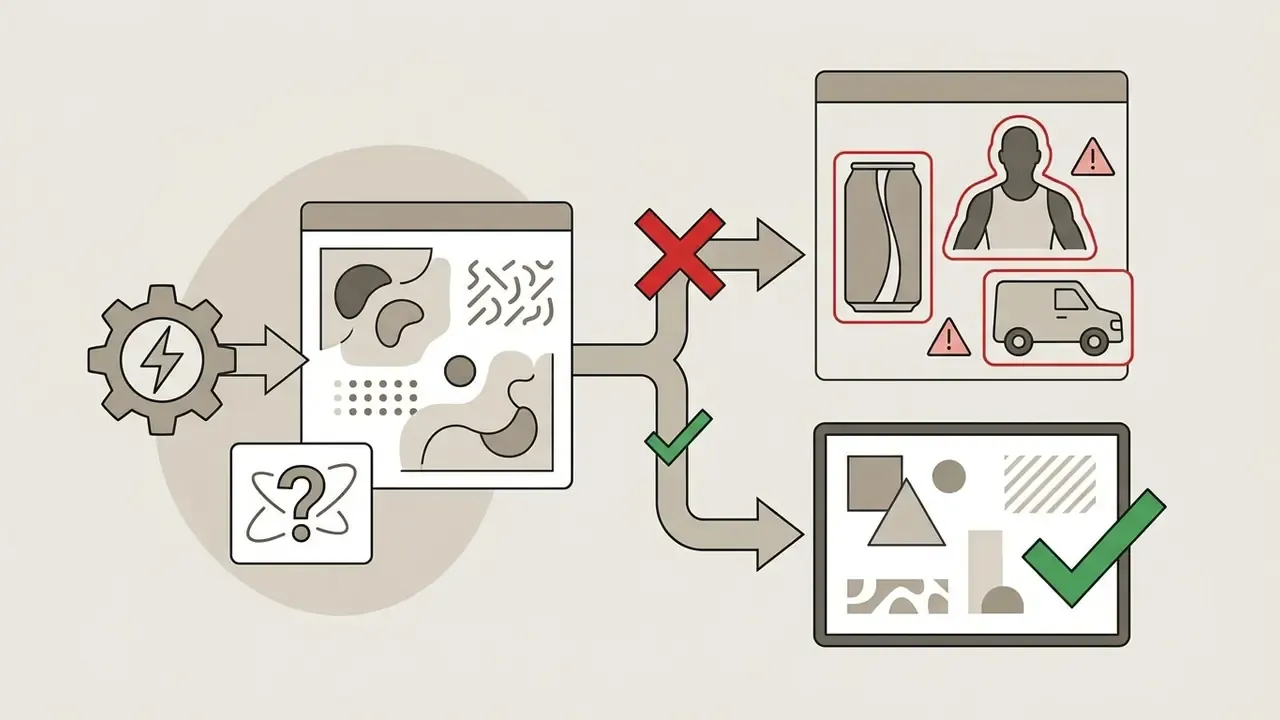
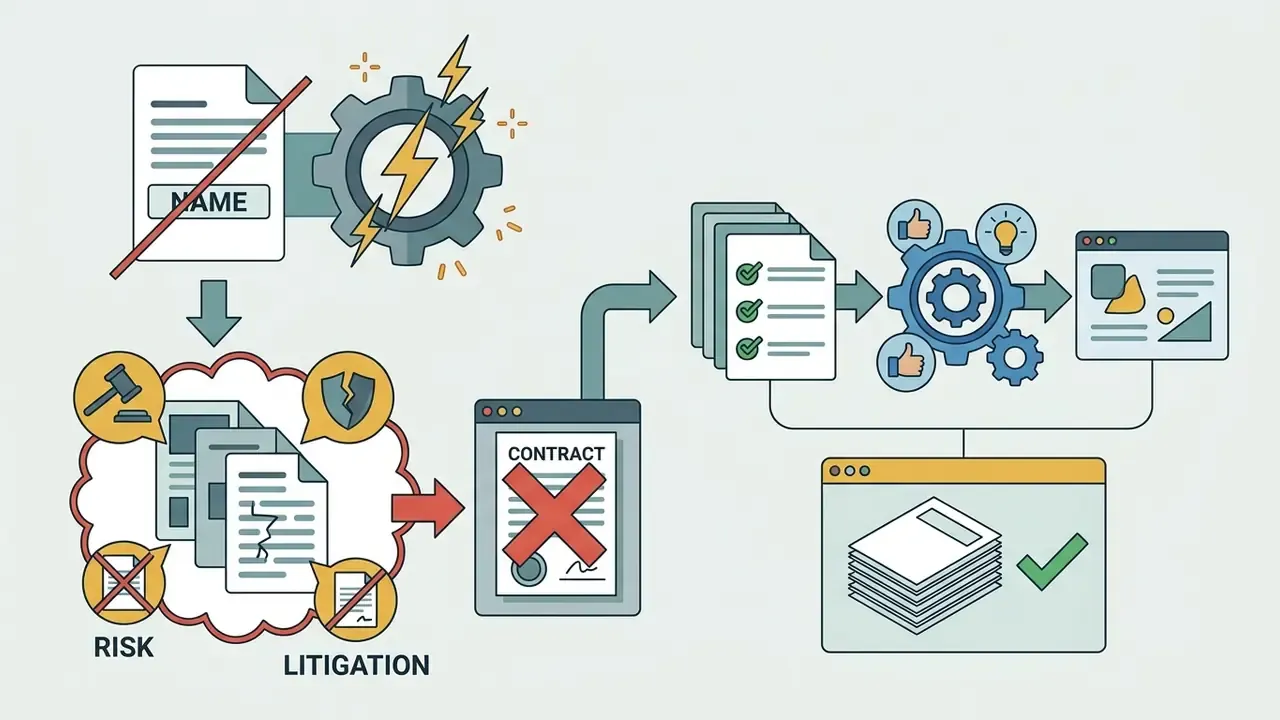
Organizations needing specialized API deployment rules for video and image pipelines can consult developer guides such as the Google Veo API Guide to analyze enterprise pricing structures and integration constraints. For guidance on active disputes surrounding generative datasets, review our resource page on AI Litigation and copyright updates.
Enterprise Risk, Shadow AI and Data Protection Controls
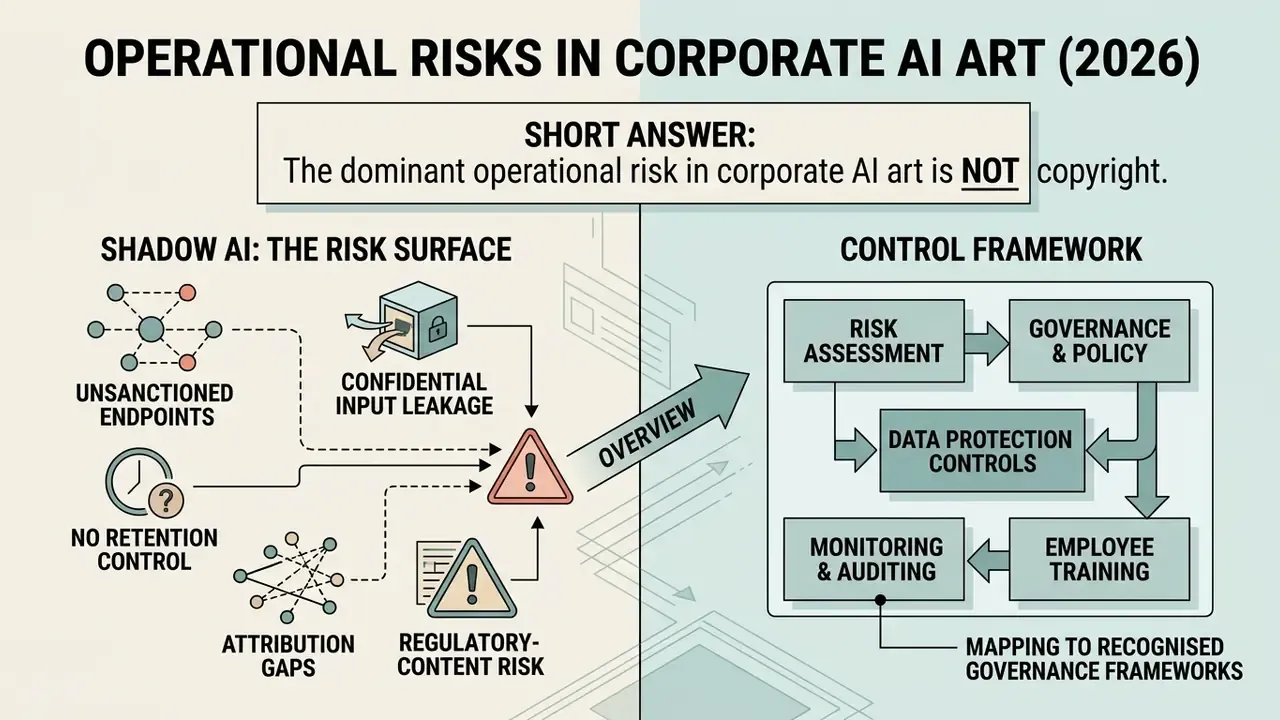
Short answer: The dominant operational risk in corporate AI art is not copyright. It is uncontrolled employee use of public generators with confidential inputs, combined with an absence of logging.
Public image generators are consumer-grade endpoints. When an employee pastes an unreleased product render, a customer photograph, an internal org chart, or an unpublished campaign brief into a free web generator, three things can happen at once: the data leaves the corporate perimeter, it may be retained under a broad provider licence, and it may be used to train future public models.
Shadow AI: the risk surface
- Unsanctioned endpoints. Free-tier generators open in any browser and need no procurement, so usage stays invisible to IT asset inventories.
- Confidential input leakage. Prompts and uploaded references are inputs. Several consumer terms grant the provider a perpetual, royalty-free licence to those inputs.
- No retention control. Consumer plans rarely offer configurable retention or zero-data-training guarantees. Those are enterprise features.
- Attribution gaps. Assets created off-platform arrive in the DAM with no prompt log, no model version, and no provenance metadata, permanently unauditable.
- Regulatory-content risk. Synthetic imagery produced outside marketing review bypasses advertising-compliance sign-off entirely.
Control framework
| Control | Implementation | Owner |
|---|---|---|
| Approved-tool allowlist | Publish a short list of sanctioned generators with tier requirements; block unsanctioned domains at proxy or CASB level. | IT Security |
| DLP inspection on prompts | Extend data-loss-prevention rules to outbound prompt payloads and image uploads, not just email and file transfer. | Security Operations |
| Private endpoints | Route generation through enterprise-controlled endpoints (VPC-hosted open-weight models, or enterprise API tiers with contractual no-training terms) instead of consumer UIs. | Platform Engineering |
| Zero-data-training contracting | Require written confirmation that inputs and outputs are excluded from provider model training; verify it appears in the executed agreement, not marketing copy. | Procurement / Legal |
| Input classification rule | Prohibit Confidential and Restricted data, customer PII, and pre-release material in any prompt, regardless of tier. | Data Governance |
| Role-based access | Limit generation rights to trained users in marketing, design, and product; log by named identity. | IAM |
| Mandatory human-in-the-loop | No synthetic asset publishes without a named reviewer's documented approval. | Brand / Marketing Ops |
| Model inventory entry | Register each generative tool in the AI/model inventory with owner, purpose, data classification, and review date. | Model Risk Management |
Mapping to recognised governance frameworks
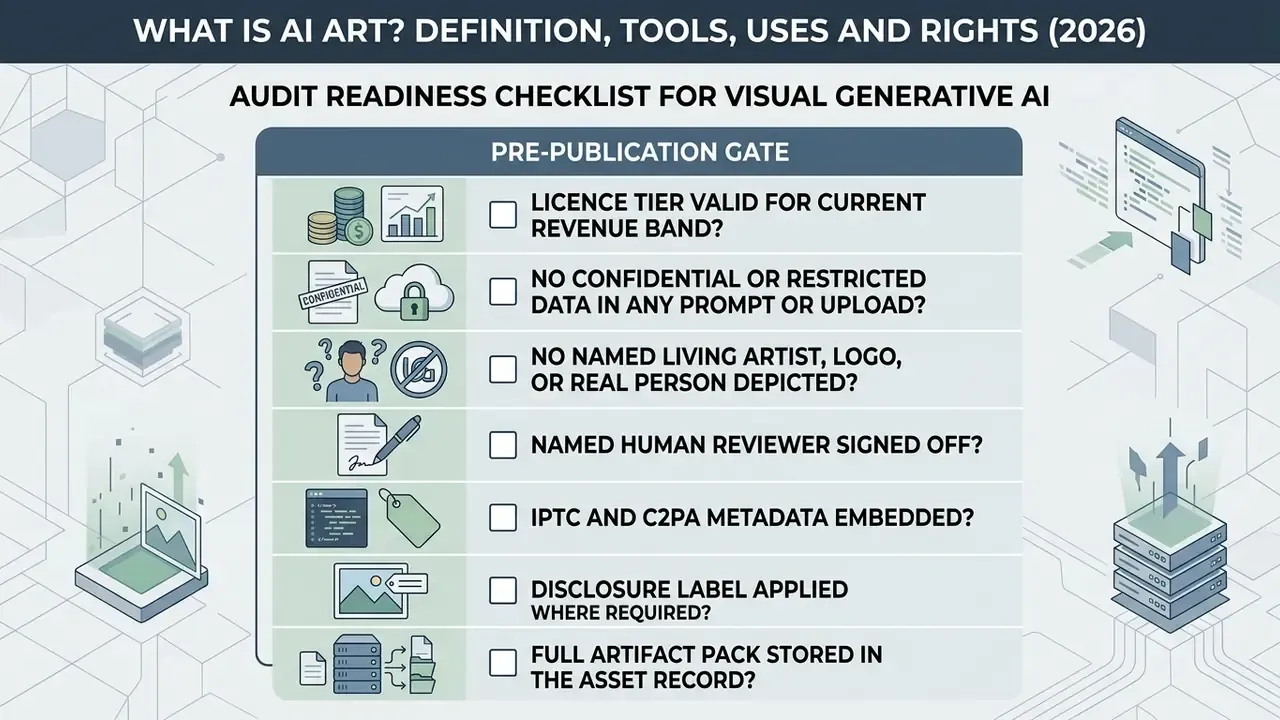
Audit Readiness Checklist for Visual Generative AI
Retain the following artifacts for every commercially published synthetic asset. Together they form the evidence pack that answers one question: how was this made, by whom, and under what licence?
| Artifact | What to capture | Why auditors ask |
|---|---|---|
| Prompt record | Full positive prompt, negative prompt, and any edit instructions, versioned | Demonstrates human expressive direction; supports copyright disclosure |
| Seed and parameters | Seed value, sampler, steps, CFG/guidance scale, aspect ratio | Enables reproduction of the exact output |
| Model identity | Model name, version or hash, hosting location (SaaS, VPC, on-prem) | Establishes which licence and indemnity terms apply |
| Tier and licence proof | Subscription tier at time of generation, licence document, revenue-threshold attestation | Proves commercial rights existed on the generation date |
| Reference inputs | Any uploaded source images, with rights clearance for each | Detects third-party IP entering the pipeline |
| Human-in-the-loop sign-off | Named reviewer, date, scope of manual edits performed | Supports the human-authorship claim and advertising review |
| Edit history | Inpainting masks, upscaler used, post-processing steps | Distinguishes human contribution from machine output |
| Provenance metadata | IPTC digitalSourceType (trainedAlgorithmicMedia or compositeSynthetic) plus signed C2PA manifest | Satisfies transparency and labeling obligations |
| Disclosure record | Where and how the AI label was displayed to the audience | Evidences compliance with ICC and IAB-style disclosure guidance |
| Retention and residency note | Provider data-retention setting and processing region | Answers privacy and cross-border transfer questions |
AI Art Ethics, Controversies and the Future of Creative Work
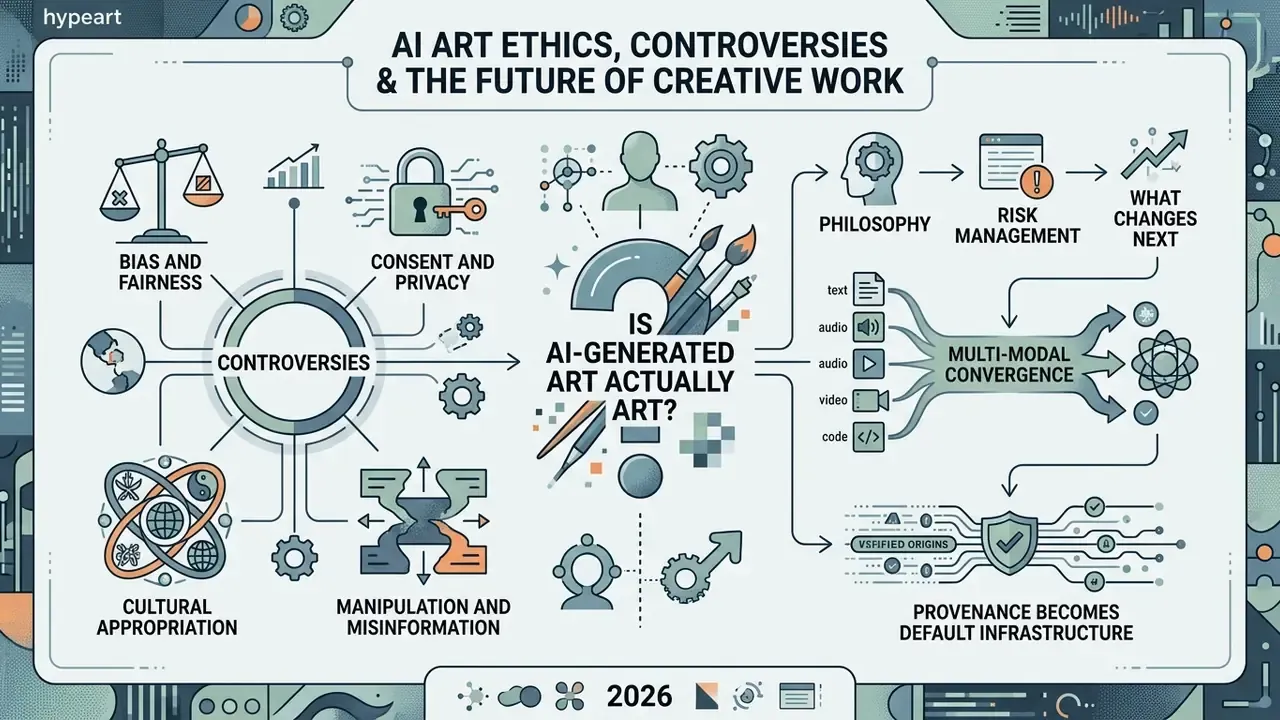
The rapid adoption of generative AI has sparked intense debate among artists, legal scholars, ethicists, and technology leaders. Key controversies centre on artist consent during dataset collection, compensation for scraped intellectual property, potential displacement of creative labour, and visual style homogenization.
Qualitative studies among digital entertainment artists reveal widespread concern about uncompensated dataset training. Many creative professionals feel that training commercial generative models on their historical portfolios without consent undermines creative agency. That concern is not only ethical; it shapes hiring, licensing, and supplier reputations.
«Twenty-two professional entertainment-industry artists reported their work being used for training without consent, credit, or compensation.»
«Generative AI destabilises traditional notions of originality and authorship, requiring new frameworks for distributed human-machine creativity.» - "AI and Creativity: A Review" (2023). https://doi.org/10.1016/j.artint.2023.103882
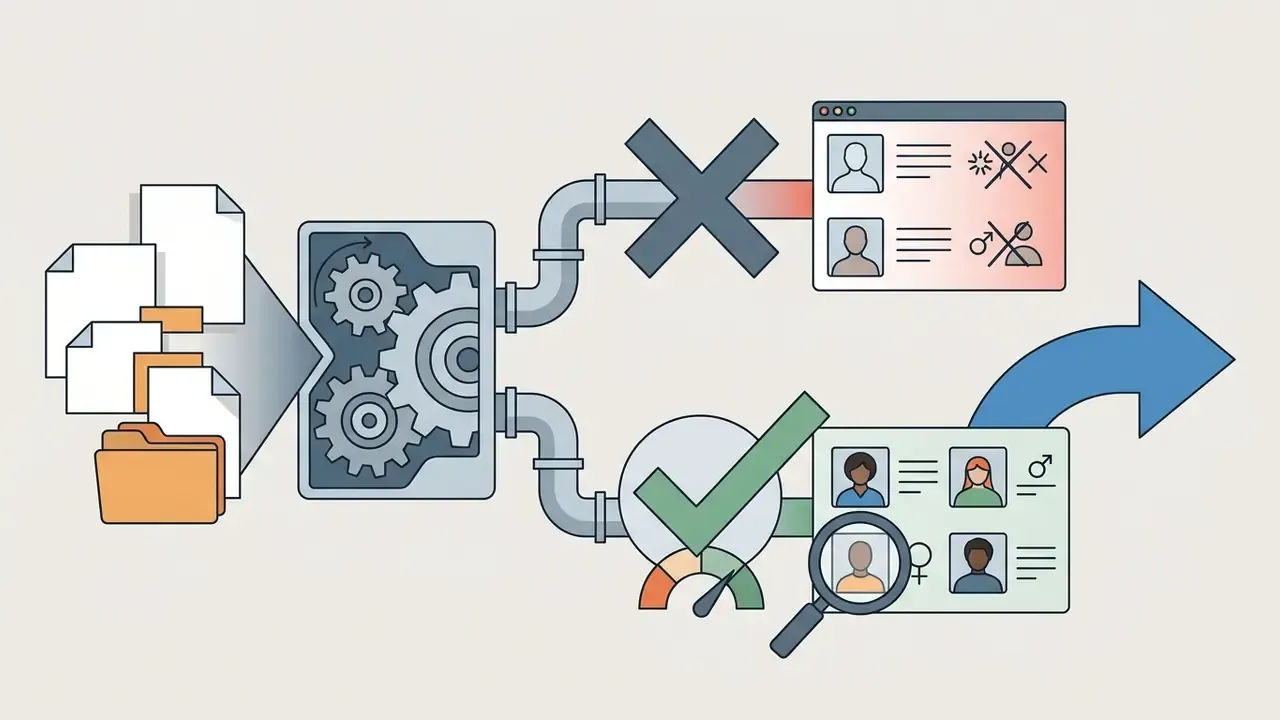
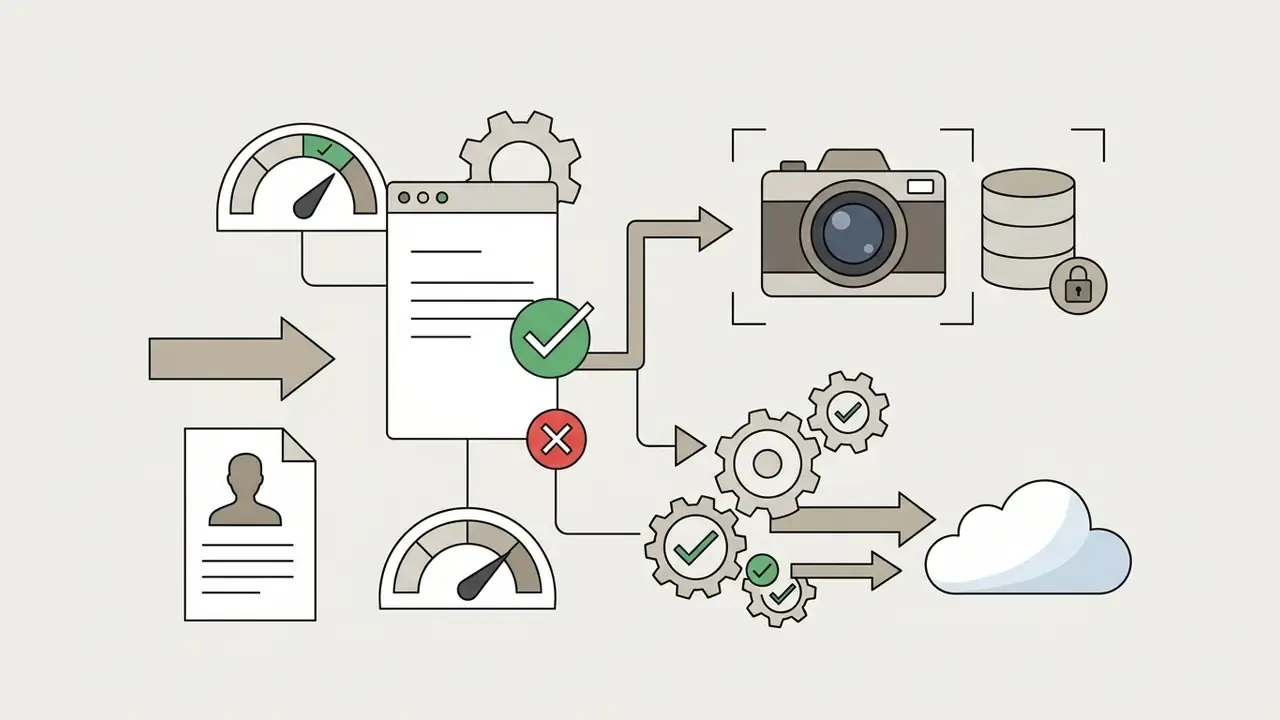
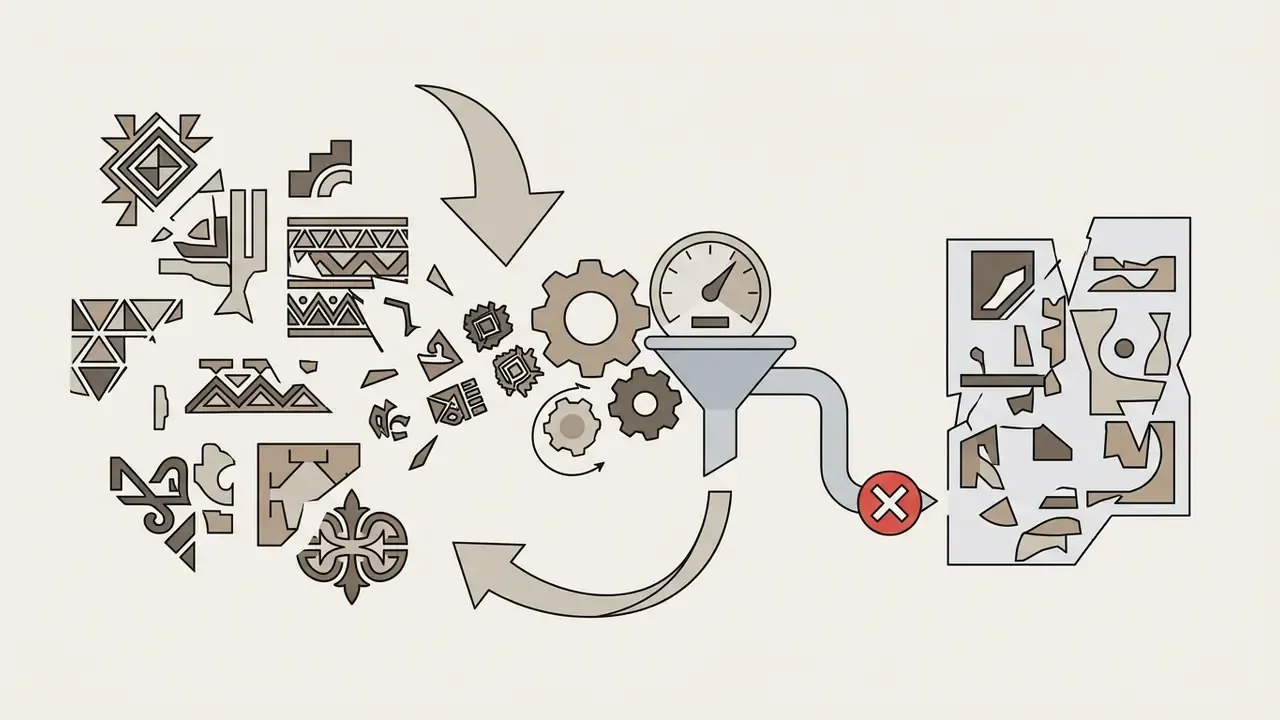
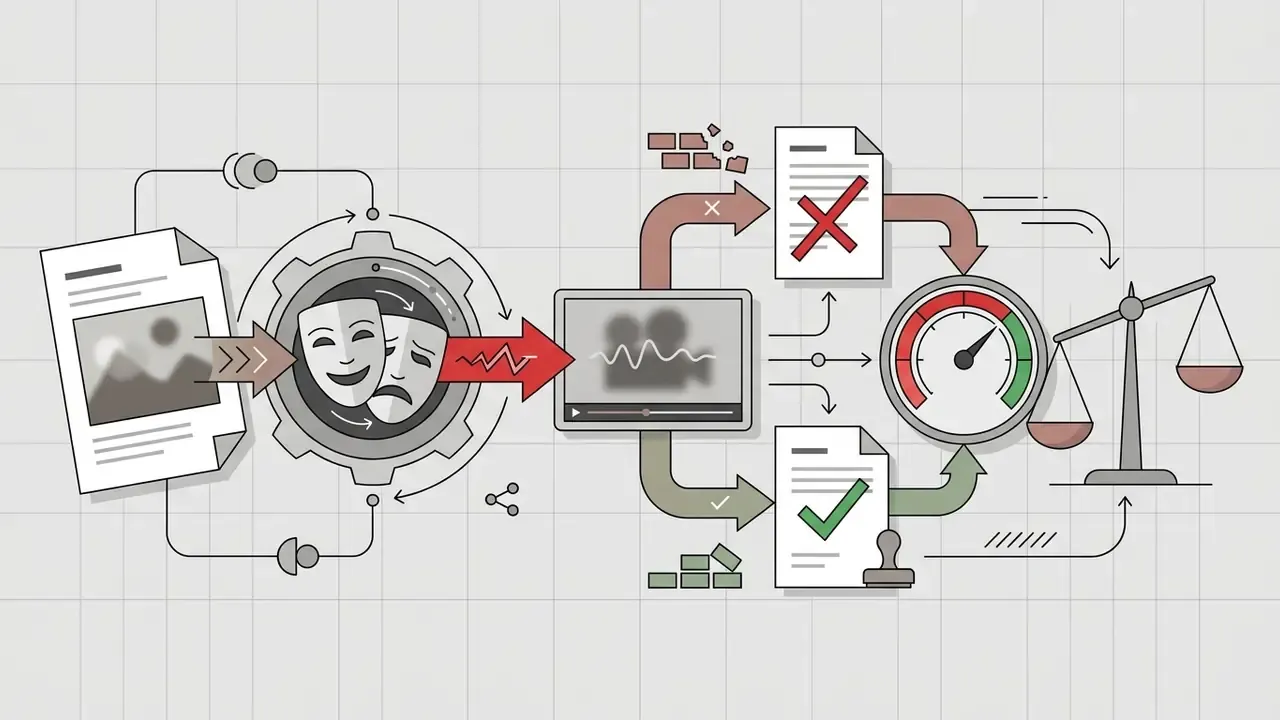
Oxford's 2025 interview study of creative workers identified the same triad, consent, credit, compensation, as the recurring harm. In response, international standards bodies emphasize machine-readable opt-out metadata tags, rights-reservation signals honoured at crawl time, and transparent dataset disclosures under EU AI Act Article 53. Additional ethical obligations recognised across practitioner guidance include:
Is AI-generated art actually art?
The philosophical debate over whether AI-generated images constitute "real art" splits along two schools of aesthetic thought:
- The intentionalist view: art is a uniquely human activity requiring conscious intent, lived emotional experience, and physical or digital execution. Proponents argue that machine learning models merely synthesize statistical patterns from prior human output, producing visual simulations that lack authentic emotional depth (PMC Aesthetic Review, 2025). A parallel position in Rivista di filosofia e teoria delle arti (2025) holds that AI-assisted works cannot be art so long as the system simulates the language of other artistic media rather than developing its own.
«Museum visitors encountering AI art demanded "the artist's backstory and emotional journey" before accepting the work as equivalent to traditional art.» - GenFrame Museum Study (2023-2024). https://dl.acm.org/doi/10.1145/3544548.3581388
- The functionalist or aesthetic view: artwork should be judged on the aesthetic experience, visual harmony, and emotional resonance it evokes, regardless of procedural origin. Analysis published by Columbia University (2026) argues that encounters with generative AI outputs are mediated by the same kinds of aesthetic judgment applied to artworks. The empirical support closest to that claim remains the Artistic Turing Test result, where observers identified AI images at only about 58% accuracy, near chance, implying that aesthetic response is not reliably gated on knowing the origin (ArtBrain / AI-ArtBench, 2023-2025, https://arxiv.org/abs/2303.13548). A 2025 Stanford study adds nuance: participants described AI as a partner that stimulates ideation while voicing concern about stylistic homogenisation and the erosion of traditional authorship.
From philosophy to risk management: what changes next
Generative AI is best read as a powerful new medium inside the long history of creative technologies. Photography pushed painting away from realistic reproduction and toward abstraction; generative AI is pushing digital art from manual execution toward conceptual direction, visual curation, and strategic art leadership.
For organizations, the forward agenda is operational rather than philosophical:
- Multi-modal convergence. Image, video, audio, and text generation are consolidating into single model families. Governance written only for "AI images" will need to cover synthetic voice, video, and music under one policy, otherwise the same controls get rebuilt three times.
- Provenance becomes default infrastructure. Expect C2PA Content Credentials and IPTC source-type fields to move from optional to expected in DAM, CMS, and ad-platform ingest pipelines.
- Indemnification becomes a procurement differentiator. As claims mature, vendors competing for enterprise budgets will compete on liability coverage, not just image quality.
- Human authorship becomes documented, not assumed. Because protection attaches only to human expression, teams that log prompt architecture, edit history, and reviewer sign-off will hold registrable, defensible assets. Teams that do not will hold unprotectable output.
- Ethical frameworks harden into contract terms. Consent, credit, and compensation language is migrating from manifestos into supplier agreements and dataset warranties.
Limitations and open questions
Honest gaps remain, and pretending otherwise would weaken the rest of this guide.
- Litigation over training data is unresolved in the U.S., so any statement about dataset legality is provisional.
- There is no standard method to quantify "substantial" human contribution for registration purposes; practitioners are working from examples, not thresholds.
- Detection and attribution research reports strong lab accuracy, yet real-world pipelines degrade with compression, cropping, and re-upload.
- Statements about buyer behaviour in this article are hypotheses drawn from public guidance, not from verified customer interviews or CRM data.
A safe next step
Start narrow. Pick one live use case, for example social campaign imagery, and run it end to end with the artifact pack from the audit checklist attached. Measure three things: production hours saved, control cost added, and defects caught at review. Then decide whether to widen scope, tighten the allowlist, or pause. Small, documented, reversible.
Frequently Asked Questions (FAQ)
What is AI art in one sentence?
AI art is media generated or substantially assisted by trained machine-learning models, where a human supplies the intent, prompt, curation, and refinement.
Can AI art be copyrighted?
Not when it is purely machine-generated. Under Thaler v. Perlmutter (D.C. Circuit, 2025) and U.S. Copyright Office guidance, protection requires human authorship. Only human-authored selections, arrangements, edits, or modifications can be registered, and AI-generated portions must be disclosed.
Can you sell AI-generated art?
Yes, on an eligible paid tier and within the platform's revenue thresholds, provided the output does not infringe third-party copyright, trademarks, or publicity rights. Note that unprotectable output can still be sold. It simply cannot be defended against copying.
Is AI art free to use commercially?
Rarely on free tiers. Midjourney trial outputs carry no commercial rights, some audio tools require attribution on free plans, and Stable Diffusion's community licence is free only below $1M annual revenue.
Do I have to disclose that an image is AI-generated?
In many contexts, yes. EU AI Act transparency rules require machine-readable marking of AI outputs, and institutional marketing standards from the ICC, IAB, and university brand guidelines require visible "Created using AI" labeling on consumer-facing visuals.
What is the difference between AI art and digital art?
Digital art is made with digital tools that execute human commands. AI art delegates part of the content decision-making to a dataset-trained model, keeping the human in a directional and curatorial role.
Why do AI images get hands wrong?
Diffusion models struggle with complex, repeated spatial geometry. Mitigate with explicit negative prompts (no extra fingers, fused digits, mutated hands) and a localised inpainting pass over the affected region.
Which AI art generator is best for enterprise use?
There is no single answer. Choose Adobe Firefly for indemnified, licensed-source generation; Stable Diffusion for private self-hosted control; Midjourney for aesthetic quality; DALL·E 3 for prompt adherence; Flux for photorealistic product imagery. Compare licensing side by side in our best AI art generator comparison and free AI art generator comparison.
Can employees use public AI generators at work?
Only under an approved-tool allowlist with DLP inspection on prompt payloads, contractual no-training terms, and a prohibition on Confidential or Restricted data in inputs. Unmanaged use is the core Shadow AI exposure.
Are prompts protectable intellectual property?
Treat them as trade secrets at best. Research shows humans and LLM-based systems can infer hidden prompts from published images, so protection depends on access control and confidentiality clauses rather than the prompt's inherent secrecy.
Appendix A: Superseded Formulations (retained for transparency)
- Original DiT sentence: "Research from UC Berkeley indicates that replacing traditional Convolutional Neural Networks (CNNs) with Transformer backbones inside diffusion pipelines yields superior image synthesis scalability and fidelity (Berkeley EECS Technical Report UCB/EECS-2023-108)." Retained, now supplemented with a direct quotation and the full report URL.
- Original ethics citation: "(SSRN Research, Digital Artists' Perspectives on AI, 2024)". Retained, now supplemented with the interview count (N=22) and the direct SSRN URL.
- Original functionalist claim: "Recent studies from Columbia University (2026) note that viewer encounters with generative AI outputs are evaluated using the same aesthetic judgment criteria applied to traditional media." Retained, now accompanied by verifiable empirical support (Artistic Turing Test, about 58% identification accuracy), because the 2026 Columbia reference could not be independently verified against a primary URL.
External References and Academic Sources
- U.S. Copyright Office (2025)Copyright and Artificial Intelligence, Part 2: Copyrightability Report. https://www.copyright.gov/ai/
- U.S. Copyright Office (2023)Works Containing Material Generated by Artificial Intelligence, Registration Guidance.
- Thaler v. Perlmutter (D.C. Circuit, 2025)human-authorship requirement for copyright registration.
- European Parliament Research Service (2025)Generative AI and Copyright: Transparency Rules and European Copyright Law. EU AI Act, Article 53.
- UC Berkeley EECS (2023)Diffusion Transformers (DiTs) in Image Synthesis Architecture. Technical Report UCB/EECS-2023-108. https://www2.eecs.berkeley.edu/Pubs/TechRpts/2023/EECS-2023-108.html
- Epstein et al. (2023)Art and the science of generative AI. Science. https://doi.org/10.1126/science.adh4451
- ArtBrain / AI-ArtBench (2023-2025)Artistic Turing Test and generative-model attribution. https://arxiv.org/abs/2303.13548
- Chang et al. (2023)The Prompt Artists. ACM. https://dl.acm.org/doi/10.1145/3563657.3596014
- ACM CHI (2024)Is It AI or Is It Me? Understanding Users' Prompt Journey. https://dl.acm.org/doi/10.1145/3613904.3642798
- ACM (2023-2024)Perceptions and Realities of Text-to-Image Generation / GenFrame museum study. https://dl.acm.org/doi/10.1145/3544548.3581388
- Trinh et al. (2024)Promptly Yours? A Human Subject Study on Prompt Inference in AI-Generated Art. https://arxiv.org/abs/2401.14725
- King's College London (2026)Designing Interactions with GenAI for Art and Creativity: Systematic Review. https://kclpure.kcl.ac.uk/portal/en/publications/designing-interactions-with-genai
- Lima et al. (2024/2025)Public Opinions About Copyright for AI-Generated Art (N=432). https://ssrn.com/abstract=4785597
- Oxford Internet Institute (2025)Governance of Generative AI in Creative Work: Consent, Credit, and Curation. https://www.oii.ox.ac.uk/research/publications/governance-of-generative-ai-in-creative-work/
- SSRN (2024)The Rise of AI Art: A Look Through Digital Artists' Eyes. https://ssrn.com/abstract=4806542
- Krook (2024)Art in the Age of Artificial Intelligence. https://doi.org/10.2139/ssrn.4906
- Artificial Intelligence journal (2023)AI and Creativity: A Review. https://doi.org/10.1016/j.artint.2023.103882
- Google Research (2021)Image Super-Resolution via Iterative Refinement (SR3).
- Goodfellow et al. (2014)Generative Adversarial Networks.
- NIST (2023)AI Risk Management Framework (AI RMF 1.0) and ISO/IEC 42001 AI management systems.
- Christie'sAI and Generative Art Collecting Guide, including the 2018 sale of Edmond de Belamy for $432,500.
- IPTCDigital Source Type vocabulary (
trainedAlgorithmicMedia,compositeSynthetic,digitalArt) and the C2PA Content Credentials specification.