Executive Summary for Decision Makers
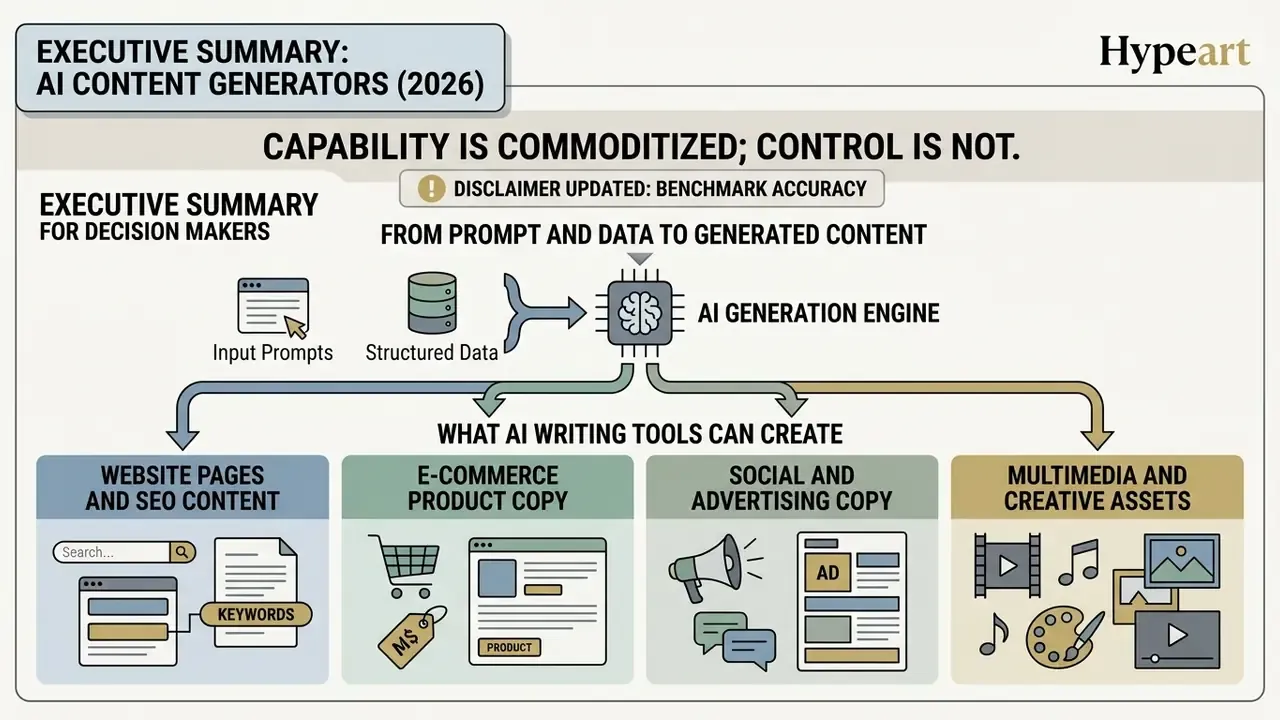
- Capability is commoditized; control is not. Frontier models cluster tightly on general benchmarks. The LLMs4All Review (2026) reports GPT-4o at 88.7%, DeepSeek V3 at 88.5%, and Claude 3.5 Sonnet at 88.3% on MMLU. Differentiation now comes from brand governance, retrieval grounding, audit trails, and workflow integration rather than raw model quality.
- Human editing determines search performance. Semrush (2025) found that content classified as fully human-written or heavily human-edited occupies position #1 with roughly 80.5% probability, versus about 10% for purely machine-generated pages.
- Cost advantage is real but partial. Ahrefs (2025) reports AI drafting is about 4.7 times cheaper than human writing, enabling roughly 47% more monthly publications at a fixed budget, before adding review, compliance, and integration costs into total cost of ownership (TCO).
- Regulated deployment requires model-risk discipline. Publishing AI text in financial, medical, or legal channels demands prompt and output logging, model version pinning, inference-parameter capture (temperature, top-p, seed), a RACI approval matrix, and defined escalation paths consistent with model risk management expectations (Federal Reserve SR 11-7 and OCC Bulletin 2011-12) and NIST AI 100-4.
Scope, Method and How to Use This Analysis
What Is an AI Content Generator and How Does It Work?
«GPT-4o reaches 88.7% on MMLU, DeepSeek V3 88.5%, and Claude 3.5 Sonnet 88.3%, comparable general language competence across frontier systems.»
Vendor-announced 2026 flagship releases (OpenAI's GPT-5.6 Sol series, Anthropic's Claude Opus 4.6, and Google's Gemini frontier line) are documented in official release notes and product documentation, but their scores on independent public benchmarks were not verified in the peer-reviewed sources used for this article. Treat model naming as vendor roadmap information, and treat benchmark claims as tied only to the models actually measured in published studies.
Because these platforms generate text probabilistically, their outputs represent statistically plausible formulations rather than independently verified factual truths.
From Prompt and Data to Generated Content
The generation pipeline transforms a user prompt into final output through a multi-stage computational process: tokenization, embedding, attention-based processing, and decoding. Input text is broken into numerical tokens, mapped to token IDs, converted into multi-dimensional embedding vectors, and processed through transformer attention layers that analyze context and relationships across long token windows. Generation itself is autoregressive. The model selects or samples the next token conditioned on the prompt and on all previously generated tokens, reusing prior context through a key-value cache until the completion criteria are met.
In modern systems, context windows of up to 1M tokens permit extensive context retention during generation, as documented in the Claude Platform Docs (Anthropic, 2026). More context, however, is not automatically better:
«Expanding context size without target filtering degrades retrieval accuracy while increasing latency and API cost.»
The same body of research reports that targeted summarization or truncation can outperform full long-context ingestion by as much as 50% in some configurations. Apple's on-device Foundation Model guidance reflects the same principle from the opposite direction, recommending prompts of one to three paragraphs maximum, because input length competes directly with the available token budget (Apple Developer Technote TN3193, 2026).
Inference parameters, including temperature, top-p sampling, max tokens, and seed, directly adjust output variance (LLM Documentation Guide, Carnegie Mellon University Libraries, 2026. https://guides.library.cmu.edu/LLMDocumentationGuide). Higher temperature values increase stylistic variety for creative campaigns, while lower values enforce deterministic consistency for technical documentation and financial reports. In regulated environments these parameters must be logged alongside the output, because they are part of the reproducibility record. Log them or lose them.
What AI Writing Tools Can Create
An ai creative content generator can produce long-form articles, structured blog posts, e-commerce product descriptions, multi-touch email sequences, and social media campaigns. Advanced multimodal systems extend these capabilities to image generation, voice synthesis, and video asset creation.
In professional marketing environments, the operational value of an ai web content generator varies across content formats:
- Website pages and SEO content
- Drafts landing page copy, user guides, and informational articles aligned with target search intent.
- E-commerce product copy
- Generates standardized product specifications, benefit highlights, and catalog summaries at scale.
- Social and advertising copy
- Creates multi-platform post variants, ad copy options, and campaign hooks.
- Multimedia and creative assets
- Produces supporting graphics, synthetic voiceovers, and video scripts.
- Long-form narrative and creative fiction
- Specialized story-generation engines assist writers with character arc design, plot outlining, world-building documentation, and getting past narrative block during manuscript drafting. This is a distinct workflow from marketing copy, because evaluation shifts from factual accuracy to coherence, topicality, and stylistic consistency (Long-Form Evaluation of Model Editing, NAACL, 2024).
- Internal knowledge and process documentation
- Converts recorded screen captures and raw process notes into structured step-by-step guides, onboarding materials, and standard operating procedures.
Teams building supporting visual campaigns can test complementary generation tools, including structured character and avatar assets via an ai character description tool for consistent brand mascots, or run low-stakes engagement experiments with lightweight visual formats such as ai cat pictures before committing production budget to a creative concept.
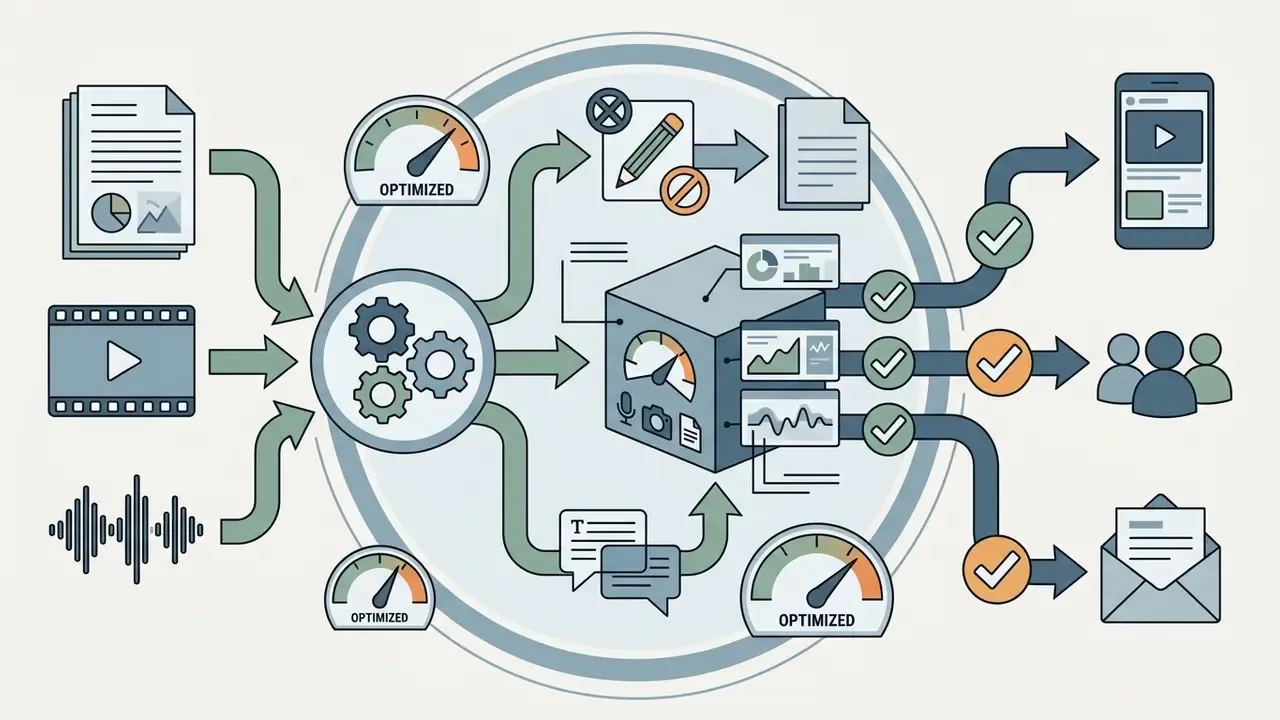
Multimodal Generation: Video Scripting, Voice Synthesis, and Podcast Editing
Modern enterprise content workflows extend beyond text into automated video and audio asset production. Because the EU AI Act framework explicitly treats synthetic text, images, audio, and video under the same transparency logic (European Commission, 2026), multimodal repurposing must inherit the same labeling and review controls as written copy. Integrating multimodal tools lets marketing teams convert approved text drafts into engagement-ready media:
Teams scaling video and audio pipelines can review capability and licensing details in our guides to AI video generators for marketing campaigns, AI voice generators, and animation makers. For synthetic likeness and persona-based audio or video advertising, licensing terms must be validated before deployment: see our references on an ai celebrity voice generator and an ai celebrity video generator, noting that synthetic representation of identifiable individuals carries publicity-rights exposure independent of copyright.
AI Content Generator Use Cases for Websites and Marketing
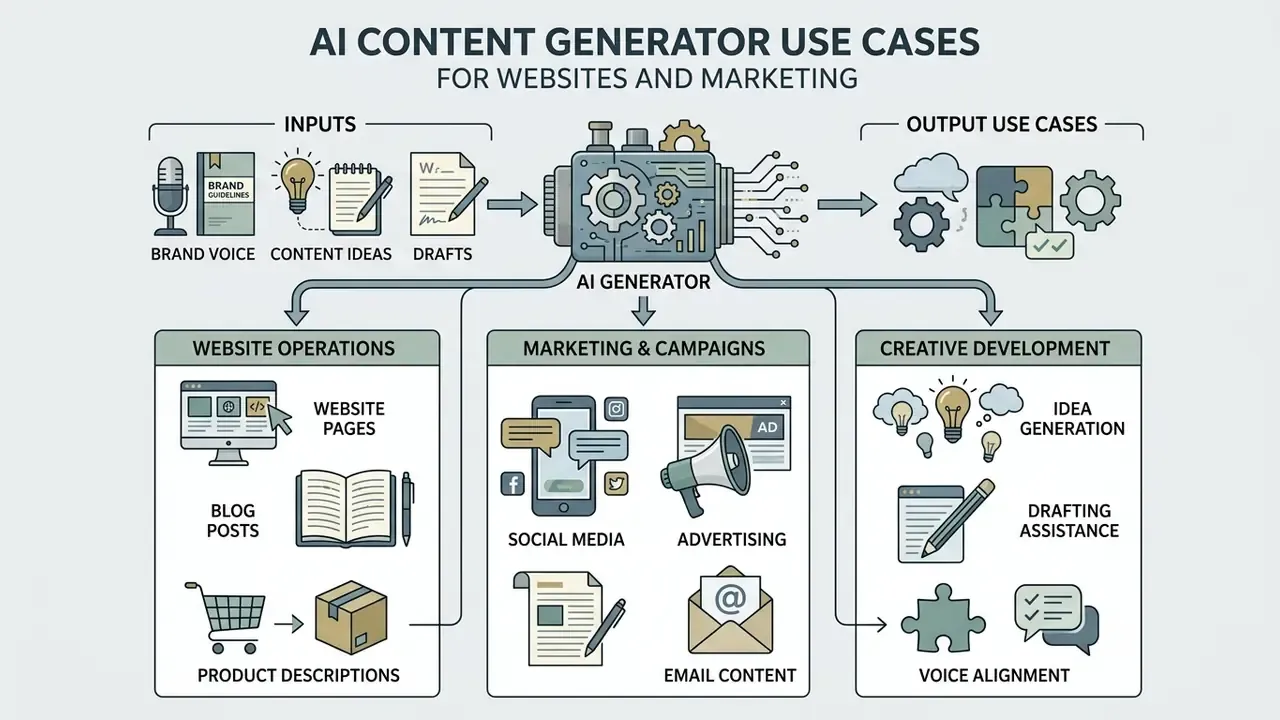
Deploying an ai content generator for website operations increases publication volume, but performance depends on matching the tool to the correct functional use case. An ai website content generator is most effective when applied to structured, high-volume drafting tasks where human editors keep control of final quality and factual accuracy.
Research conducted by Ahrefs (2025), an analysis of roughly 600,000 pages across 100,000 keywords, indicates that 74% of newly published web pages contain AI-assisted content, and that:
«AI content generation is on average 4.7 times cheaper than human writing, allowing 47% more published material per month at the same budget.»
High-performing websites, though, combine automated generation with human oversight to maintain content depth, domain authority, and compliance with search engine quality guidelines. Volume alone has never been the moat.
Website Pages, Blog Posts and Product Descriptions
Executing ai website text content creation for core website pages and blog posts accelerates editorial workflows when guided by clear structural briefs. AI writing assistants excel at generating initial outlines, draft paragraphs, H2 and H3 section structures, and concise meta descriptions.
A comprehensive study by Semrush (2025), analyzing 42,000 blog posts across 20,000 keywords with a GPTZero-based classifier, revealed that while AI-assisted content is widely deployed across search results, top-ranking positions skew heavily human:
For e-commerce catalogs, an ai content generator tool can process raw product specifications and write hundreds of unique descriptions, provided that compliance teams review technical claims and regulatory statements. Google's own guidance confirms that AI-assisted product and blog copy is permitted when it is accurate, original, and people-first, and becomes a spam violation only when automation is used primarily to manipulate rankings at scale (Google Search Central, Spam Policies, 2026).
Content Ideas, Drafts and Brand Voice
Using an ai powered content generator for brainstorming and outline creation helps teams overcome initial drafting friction. In controlled co-writing trials with 131 participants (Dhillon et al., 2024), paragraph-level AI scaffolding significantly improved argument structure and writing speed, especially for writers without regular writing practice.
The same research also documents the cost of over-delegation:
«Direct AI generation reduced writers' sense of ownership over the text and decreased the stylistic diversity of expression.»
Generic models frequently produce standardized prose that lacks brand distinctiveness. Linguistic analyses using the Biber Multidimensional Framework (2024) show that unconstrained LLM outputs exhibit predictable grammatical patterns:
«Biber-based analysis reveals systematic differences in participial phrases, passive voice, and nominalizations between LLM and human texts.»
There is also a cross-cultural dimension that global brands routinely underestimate:
«AI suggestions from a Western-centric model nudged Indian participants toward Western writing styles, reducing culturally specific nuance.»
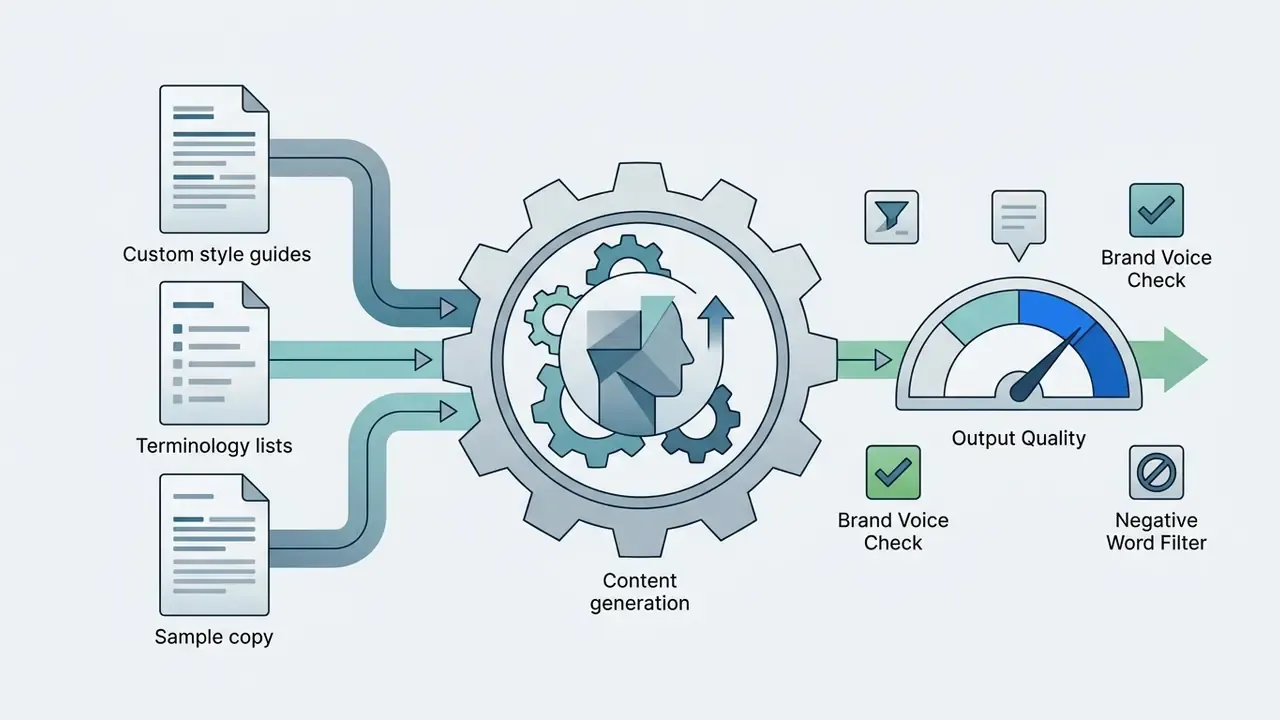
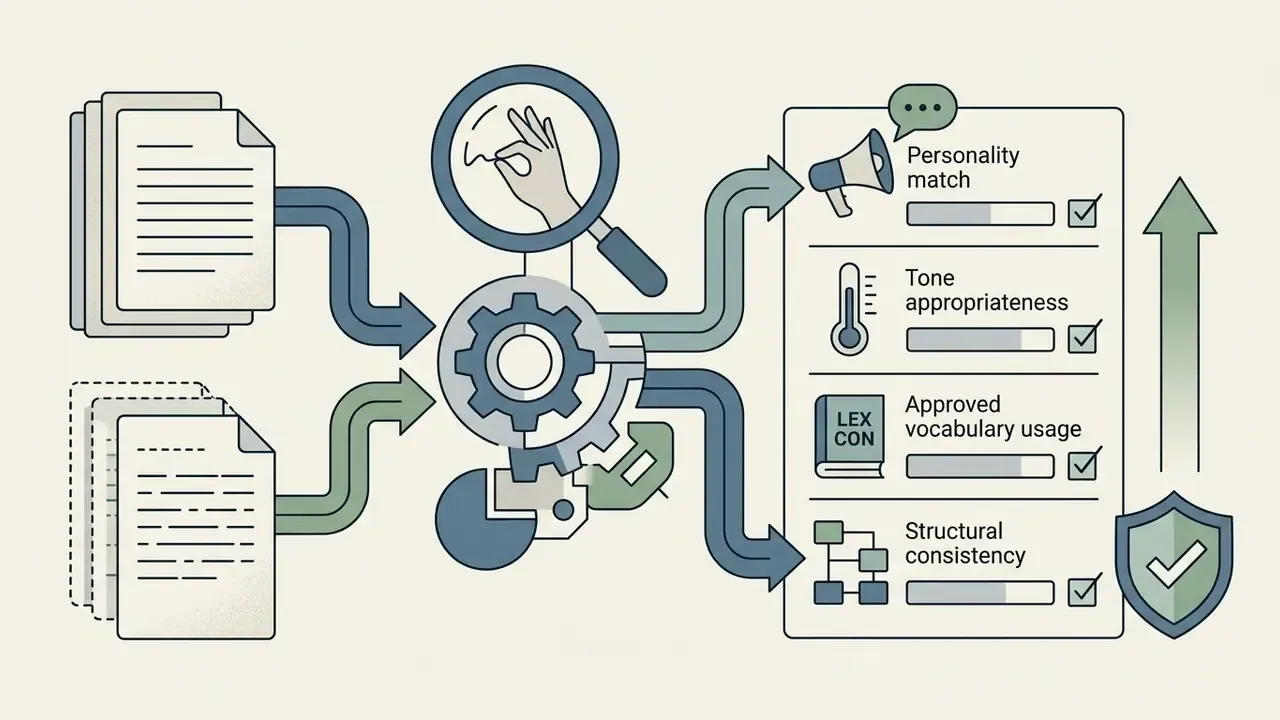
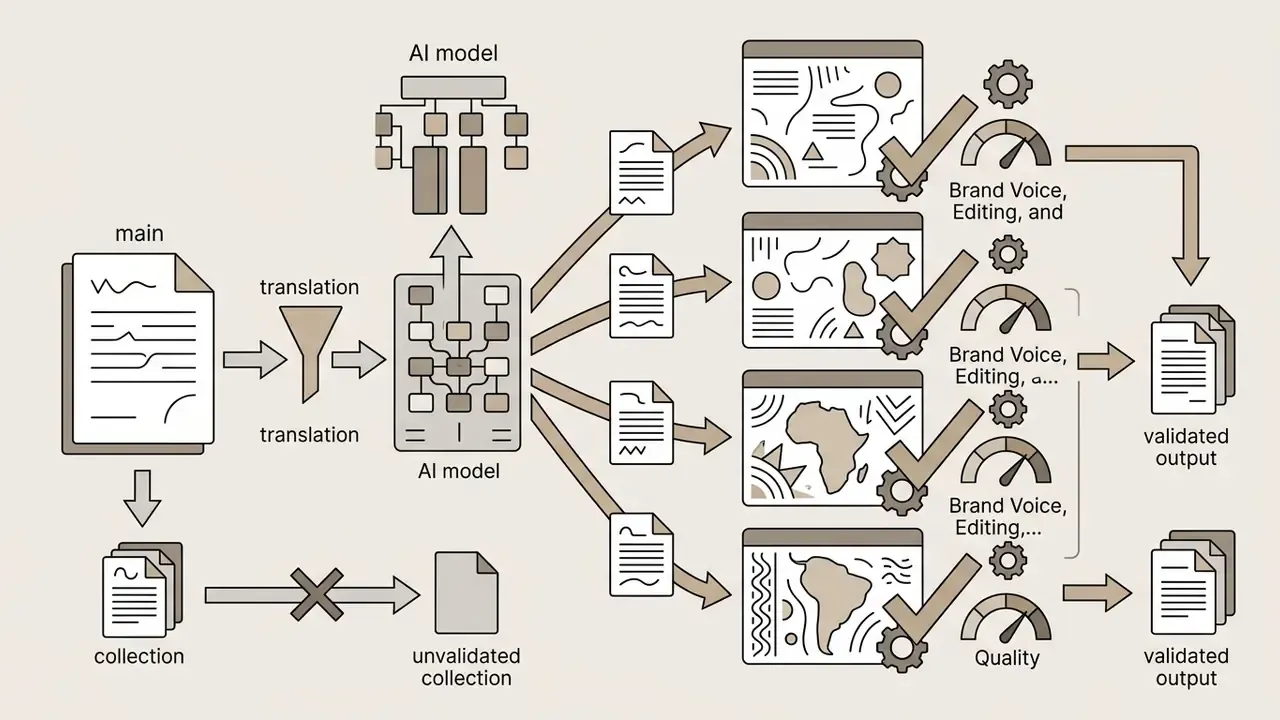
Maintaining brand voice therefore requires clear style parameters inside system prompts, approved vocabulary guides, editorial review protocols, and staffed regional review for localized markets. Practical brand-voice guides published in 2025 and 2026 converge on four inputs: source content samples, explicit do and do-not rules, tone rules by context, and an approved vocabulary list.
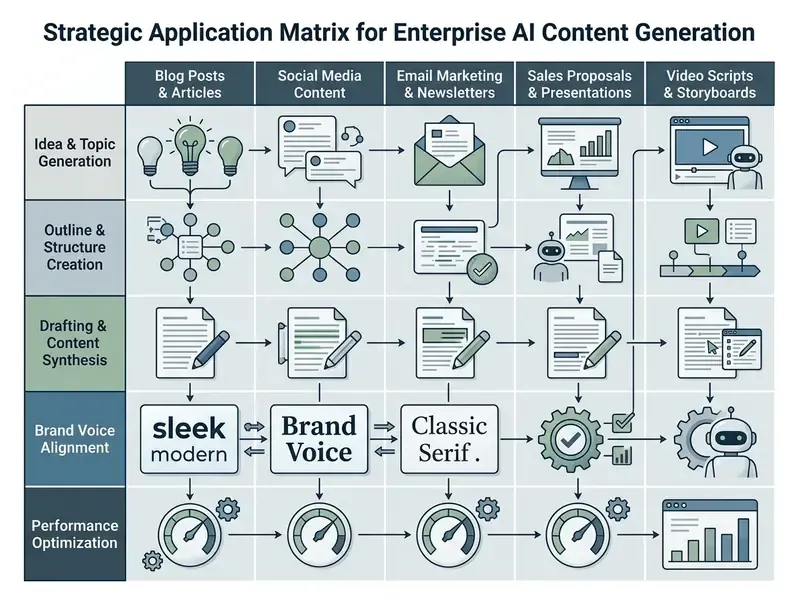
Enterprise AI content generation: use case application and review standards
| Marketing and web task | Recommended AI generator category | Primary expected output | Mandatory human review focus |
|---|---|---|---|
| Informational website pages and blogs | General-purpose LLMs or specialized SEO platforms | Outlines, draft sections, meta tags, FAQ structures | Fact-checking, E-E-A-T verification, original insights, internal link validation |
| E-commerce product descriptions | Template-based marketing generators | Feature lists, standardized product copy, technical summaries | Specification accuracy, regulatory claim validation, competitor differentiation |
| Long-tail SEO article clusters | SEO-focused AI writing suites | Structured drafts, search-intent headings, schema markup | Search intent match, elimination of repetitive content, factual depth |
| Social media and thread campaigns | Short-form copy generators | Hook options, post variants, campaign threads, hashtags | Brand voice alignment, tone check, cultural context, sensitivity review |
| Paid advertising (search and social) | Ad-specialized copywriting tools | Headline variations, value propositions, CTAs | Ad policy compliance, substantiation of promotional claims, offer accuracy |
| Email marketing and nurture sequences | CRM-integrated AI assistants | Subject lines, email body copy, personalization tokens | Spam trigger avoidance, tone check, offer verification, consent compliance |
| Video and podcast repurposing | Text-to-video and transcript-based editors | Video summaries, captions, synthetic voiceovers, show notes | Provenance labeling, likeness and licensing rights, claim accuracy in audio |
| Regulated customer communications | Grounded RAG systems with logging | Templated disclosures, service explanations, FAQ answers | Legal sign-off, model version logging, escalation on any unverifiable claim |
Key takeaway: While an ai content generator speeds up drafting across all digital formats, mandatory human review remains essential. Highly regulated channels, meaning core web landing pages, paid advertising, and financial customer communications, require strict factual, policy, and audit checks before publishing.
Best AI Content Generator Tools by Category
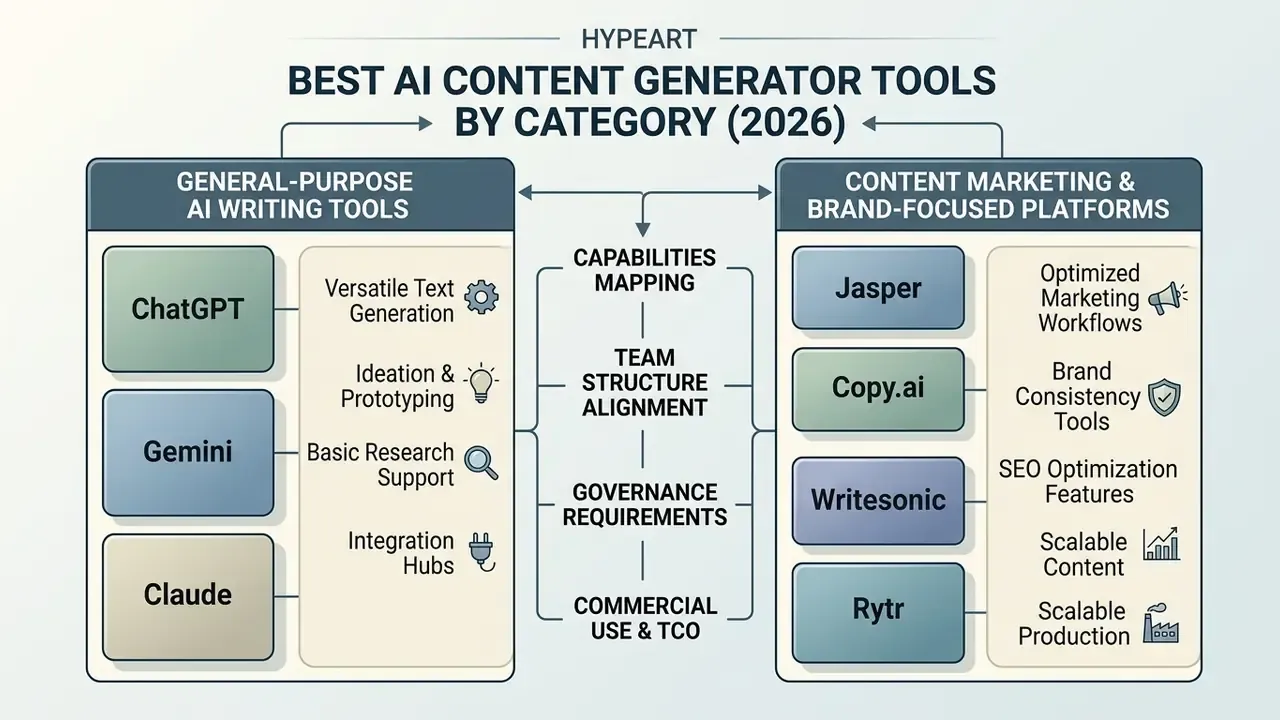
Selecting the best ai content generator requires matching organizational objectives against tool capabilities, team structures, and governance requirements. The market for ai content generator tools divides into three primary categories: general-purpose frontier models, specialized marketing platforms, and SEO-focused optimization suites. Buyers evaluating content generator ai tools should score each category separately, because a content ai generator built for campaign governance rarely wins on raw reasoning, and the reverse is equally true.
Market trust and user satisfaction benchmarks
Evaluating tool reliability means combining technical specifications with empirical user feedback. In a practitioner poll of 168 SEO and content marketing professionals conducted during a Clearscope webinar (May 2024), 68% named ChatGPT the most reliable and trustworthy AI chat tool. Small sample, yes, but drawn from an audience deeply engaged with search technology. Aggregated sentiment across enterprise review platforms (G2, Capterra) mirrors this pattern: general-purpose frontier models (ChatGPT, Claude, Gemini) serve as the default daily drafting baseline, while specialized platforms (Jasper, Surfer SEO, Clearscope) earn higher satisfaction scores specifically for multi-author campaign governance and SERP-aligned structuring. Practitioner reviews also converge on one recurring caveat: output quality tracks input quality, and tools marketed as "hands-off SEO automation" consistently require the most human rework.
General-Purpose AI Writing Tools: ChatGPT, Gemini and Claude
General-purpose platforms provide flexible drafting, technical reasoning, and long-form writing capability, and they are what most teams mean when they search for a top ai writing generator:
- ChatGPT (OpenAI) Positioned by OpenAI's 2026 release notes around the GPT-5.6 Sol flagship series, ChatGPT offers broad multi-task performance across content drafting, code execution, and data analysis. It works as a versatile content generator ai tool when guided by detailed system prompts. Official documentation confirms the free tier includes web search, file and image uploads, image generation, data analysis, and use of existing custom GPTs, but not creation of new GPTs on personal accounts.
- Gemini (Google) Built on Google's Gemini frontier architecture, this platform performs well on research-heavy workflows, real-time data integration, image generation and editing, Deep Research, and native Workspace tasks across Docs and Gmail. A practical advantage for SEO teams: you can interrogate Google's own model about current content-first search guidance and cross-check claims against live web results.
- Claude (Anthropic) Using the Claude Opus 4.6 model line (released February 2026), Claude is optimized for long-context analysis, complex document synthesis, financial and research workflows, and nuanced prose that adheres closely to style guidelines. Anthropic's Marketing plugin explicitly bundles brand voice management, SEO audits, competitive briefs, and style-guide enforcement, the only vendor documentation in our verified set that names brand voice and SEO controls together.
Content Marketing and Brand-Focused Platforms
Specialized platforms wrap underlying LLMs in structured marketing workflows, offering pre-built templates and brand voice management:
- Jasper Designed for enterprise marketing teams, Jasper provides 50 plus templates, multi-voice profiles, and direct CMS integrations to hold style consistency across large campaigns. Its differentiator is the governance layer marketed as Jasper IQ, combining Brand Voice, Audiences, a Knowledge Base, and a Style Guide. Official documentation confirms users can seed a Brand Voice with up to eight text, file, or URL examples, set workspace-public or private visibility, and restrict who may create, edit, or delete voices; Pro tiers include three Brand Voices while Business tiers are unlimited. In hands-on reviews, brand-voice-tuned output landed noticeably closer to the reviewer's own writing than a generic "casual tone" setting, though drafts still needed editing to reach publication standard.
- Copy.ai Focuses on go-to-market automation, sales copy generation, and multi-step content workflows. Brand Voice can be applied in both Chat and Workflows, and Teamspaces isolate access by team. The platform offers 90 plus templates spanning email subject lines, sales emails, blog outlines, and product descriptions; its main friction is the absence of a browser extension, which forces manual transfer into the working document.
- Writesonic and Rytr Entry-level tools serving freelancers and small teams that want budget-friendly copy for short-form ads, social posts, and blog snippets. Rytr exposes 30 plus templates, 20 plus tone styles, and 25 plus input languages; Writesonic includes an SEO article generator plus a separate SEO checker that must be run after generation. Note that no official vendor documentation on Brand Voice governance, workflow permissions, or team access controls was verifiable for either platform at the time of review. For enterprise buyers, that gap is material.
- HubSpot AI Integrates content generation directly into HubSpot CRM, enabling automated email sequence creation and inbound landing page drafting. HubSpot's permission model includes granular Workflows toggles (view and edit, create and delete), though its documentation does not expose a dedicated Brand Voice module comparable to Jasper IQ.
SEO, Research and Editing Tools
SEO platforms combine content generation with real-time search engine result page (SERP) data, semantic keyword clustering, and style analysis:
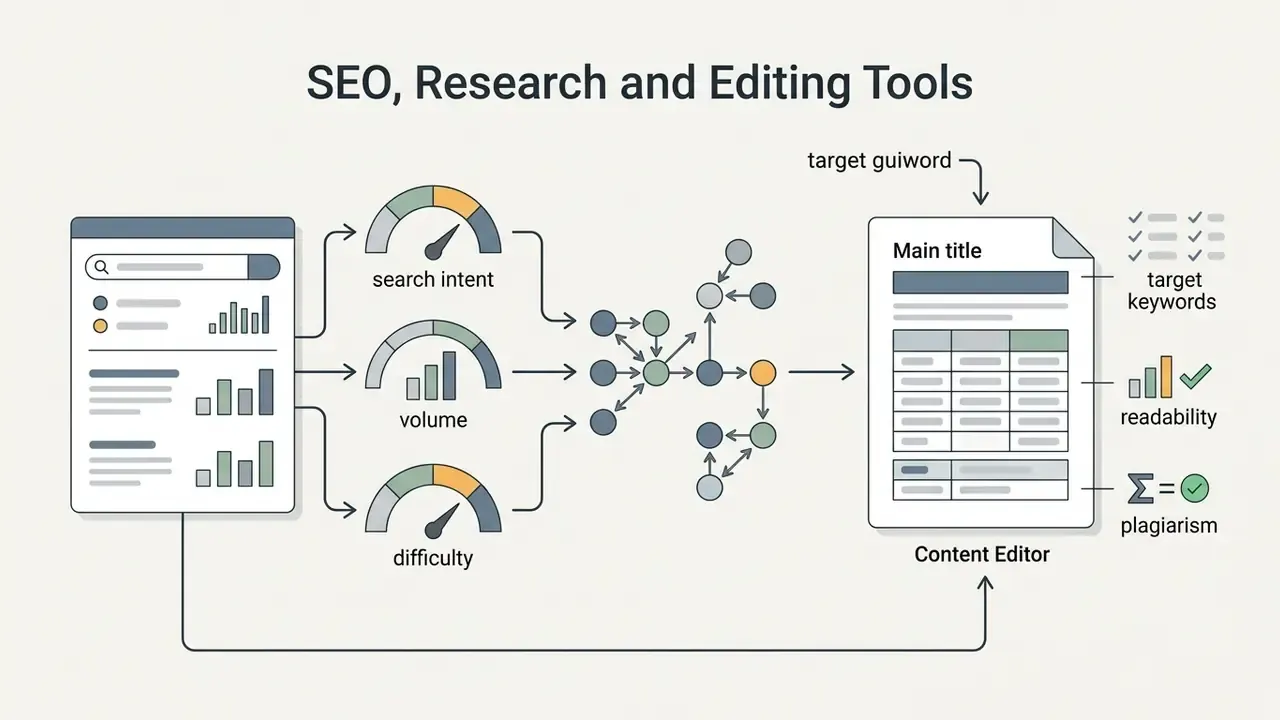
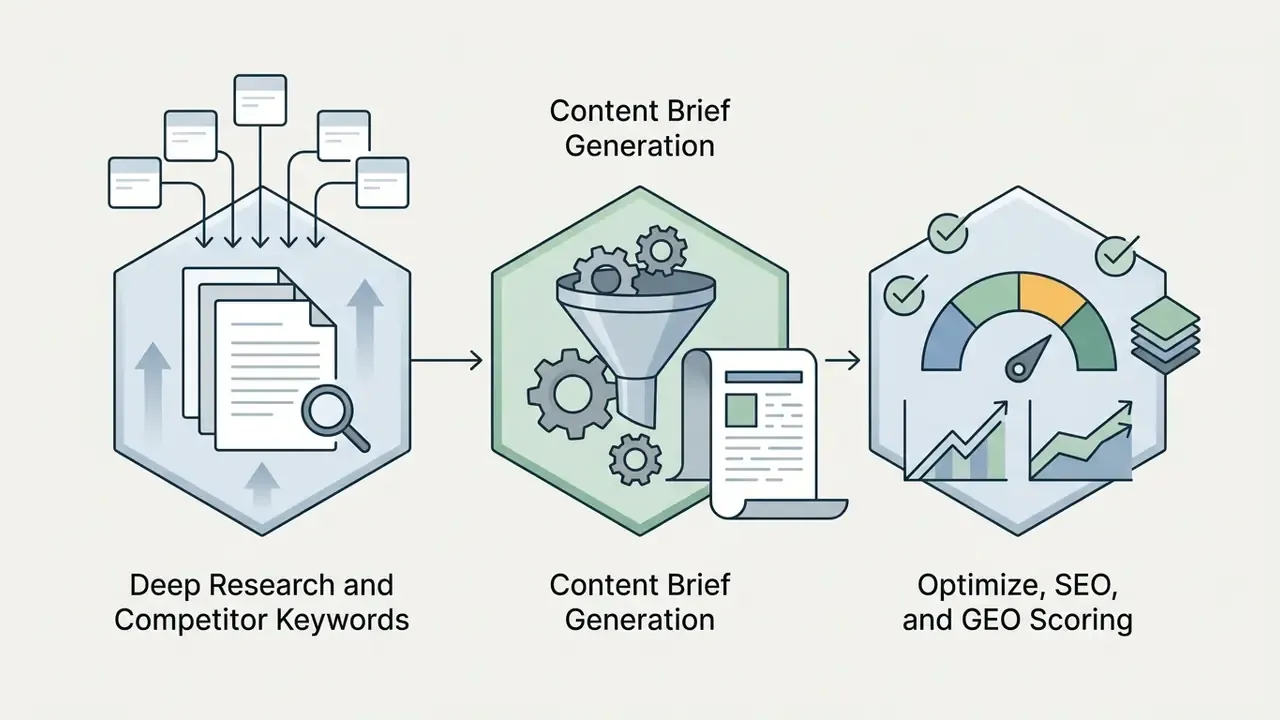

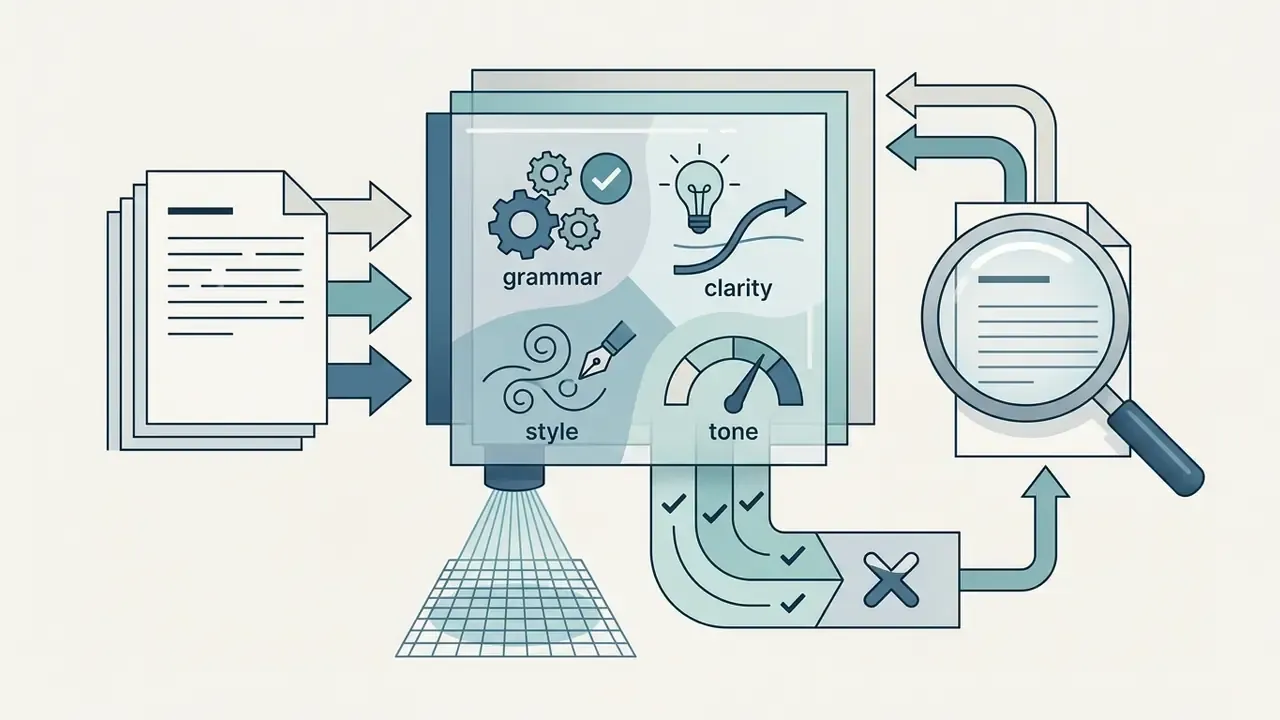
For visual design and media teams seeking complementary tooling, review our comparative guides on the best ai art generator, the best AI image generators, and practical video editing tools for teams repurposing written assets into media. To weigh vendors side by side across categories, browse the hub.
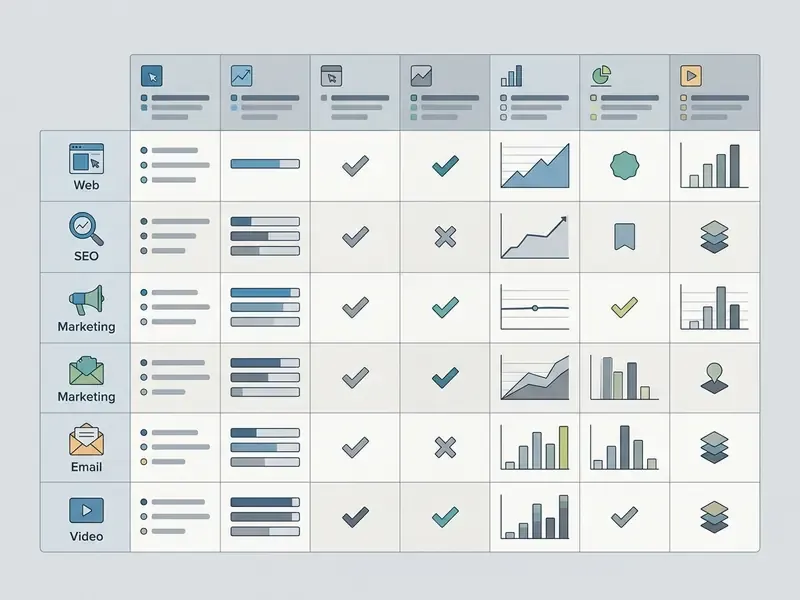
Enterprise platform comparison: capabilities, SEO integration, governance and security features
| Tool / platform | Primary target application | SEO optimization features | Brand voice and style governance | Security and compliance posture (verify per plan) | Training data and retention controls | Admin: SSO / RBAC | Free tier / trial access |
|---|---|---|---|---|---|---|---|
| ChatGPT (OpenAI) | General-purpose text, research, analysis | Prompt-dependent; web search on free tier; no native keyword database | Custom instructions and project context settings | Enterprise tiers documented with SOC 2-class attestation; verify current scope in vendor trust portal | Business and Enterprise tiers exclude prompts from model training by default; consumer tiers require manual opt-out | Available on Business and Enterprise plans | Free plan with usage caps (about 10 flagship messages per 5 hours before fallback) |
| Gemini (Google) | Multimodal research and Workspace drafting | Native integration with real-time Google search data | Prompt-based tone instructions; enterprise admin controls | Inherits Google Cloud and Workspace compliance framework on enterprise plans | Workspace-tier data handling separates enterprise content from consumer training flows | Available via Workspace admin console | Free access via Google account; compute-based usage limits |
| Claude (Anthropic) | Long-context documents and nuanced prose | Requires external research inputs; Marketing plugin adds SEO audits | High adherence to system prompts; plugin-based brand voice and style-guide enforcement | Enterprise plans documented with commercial compliance controls; verify per contract | Commercial API terms exclude customer content from training by default | Available on Team and Enterprise plans | Free tier with rolling message limits |
| Jasper | Enterprise campaign management and marketing | Integrates with Surfer SEO for keyword scoring | Brand Voice (3 on Pro, unlimited on Business), Audiences, Knowledge Base, Style Guide | Enterprise-oriented; confirm attestations and DPA in procurement | Workspace isolation; confirm retention terms per plan | Workspace admin and manager permission tiers documented | Paid only; limited free trial |
| Copy.ai | Go-to-market and automated sales copy | Basic template-level search guidance | Brand Voice in Chat and Workflows; Teamspace separation | Team and enterprise tiers; verify certifications directly | Workspace-scoped data; confirm retention controls | Teamspace-level access control | Free tier with monthly credit caps (about 2,000 words) |
| Writesonic | Multi-channel marketing copy drafting | Built-in SEO article generator; separate SEO checker | Preset tone selections; no verified brand-voice governance docs | Not verified in official documentation | Not verified in official documentation | Not verified | Free trial with initial credit allocation |
| Rytr | Budget-friendly short-form generation | Basic keyword input integration | Dropdown tone selector (20 plus styles) | Not verified in official documentation | Not verified in official documentation | Not verified | Free tier (10,000 characters per month) |
| Frase | SEO research, briefing, and writing | SERP topic extraction, keyword and GEO scoring | Template-based tone and style instructions | SaaS-only; verify DPA for regulated data | Confirm retention settings before uploading internal documents | Limited team roles | Paid only; low-cost trial |
| Surfer SEO | Data-driven on-page SEO optimization | Real-time keyword scoring, NLP terms, SERP analysis, AI-readability check | Guided by target SERP competitor structures | SaaS-only; verify DPA | Content stored in workspace; confirm deletion policy | Team seats with basic roles | Paid only; no permanent free tier |
| Grammarly | Enterprise proofreading, style, tone editing | Readability and conciseness optimization | Enterprise style guides and custom tone targets | Enterprise plans marketed with security attestations; verify scope | Enterprise tiers offer restricted data handling | SSO available on enterprise plans | Free tier for core grammar checks; limited AI prompts |
Data freshness note: Features, API limits, security attestations, and subscription terms reflect verified market specifications as of Q1 2026. Security and data-retention claims must be re-validated against the vendor's current trust portal, DPA, and contract annexes before procurement sign-off. Marketing pages are not acceptable audit evidence.
Free AI Content Generators, Pricing, TCO and Risk-Adjusted ROI
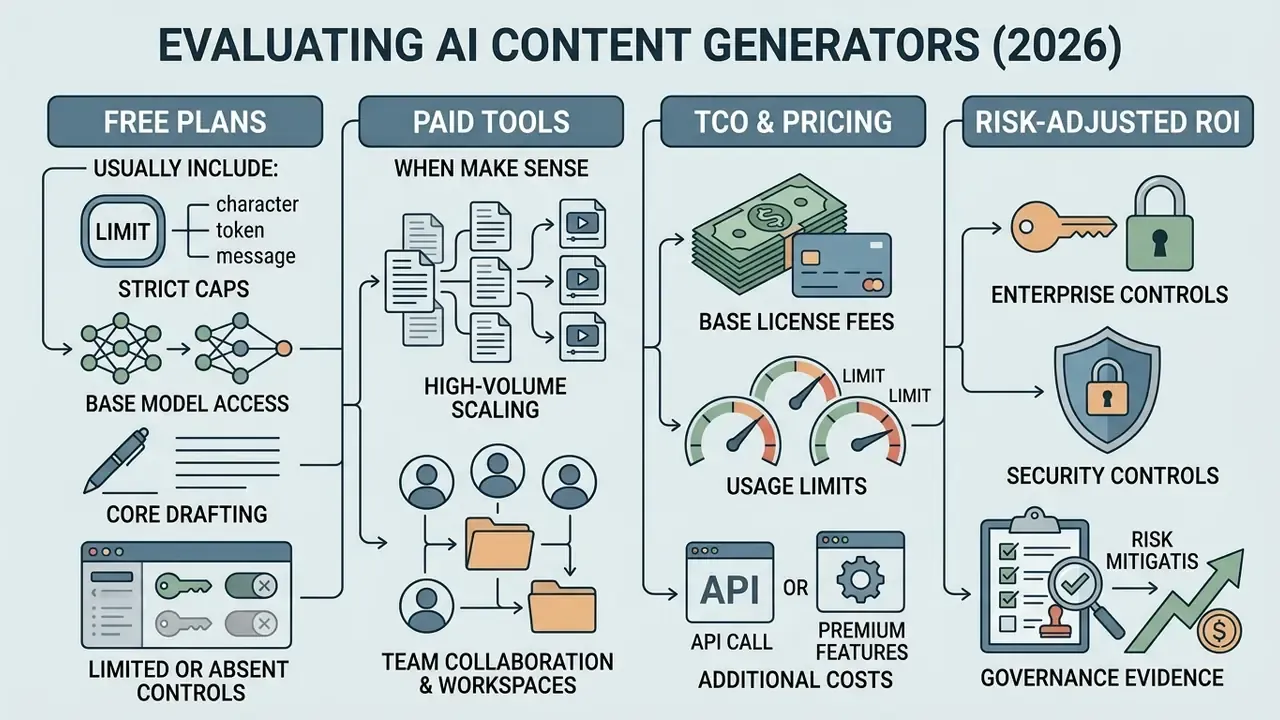
Evaluating an ai content maker or content maker ai platform means weighing base license fees against usage limits. Best ai content generator free plans lower entry barriers, yet enterprise content scaling usually forces an upgrade to paid tiers to unlock custom brand controls, API integrations, security features, and team workspaces. To model license, seat, and credit scenarios before procurement, browse the hub and compare options with your own volume assumptions.
The economic case is supported by practitioner survey data:
«67% of small businesses using AI for content marketing report improved content quality; 68% report higher content-marketing ROI.»
Enterprise AI TCO evaluation model
| Cost layer | What it covers |
|---|---|
| Direct software costs | Platform subscriptions plus API token consumption |
| System integration | CMS and CRM pipeline engineering, API connectors |
| Human review costs | Editorial review hours multiplied by loaded hourly rates |
| Governance and audit | Model risk validation, legal review, fact-checking |
| Monitoring and change | Logging, drift checks, prompt and version management |
| Exit provision | Data export, vendor migration, re-training cost |
| Total cost of ownership | Fully loaded operational investment, three-year view |
What Free AI Writing Generator Plans Usually Include
Free access tiers let individual creators test capability before any financial commitment. A best free ai information generator search usually lands on the same shortlist, and a typical best ai information generator or entry-level content ai creator plan provides:
For teams testing adjacent free asset tooling, see our summaries of free photo editors, free AI art generators, and free AI image generators.
When Paid AI Content Generator Tools Make Sense
Upgrading to a paid subscription is financially justified when content volume, team size, integration depth, and commercial risk exceed free plan limits:
- High-volume content scalingAhrefs (2025) confirms that AI generation lowers drafting costs by 4.7 times, enabling roughly 47% more monthly content within a fixed budget.
- Team collaboration and workspacesPaid plans unlock shared workspaces, shared connections, role-based access control (RBAC), and centralized administrative governance. For most organizations this, not raw usage limits, is the actual purchase driver.
- Advanced API and CMS integrationsEnables direct content pipelines into WordPress, Webflow, HubSpot, or headless CMS platforms via automated API calls and webhook triggers. Developer quotas and rate limits are worth checking early, so explore the hub before you design the pipeline.
- Compliance requirementsContractual exclusion of prompts from model training, retention controls, and audit logging typically exist only on business or enterprise tiers.
- Usage-based scaling economicsAs vendors shift from pure seat-based to hybrid or credit-bundle pricing, value accrues to organizations executing high volumes of automated actions rather than isolated manual queries.
How to Compare Pricing Beyond the Monthly Cost
Evaluating software investment requires looking past monthly subscription rates to total cost of ownership over a three-year horizon. A complete TCO analysis accounts for:
- Human review and editing hours: Calculated as output volume multiplied by review time per unit multiplied by loaded reviewer rate, plus exception handling and rework.
- Integration and technical support: Engineering time required to build and maintain stable API connections with identity, data, logging, and publishing systems.
- Compliance and risk mitigation: Model risk assessments, copyright clearance, legal review, and data privacy protection.
- Monitoring, change management and exit provision: Prompt and version management, drift monitoring, and the cost of migrating data and re-training staff if the vendor is replaced.
How to Choose the Right AI Content Generator Tool
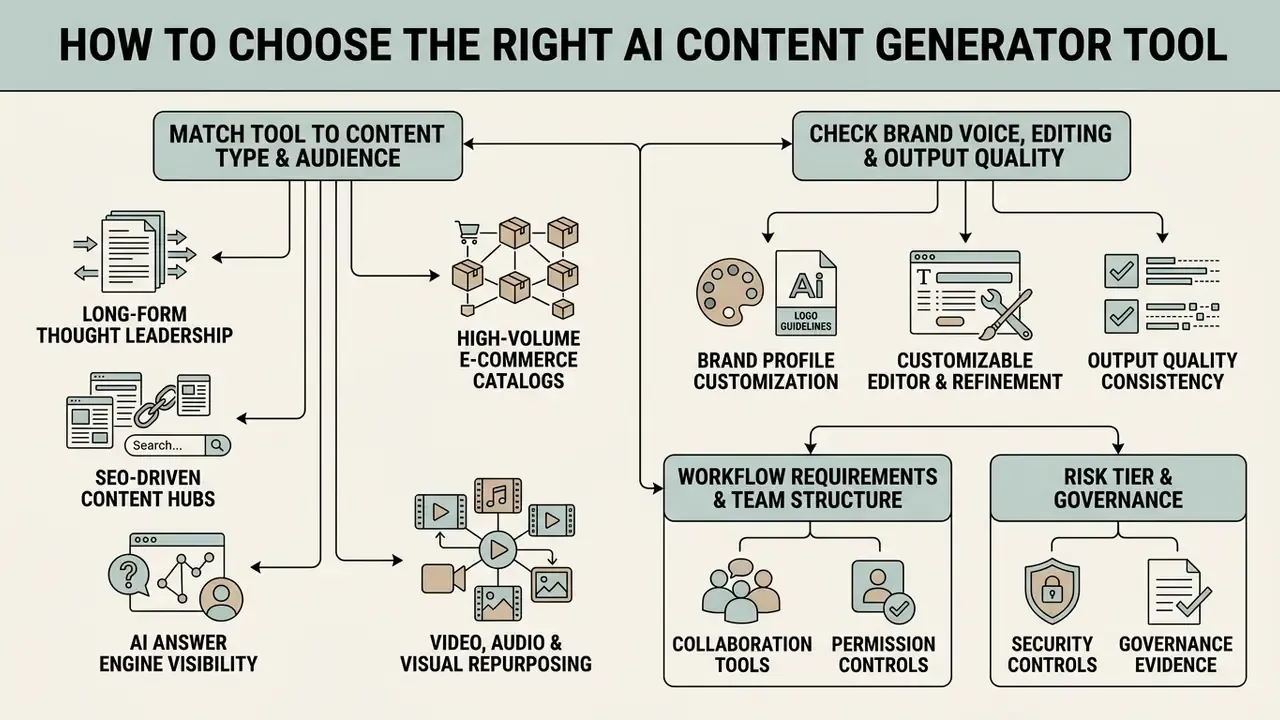
Selecting an ai content generator tool requires a structured framework that aligns software capability with workflow requirements, team structure, brand standards, and risk tier. Public-sector procurement guidance offers a usable template: define the problem statement and risk tier first, then score vendors against a standardized rubric covering performance, cost, safety, security, bias mitigation, transparency, privacy, and mission-aligned KPIs (U.S. federal AI acquisition guidance, 2024; Georgia AI procurement guidance, 2025). ISO/IEC 42001:2023 remains the baseline management-system standard for establishing and continually improving organizational AI governance around that process.
Match the Tool to Content Type and Audience
Content teams must match software strengths to specific channel requirements, and should segment the audience before selecting channel and format (UNECE, Strategic Communication, 2024):



Creators working with visual characters or avatar assets can use an ai character generator from photo tool or test a free ai character generator to streamline asset production, while brand teams standardizing visual identity can review our overview of AI logo generators for branding.
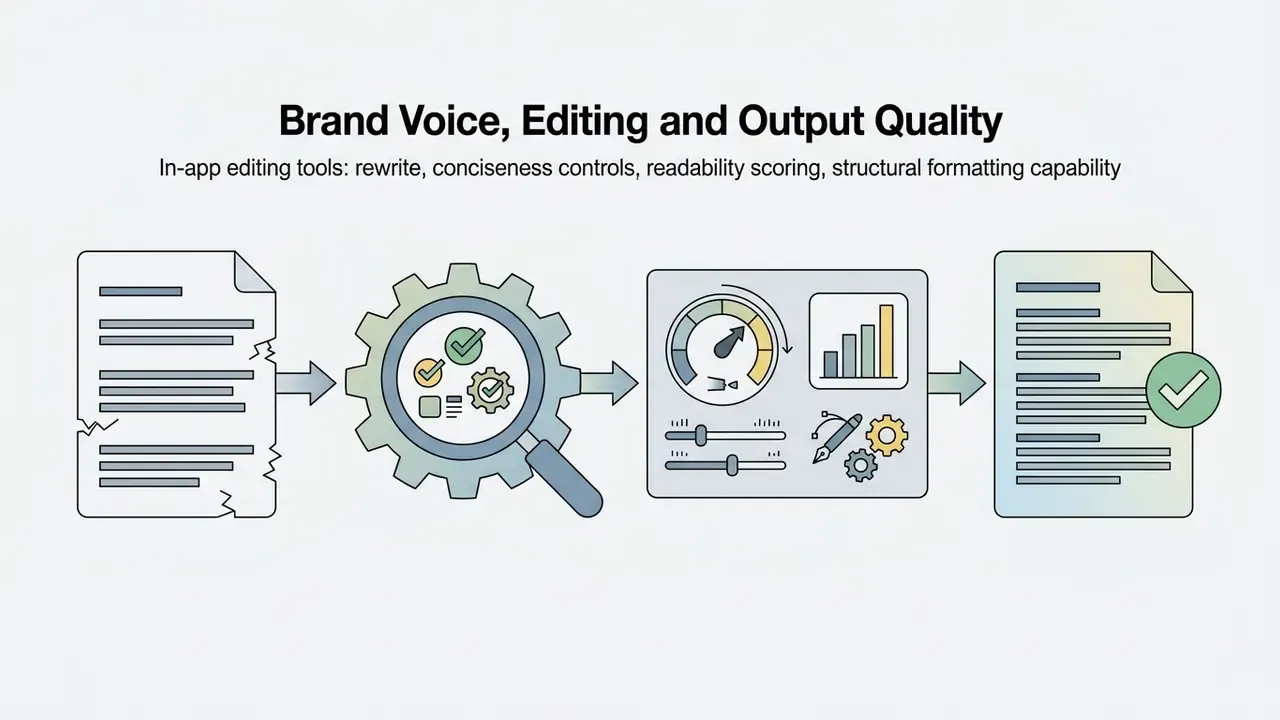
Check Brand Voice, Editing and Output Quality
Maintaining brand differentiation requires testing a tool's style control capability rather than trusting the demo:
Evaluate Workflow, Automation, Data Protection and Team Needs
Enterprise adoption requires evaluating platform infrastructure against IT security and operational requirements:
- Data privacy and security Verify contractually that user inputs and draft data are excluded from training public foundation models, and confirm Zero Data Retention (ZDR) options, encryption in transit and at rest, regional data residency, and retention and deletion windows. Map controls to NIST SP 800-53 Rev. 5 privacy and security control families, and require attestation evidence (SOC 2 Type II, ISO/IEC 27001, ISO/IEC 42001) rather than marketing claims.
- Shadow AI risk mitigation Unsanctioned use of consumer AI tools is the most common source of confidential data leakage in content teams. Controls include network and CASB-based discovery of generative AI domains, DLP rules blocking PII and material non-public information in prompt fields, an approved-tool allowlist paired with a fast exception process, mandatory onboarding training, and periodic attestation by team leads. A published, genuinely usable sanctioned tool removes most of the incentive for shadow usage.
- Deployment mode Determine whether the vendor supports SaaS multi-tenant, dedicated tenant, private VPC, or API-only deployment, and whether logging can be exported into your SIEM or GRC stack.
- Workflow automation Check for webhooks, Zapier or Make connectors, and native REST API access to automate publishing workflows.
- Administrative access control Confirm support for Single Sign-On (SSO), SCIM provisioning, and granular role-based permissions across team workspaces, including who may publish versus who may only draft.
- Scalability Controls and access infrastructure must scale with process load; NIST SP 800-53 and Zero Trust Architecture guidance both require implementation rigor and infrastructure to scale with business-process demand.
Adoption velocity carries a governance dimension too. Analysis of more than 2 million preprints across arXiv, bioRxiv, and SSRN (2018 to 2024) found:
Output can therefore rise faster than review capacity, which is exactly the condition under which unreviewed content reaches production. If usage rights for generated assets are unclear at that point, explore the hub, and for dispute and enforcement precedents browse the hub.
Automated workflow integration via API and no-code connectors
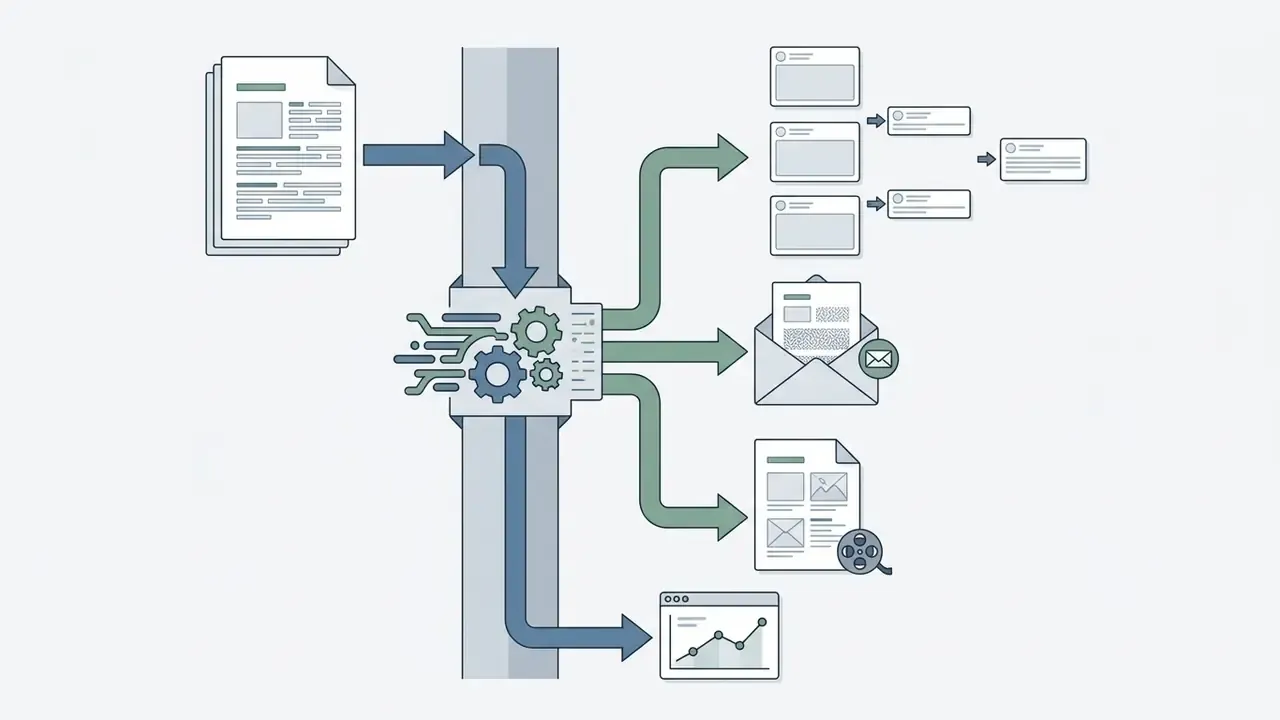
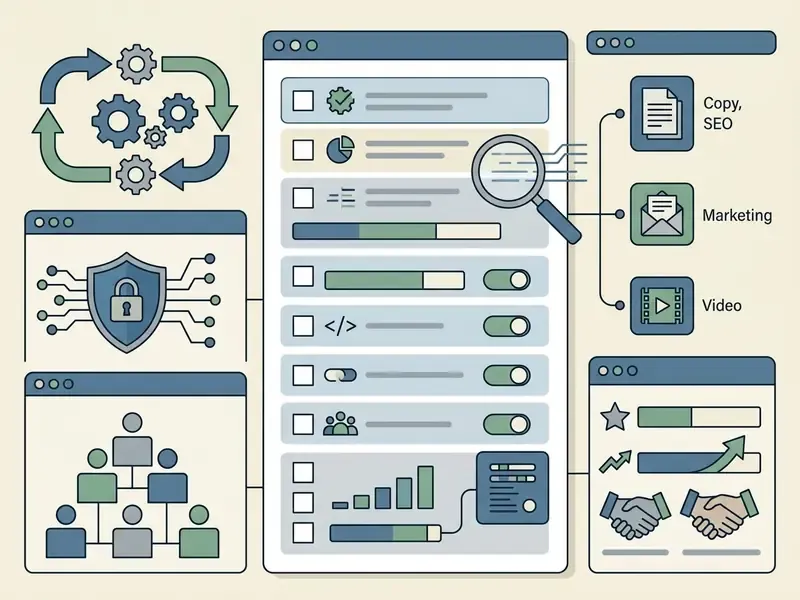
To maximize operational leverage, enterprise deployment must move beyond standalone chat interfaces into automated pipeline architectures. Using webhooks and no-code platforms connecting thousands of applications, organizations can execute automated content triggers across their tech stack:


Checklist0 / 14
How to Generate High-Quality AI Content Effectively
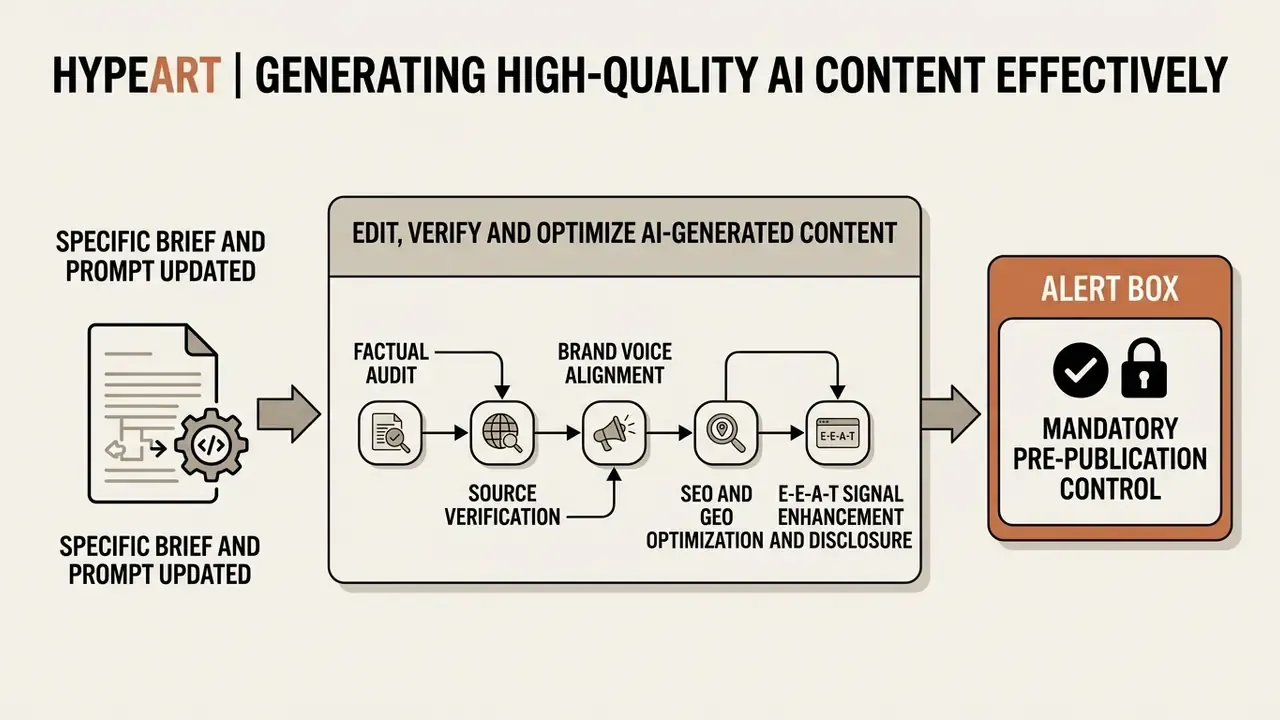
Producing high-quality content with an ai generator content system means replacing vague requests with structured briefing protocols and rigorous editorial post-processing. There is no third option that survives audit.
Start With a Specific Brief and Prompt
Output quality depends on structured inputs, and the empirical evidence favors structure over volume:
«Paragraph-level prompting significantly improved argument structure and productivity, especially for writers without regular writing practice.»
Structured, iterative practice with an AI assistant also outperformed conventional feedback in controlled writing trials:
«Participants practicing with an AI tool wrote better than those receiving feedback from professional editors (d=0.76) or using Google (d=1.03).»
| Brief element | What to specify |
|---|---|
| 1. Primary goal | Exact business objective and target output format |
| 2. Target audience | User persona, technical expertise, and search intent |
| 3. Context and data | Verified background facts, source metrics, approved assets |
| 4. Brand tone | Required vocabulary, style guide, point of view |
| 5. Constraints | Word limits, heading structure, mandatory CTAs and disclosures |
Illustrative scenario (hypothetical, not a client result): A regional fintech institution wants to scale its educational blog. By replacing open-ended prompts with the five-point briefing structure, specifying customer personas, source financial statistics, brand tone constraints, and structural heading rules, the editorial team reduces draft rework by roughly half and accelerates publication without loosening compliance standards. The detail that matters most in this scenario is secondary: the same brief template doubles as audit evidence, because each published article retains its brief, model version, and reviewer sign-off in the content management record.
Edit, Verify and Optimize AI-Generated Content
Publishing unedited drafts exposes organizations to search engine quality downgrades, factual errors, and regulatory findings. Guidance from Washington State WaTech, State Agency Generative AI Guidelines (2023/2024), NIST AI 100-4 (2024/2026), the Government of Canada (2024), and university policies including the University of Florida (2024) and Louisiana State University (2025) converges on a four-step verification sequence:
- Factual audit and source verificationCross-check every statement, statistic, quotation, and citation against authoritative primary sources. Generated content is not authoritative on its own, and fabricated references are a documented failure mode.
- Brand voice and tone alignmentRephrase repetitive constructions, reduce passive voice and nominalizations, edit for bias, and add distinctive brand perspective.
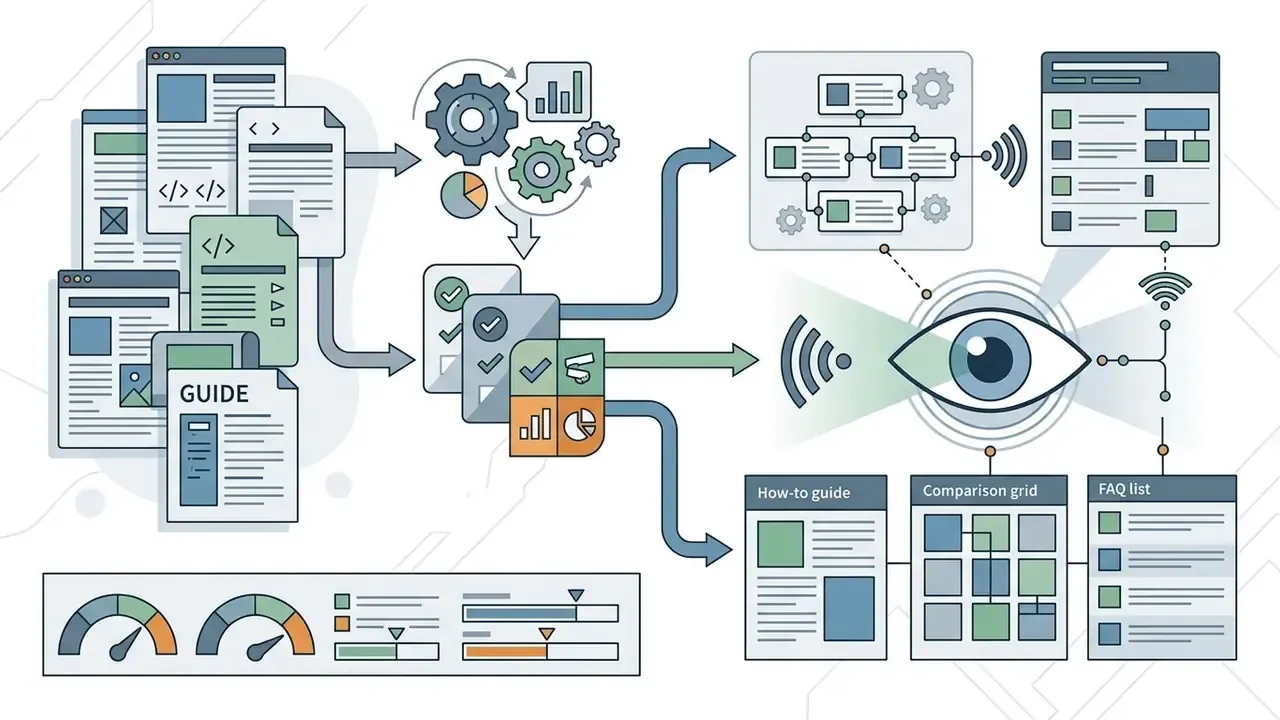
- SEO and GEO optimizationEnsure clear H2 and H3 heading structures, add concise summary paragraphs, and integrate schema data to improve AI answer engine visibility. The Semrush AI Citation Study (2025) quantifies which signals matter:
«Clarity and summarization raise AI citation likelihood by 32.83%; E-E-A-T signals by 30.64%; explicit Q&A structure by 25.45%.»
Model Risk Management, Audit Trail and Governance Controls
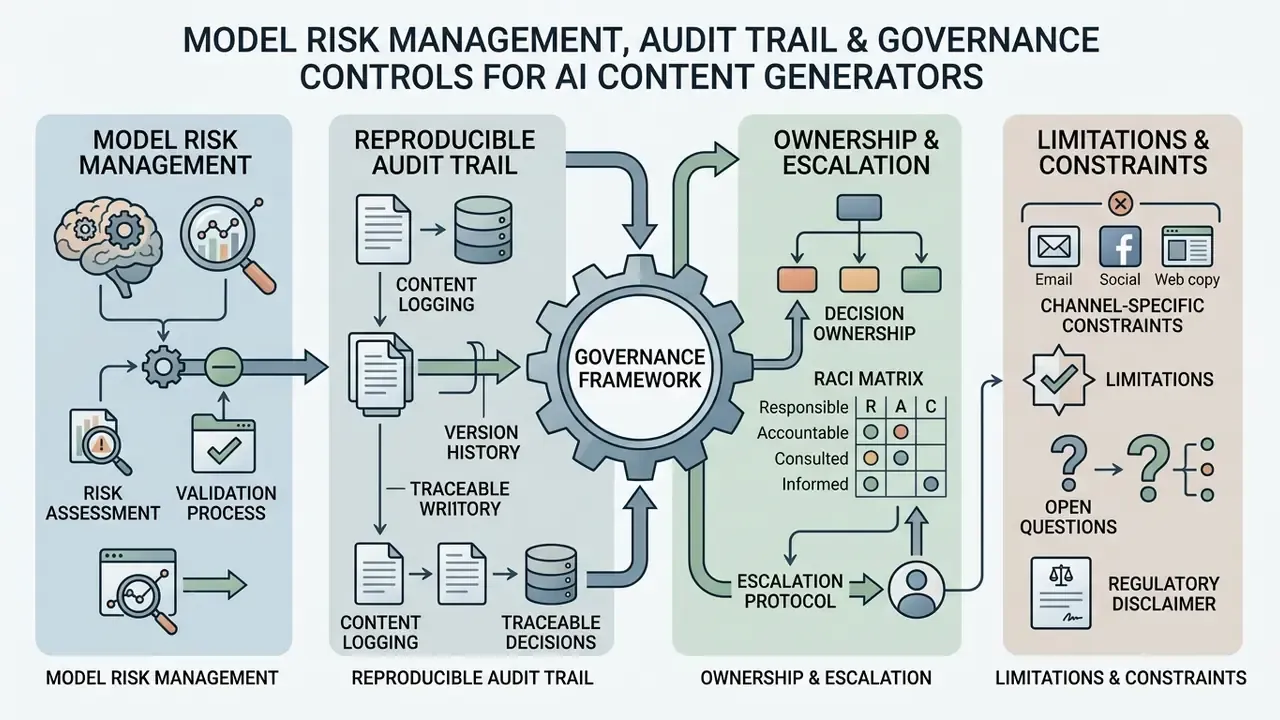
For financial services, insurance, healthcare, and other regulated environments, an AI content generator is not merely a productivity tool. It is a model whose outputs reach customers. Supervisory expectations for model risk management (Federal Reserve SR 11-7 and OCC Bulletin 2011-12) require conceptual soundness review, ongoing monitoring, and independent validation, with documentation sufficient for an examiner to reconstruct how an output was produced. NIST AI RMF and ISO/IEC 42001:2023 supply the complementary management-system scaffolding.
Reproducible Audit Trail for Generative Writing
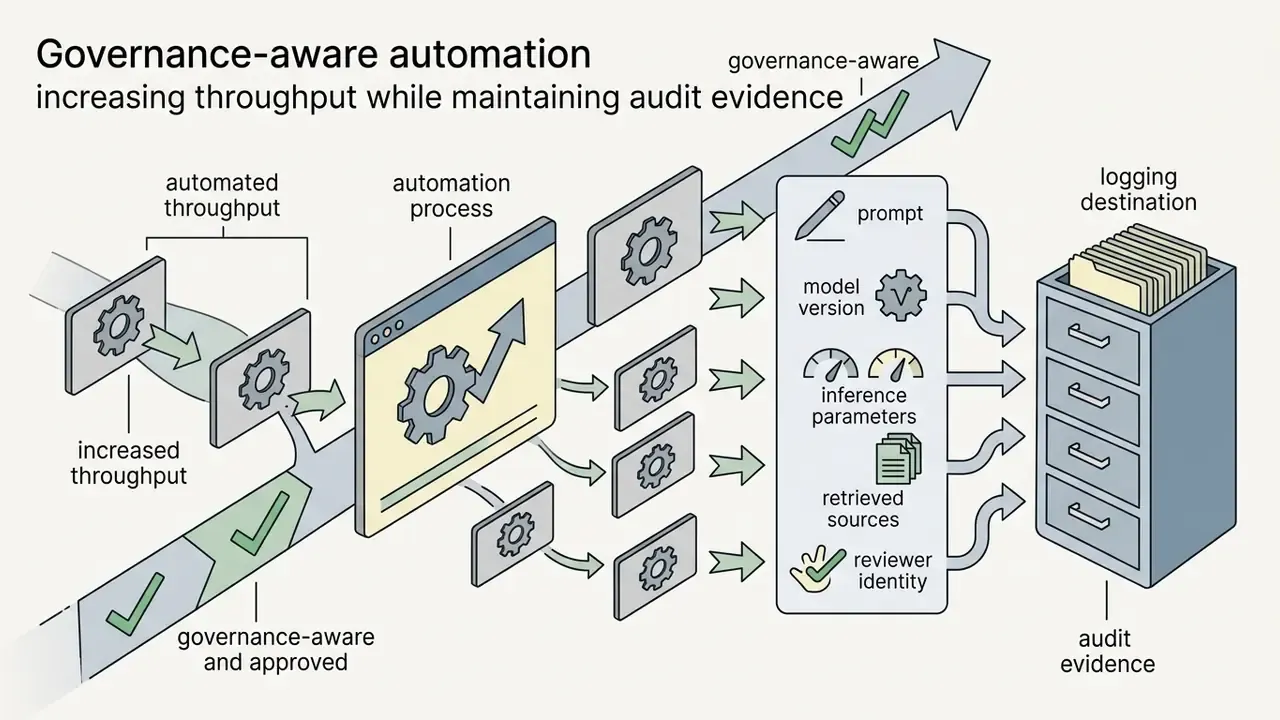
A defensible audit trail for published AI-assisted content should capture, per artifact:
| Evidence field | Required detail |
|---|---|
| 1. Prompt and brief | Full prompt text, system prompt version, brief ID |
| 2. Model identity | Vendor, model name, version or build, deployment mode |
| 3. Inference parameters | Temperature, top-p, max tokens, seed where available |
| 4. Grounding sources | Retrieved documents, versions, retrieval scores |
| 5. Raw output | Unedited generation, timestamped and immutable |
| 6. Human edits | Diff between raw output and published version |
| 7. Approvals | Reviewer identity, role, timestamp, sign-off scope |
| 8. Disclosure status | AI labeling applied, provenance metadata, channel |
| 9. Retention and access | Storage location, retention period, access controls |
This record is what converts "we reviewed it" into examinable evidence. It also enables root-cause analysis when a hallucination reaches production, because teams can determine whether the failure started in the brief, the retrieval layer, the parameters, or the review step.
Decision Ownership, RACI Matrix and Escalation Paths
Accountability must be assigned before scale, not after an incident. The matrix below is a starting template for regulated publishing workflows.
RACI matrix for AI-assisted content in regulated channels
| Activity | Marketing / content owner | AI governance officer | Legal / compliance | Model validation / risk |
|---|---|---|---|---|
| Approve use case and risk tier | C | A | C | R |
| Configure brand voice, style guide, knowledge base | R | A | C | I |
| Draft generation and first-pass editing | R/A | I | I | I |
| Factual verification and source attribution | R | C | C | I |
| Claims, disclosures and regulatory review | C | C | R/A | C |
| Model version change and parameter policy | I | R | C | A |
| Audit evidence retention | C | R | C | A |
| Incident response and content retraction | R | A | R | C |
Escalation protocol. Define tiers with explicit response times: (1) style deviation, returned to the content owner for revision; (2) unverifiable factual claim, claim removed or held until a primary source is produced; (3) regulatory or disclosure risk, routed to Legal and Compliance with publication blocked; (4) published error, immediate retraction or correction, incident log entry, and root-cause review against the audit evidence record; (5) systemic model failure, model version rollback and suspension of automated pipelines pending revalidation.
Channel-specific constraints. Automated customer-facing communications in financial services intersect with communications rules such as FINRA Rule 2210 (content standards, principal approval, and recordkeeping for retail communications) and consumer-protection expectations for automated messaging under CFPB supervision, including prohibitions on unfair, deceptive, or abusive acts and practices. The practical consequence is simple: promotional or advisory content generated by an LLM must pass the same principal-approval and recordkeeping controls as human-drafted material. Automation changes the drafting method, not the obligation.
Limitations and open questions. Two gaps remain unresolved in the public evidence base. First, no peer-reviewed study yet quantifies residual hallucination rates for grounded, reviewed marketing content in regulated channels, which means expected-loss estimates still rest on internal incident data. Second, validation methodology for agentic publishing workflows, where a system chains retrieval, drafting, and scheduling without a human gate at each step, is not settled in supervisory guidance. Until it is, keep a human approval gate before anything reaches a customer.
AI Content Generator FAQ
Disclaimer: The following answers summarize public guidance for general information. They are not legal advice on copyright, regulatory obligations, or vendor terms of service.
Can AI-Generated Content Be Used for Commercial Website Content?
Yes. AI-generated content can be used for commercial website pages, marketing campaigns, and customer communications, provided it adheres to platform terms of service, copyright regulations, disclosure obligations, and search engine quality guidelines.
One behavioral finding deserves attention before you decide how prominently to disclose AI involvement:
«Experiments show a +13.7 percentage-point shift toward preferring content labeled as human-written, even when the text is identical.» Attribution bias study using Queneau's Exercises in Style (2025 preprint)
Disclosure is frequently mandatory and always advisable for public-interest content, but it should be paired with strong authorship, expertise, and original insight signals, since audiences discount perceived machine authorship independently of text quality.
What Are Google's Current Guidelines on AI-Generated Website Content?
Google Search guidance (2026 update) states that using AI or automation to create helpful, high-quality, people-first content is acceptable. Google ranks content based on quality, relevance, and E-E-A-T signals regardless of how it is produced. However, its spam policies prohibit scaled content abuse, meaning generating many pages with generative AI primarily to manipulate search rankings, which can result in ranking loss or deindexing. Google's 2026 optimization guidance for generative AI features additionally emphasizes unique, non-commodity, reliable content, and notes that tactics such as llms.txt or artificial content chunking are not required for Google Search.
Who Owns the Copyright to AI-Generated Text and Content?
Under U.S. Copyright Office guidance and rulings (2023 to 2025), purely machine-generated material created without sufficient human creative involvement is not eligible for copyright protection. Where AI determines the expressive elements, the output lacks human authorship, and protection extends only to original human contributions such as creative arrangement, selection, or substantial modification. Registration applicants must disclose and exclude more than de minimis AI-generated material from the claim. WIPO's 2024 guidance adds that organizations must review vendor terms of service, output ownership provisions, licenses, and potential infringement exposure before commercial exploitation, and notes that in Japan uploading, publicly posting, and selling AI-generated images are treated under ordinary copyright infringement rules. The Congressional Research Service (2025) notes that commercial use is one fair-use factor, but legality depends on all four statutory factors.
What Are the Disclosure Requirements Under the EU AI Act for Public Content?
Under the European Union AI Act, with transparency provisions effective from 2 August 2026, providers and deployers of generative AI systems must ensure that AI-generated or synthetic content is identifiable, marked in machine-readable form, and clearly labeled, with deepfakes and AI-generated text on matters of public interest explicitly named. European Commission guidance exempts certain machine-to-machine outputs, source code, and closed-loop industrial or film-production uses unless they constitute final outputs, and standard spelling, grammar, and editing assistance falls outside the marking duty. Fully automated public-facing content generation without human review or editorial control requires clear provenance disclosure.
How Can Enterprise Teams Mitigate Hallucination Risks in Commercial Copy?
Mitigating hallucination risk requires a strict human-in-the-loop protocol. Ground generation with retrieval-augmented generation tied to verified internal document repositories, lower temperature and top-p settings for factual tasks, restrict long-context dumping in favor of targeted retrieval, and require qualified subject matter experts to sign off on all technical, financial, medical, or legal claims before external publication. Log the prompt, model version, parameters, and retrieved sources so any error can be reconstructed and remediated.
What Data Protection Controls Should Be Contractually Required?
Require contractual exclusion of prompts and outputs from foundation-model training, Zero Data Retention or bounded retention windows with documented deletion, encryption in transit and at rest, regional data residency where applicable, exportable audit logs, SSO and SCIM with role-based access control, incident notification timelines, and current attestation evidence (SOC 2 Type II, ISO/IEC 27001, ISO/IEC 42001). Marketing pages are not audit evidence. Obtain the trust-portal reports and the data processing agreement.
How Do We Prevent Shadow AI Usage in Content Teams?
Combine detection with enablement. Discover generative AI domain traffic through network monitoring or a CASB, apply data-loss-prevention rules to prompt fields to block PII and material non-public information, publish an approved-tool allowlist with a fast exception path, require onboarding training and periodic team-lead attestation, and make the sanctioned tool genuinely good enough that circumvention has no upside.
Do Financial Services Communications Rules Apply to AI-Drafted Content?
Yes. Automation does not change the underlying obligation. Retail communications drafted with AI remain subject to applicable content standards, principal approval, and recordkeeping requirements, for example FINRA Rule 2210 for member firms, and automated consumer communications remain subject to prohibitions on unfair, deceptive, or abusive acts and practices under CFPB supervision. Institutions should treat generative writing tools as models within their model risk management framework, consistent with Federal Reserve SR 11-7 and OCC Bulletin 2011-12 expectations for documentation, validation, and ongoing monitoring. General information, not legal advice.
Should AI-Generated Content Be Labeled Even Where Not Legally Required?
Public-sector guidance, for example Washington State and Australian government guidance, recommends labeling when AI created most of the content, using visible labels, watermarking, or metadata. Note the trade-off: attribution research indicates audiences shift preference toward content labeled as human-written by roughly 13.7 percentage points even when the text is identical. The practical resolution is honest disclosure paired with visible human expertise: named authors, reviewer credentials, original data, and firsthand experience.
Appendix A: Superseded Statements and Editorial Corrections
For transparency, the following claims from earlier versions of this analysis were revised during fact-checking. Original phrasing is preserved alongside the correction.
| Original statement | Status | Correction applied |
|---|---|---|
| "Frontier models such as GPT-5.6 Sol, Claude Opus 4.6, and Gemini 2.5 reach accuracies exceeding 88% on complex reasoning tasks (MMLU)." | Needed verification | Benchmark figures now attributed to the models actually measured in the LLMs4All Review (2026): GPT-4o 88.7%, DeepSeek V3 88.5%, Claude 3.5 Sonnet 88.3%. The 2026 flagship names are retained as vendor roadmap information, not benchmark claims. |
| "According to prompt engineering standards (Yale University and Stanford AI Guides, 2026), an enterprise brief must include five core elements." | Unverified framing | Reframed as convergence across published guides: Yale (Goal, Context, Source, Expectations), Notre Dame CRAFT, and the U.S. Department of Energy Generative AI Reference Guide (2024). |
| "Organizations can accelerate drafting cycles by 40% to 60%." | Practitioner-reported | Retained with an explicit caveat that the range reflects self-reported figures and should be validated internally through cycle-time measurement. |
| "Article Forge-style tools offer true SEO automation with minimal human input." | Contradicted | Fully automated generation without retrieval grounding raises hallucination and spam-policy risk (NIST AI 100-4; Google Spam Policies, 2026). Autonomous publication is not recommended. |
Article Metadata




Social Media, Advertising and Email Content
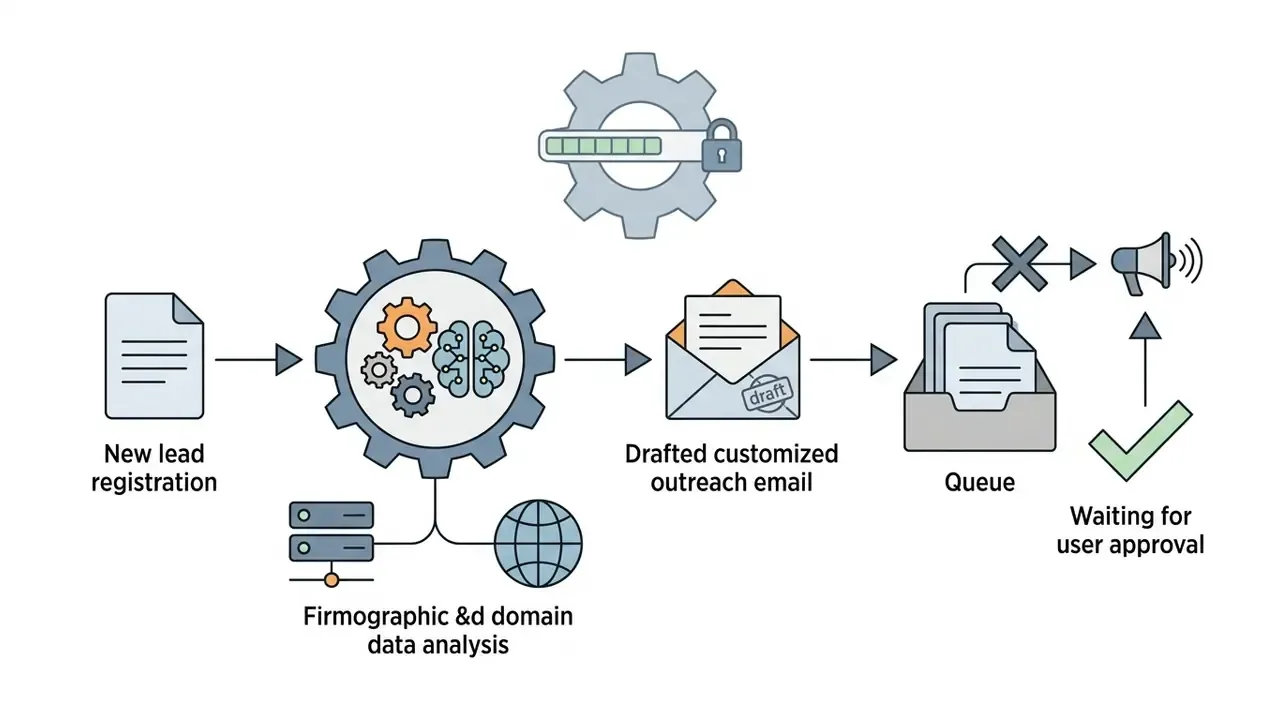
Short-form marketing channels benefit from the iteration speed of an ai content genrator. Marketers use AI assistants to generate dozens of headline options, A/B test ad variations, and construct personalized outreach emails. Desktop and mobile clients matter here too: an ai content generator app on a phone is often what a social manager actually uses between meetings, which is exactly why sanctioned tooling needs to be convenient, not just approved.
When deploying automated copy across professional networks such as LinkedIn, official channel guidelines (LinkedIn Ads Guide and Ad Guidelines, 2026) require matching creative language to the selected audience language, using appropriate titles and imagery, avoiding misleading affiliation claims, and supporting all commercial claims with documented evidence. Sponsored messaging guidance additionally recommends A/B testing at least two target audiences, short subject lines, a single clear call to action, working links, and mobile-responsive landing pages (Adobe Sponsored InMail guidance).
For specialized creative assets, teams often combine text generation with synthetic media platforms, see our overview of AI video generators for marketing campaigns, provided commercial licensing terms permit the intended synthetic representation and provenance labeling requirements are satisfied.