How Does AI Generate Images? Models, Prompts, Pricing and Commercial Use
Definition
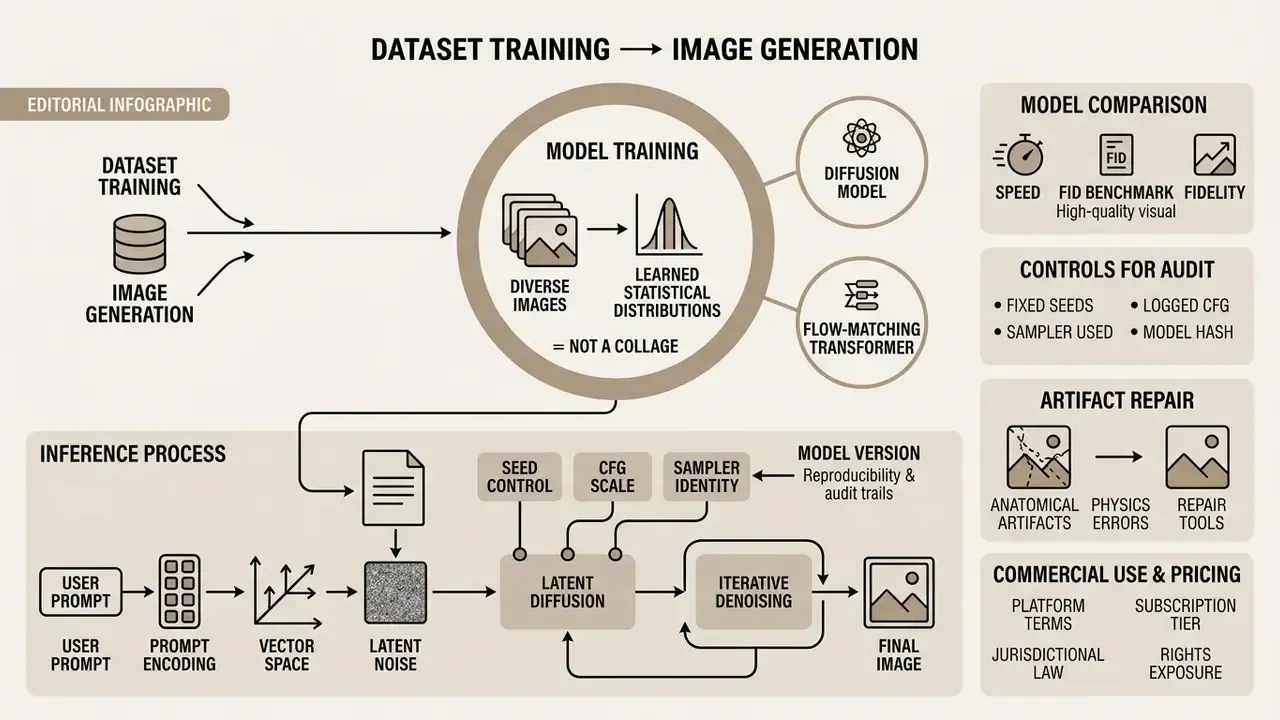
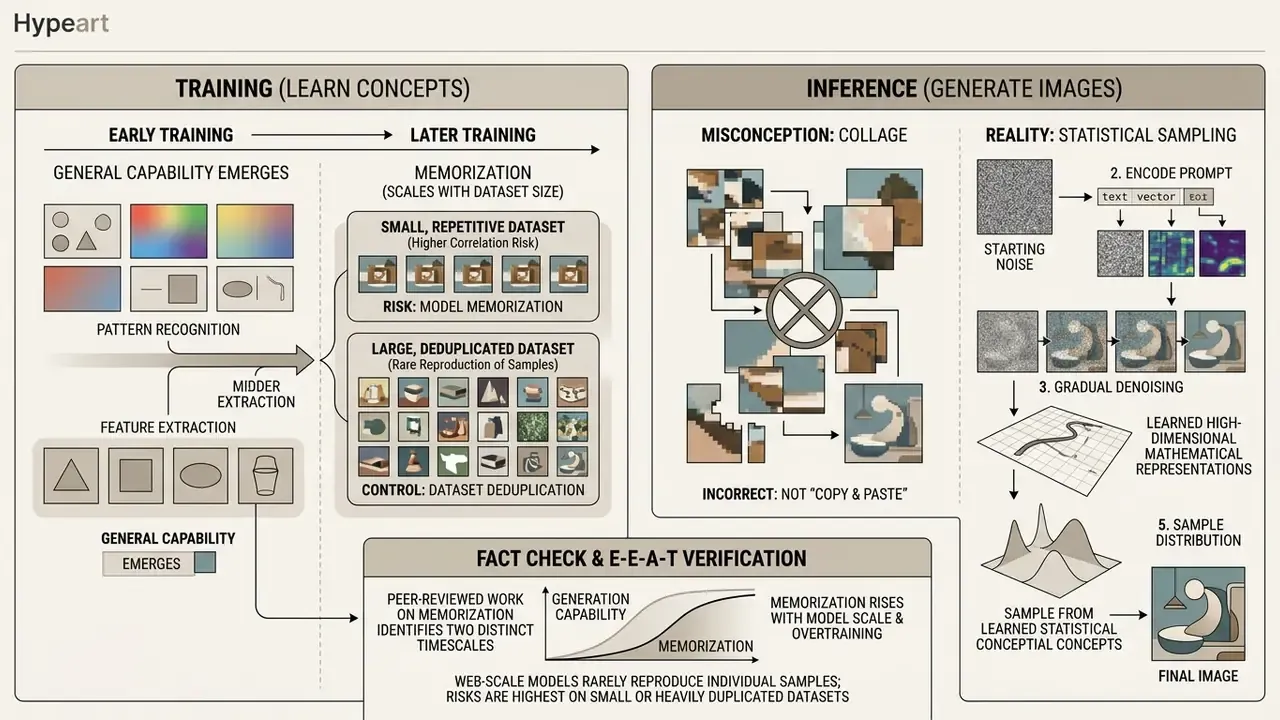
Artificial intelligence generates images by running deep learning inference that converts text instructions, or plain random Gaussian noise, into structured arrays of pixels. No archive lookup happens. No collage gets assembled from stored fragments. Contemporary generative models sample brand-new visual data from probability distributions learned during large-scale training, and that distinction drives almost every governance question that follows.
Term type
Glossary / Entity
Last checked
· Reviewed by the AI Media Governance & Model Risk editorial group
Source status
Manual check
Why should a risk or compliance leader care about denoising schedules? Because the same evidence you demand from a credit model, version identity, reproducible runs, documented inputs, applies here too. Synthetic imagery now sits inside marketing approvals, customer communications, and product interfaces at regulated institutions. If nobody can reproduce an asset, nobody can defend it.
«Generative diffusion models do not possess an innate causal understanding of the physical world; instead, they represent statistical crystallizations of human visual data. Evaluating their operational boundary requires understanding where pattern correlation ends and spatial logic fails.»
Executive Summary for Risk, Compliance and Content Leaders
What Is AI Image Generation?
AI image generation is the computational process of synthesizing novel digital visual content from input prompts or noise vectors using trained artificial intelligence models. An AI-generated image differs from a traditional digital graphic or a search result in one decisive way. Every pixel is calculated during inference rather than retrieved from an indexed storage database or drawn by a human in graphics software.
«Diffusion models are trained to reverse a gradual noising process, iteratively reconstructing an image from random noise rather than copying pixels from training data.»
When an enterprise user submits a text prompt, the system processes that text as a mathematical conditioning vector. The model converts the vector into visual features, applying learned rules for geometry, lighting, texture, and semantic context. Legacy raster editors apply deterministic transformations to existing pixel files: cropping, curve adjustments, filter convolutions. Generative image tools do something else entirely. They synthesize new data structures, producing a fresh file each time inference runs. Teams evaluating specific platforms can review capability and licensing breakdowns across AI image generators.
In one hypothetical model validation review, a risk team assessed an automated media system built to create promotional assets. The question on the table was blunt: does this network store cached image fragments, or does it synthesize unique output? By measuring latent feature representations across 5,000 inference cycles, the team concluded that outputs were statistically distinct synthetic constructions rather than derivative asset collages. Composite example, not a named engagement.
How Fast Output Quality Has Actually Improved
A useful trick for understanding architectural progress is to hold the prompt constant across model generations. Running the same trivial prompt, "a person eating an apple", through successive model families exposes exactly which bottleneck each generation solved.
Generation Era
Example Output Quality (Prompt: "A person eating an apple")
Practitioners describe the same trajectory in blunter terms. Outputs moved "from nightmare fuel to photorealism in just a few short years," driven by continual retraining, human preference voting inside platforms like Midjourney, and progressive redesign of the denoising networks themselves. The pace matters for governance: a control designed against 2023 artifact rates will misjudge 2026 output.
How Do AI Models Learn to Create Images?
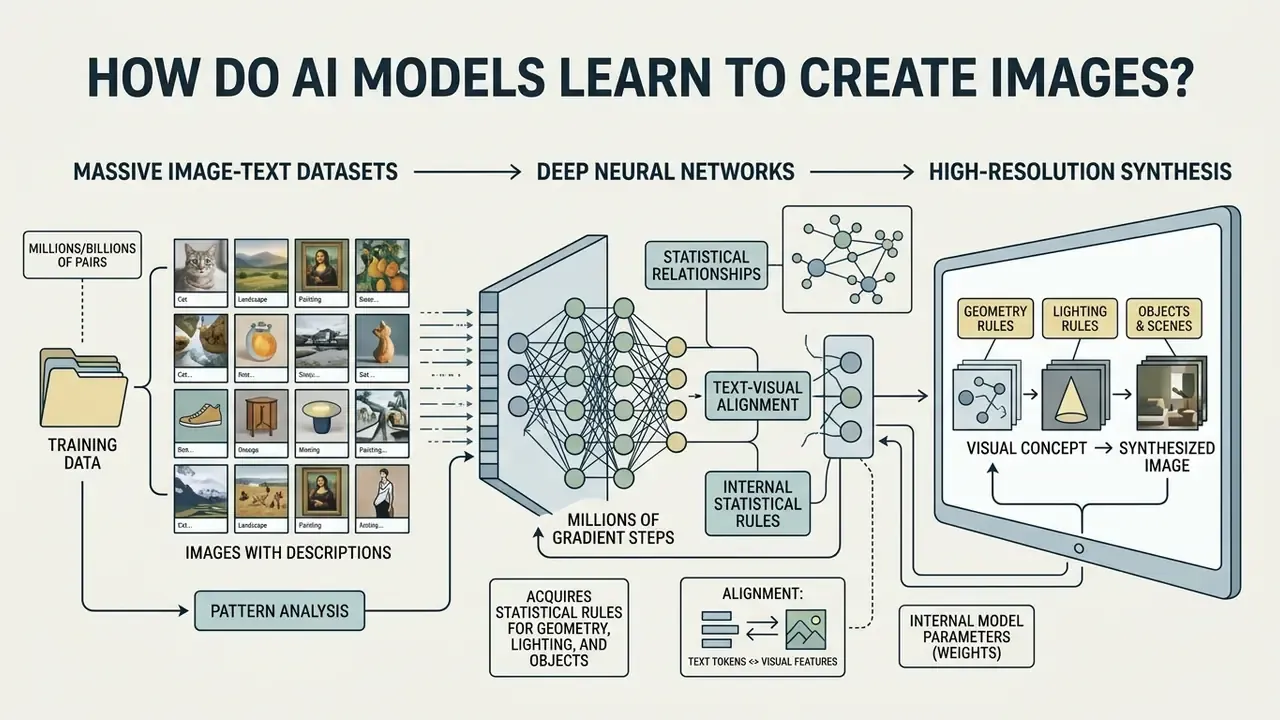
AI models learn to create images by analyzing massive image-text datasets through deep neural networks, building statistical relationships between words and visual concepts. During this machine learning process the network identifies recurring patterns. It learns, for instance, how the word "sunset" correlates with specific color gradients, light angles, and atmospheric textures, then maps those relationships into a mathematical coordinate system known as a latent space.
Training Data, Patterns and Neural Networks
Neural network training relies on paired datasets holding millions or billions of images with descriptive captions. Contrastive language-image pre-training architectures, such as OpenAI's CLIP, use dual encoders: an image encoder (ResNet or Vision Transformer) and a text encoder (Transformer). Both project visual features and text tokens into a shared embedding space. By optimizing contrastive loss functions, the model places matching image-text pairs close together while pushing mismatched pairs far apart. That shared space is the reason a single prompt token can later steer pixel-level geometry. Text and images are living in the same coordinate system.
Once alignment between text tokens and visual features is established, high-resolution synthesis models such as Latent Diffusion Models (Rombach et al., CVPR 2022) train variational autoencoders to compress pixel data into lower-dimensional latents. The core network, typically a U-Net or a Diffusion Transformer (DiT), then learns to predict and remove noise inside that compressed space.
«Diffusion models offer more stable training and better data-distribution coverage than GANs and VAEs.»
Source: Yang et al., Diffusion Models: A Comprehensive Survey of Methods and Applications, ACM Computing Surveys (2023). https://arxiv.org/abs/2209.00796
Across millions of gradient steps, the network acquires internal statistical rules for geometry, perspective, lighting, and semantic style over thousands of visual categories. Since training runs on human-authored imagery, the finished model behaves less like an independent artist and more like a compressed statistical archive of human visual production. Which is precisely why provenance and dataset documentation belong in any model validation file, alongside the usual performance metrics.
How Does AI Turn a Text Prompt Into an Image?
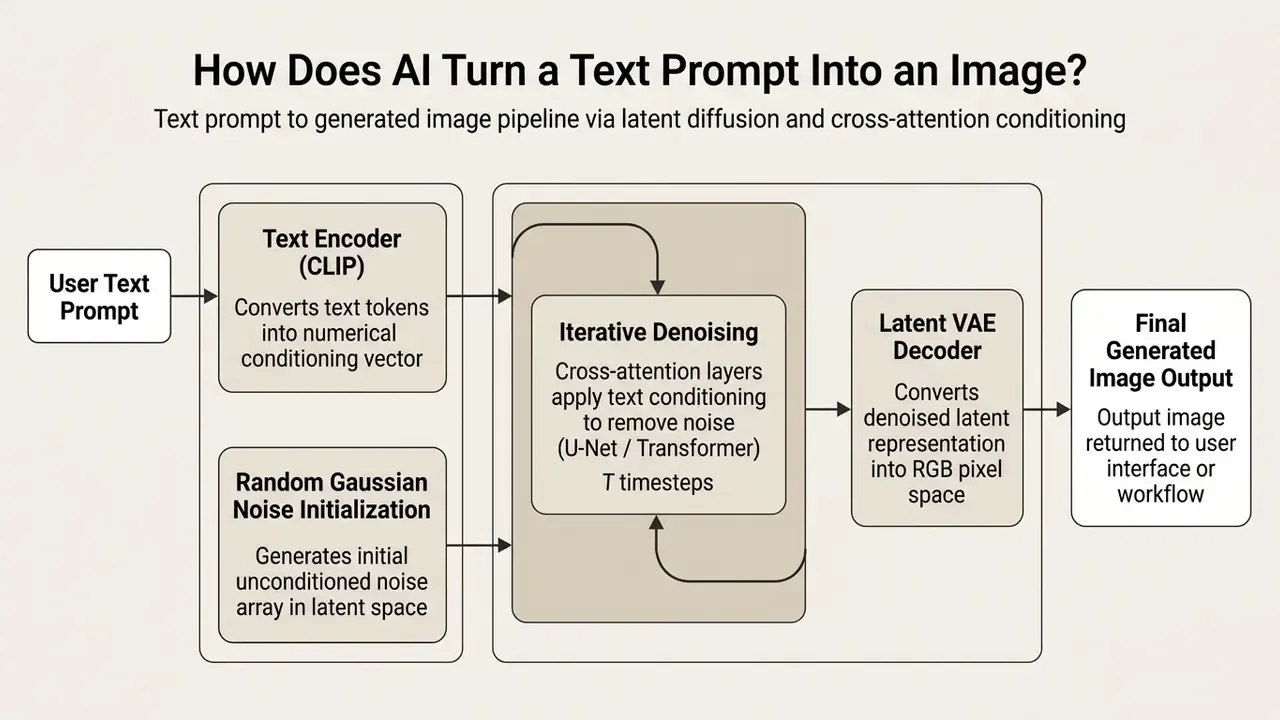
An AI system turns a text prompt into an image by encoding user text into a numerical conditioning vector, then using cross-attention mechanisms to steer iterative denoising toward matching visual structures. The prompt acts as a control boundary, guiding the network from abstract noise toward a refined composition. Formally, the network learns a conditional distribution p(x∣c) rather than an unconditional image distribution, where c is the encoded prompt.
At the token level, prompt embeddings act as keys and values inside cross-attention layers, while spatial image features act as queries. That is the mechanical reason word order, emphasis, and token count visibly reshape composition. Different tokens compete for attention mass over the same latent canvas, and the loudest tokens win.
How Diffusion Models Generate Images From Noise
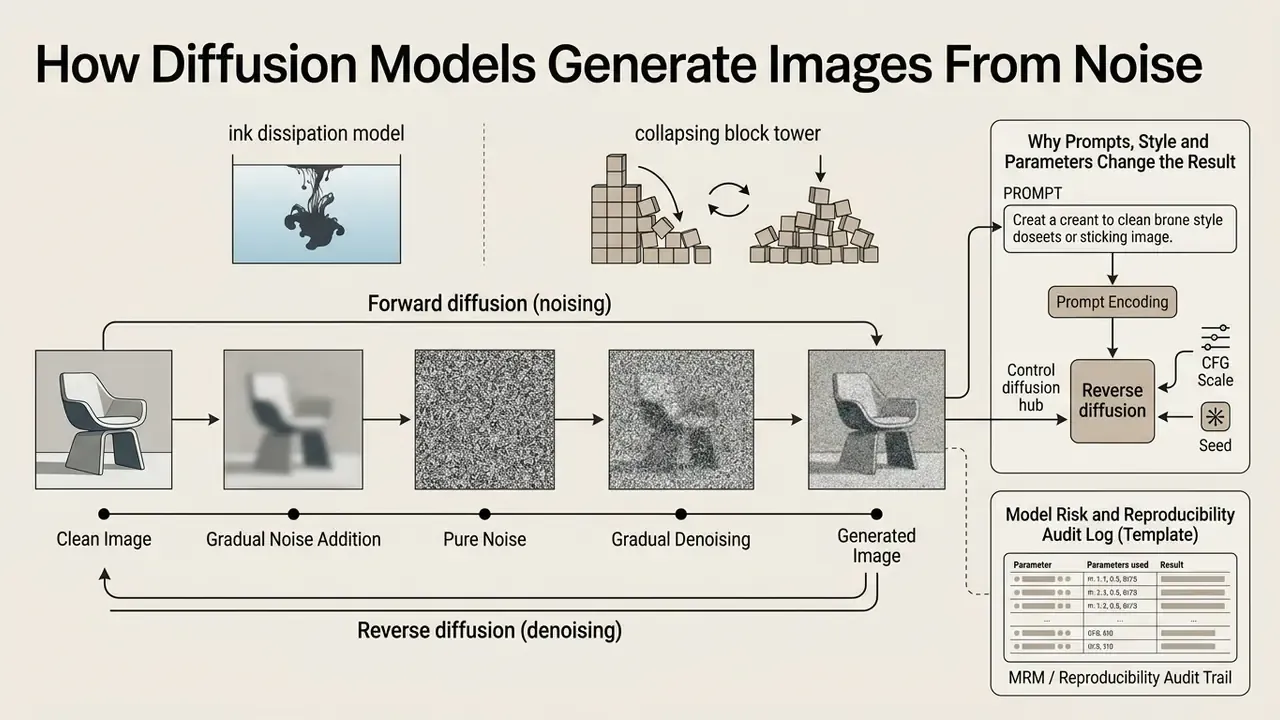
Diffusion models generate images by reversing a mathematical process that gradually converts clean visual data into pure Gaussian noise. The model learns the reverse direction. Starting from complete randomness, it predicts and subtracts noise step by step until a coherent image emerges.
From Random Noise to a Generated Image
To grasp reverse diffusion without wading into stochastic calculus, two physical analogies help.
Both analogies come straight from the energy-based modelling tradition that diffusion inherits. An energy landscape is constructed over images, and generation simulates the reversal of physical dissipation.
With intuition in place, the generative journey runs through two distinct mathematical processes across discrete timesteps t:
The ink dissipation modelDrop a spot of black ink into a glass of water and it disperses until only uniform cloudiness remains. That is forward diffusion. Reversing it resembles calculating the trajectory of every water molecule to force the dispersed particles back into one pristine drop.
The collapsing block towerHit a structured toy tower and it collapses into a disordered pile. Reverse diffusion analyzes the chaotic pile and executes an inverted sequence of mechanical steps, restoring the original architecture layer by layer.
Forward diffusion (noising)A Markov chain adds small amounts of Gaussian noise across T timesteps until the original signal is destroyed, leaving pure noise (xT∼N(0,I)).
Reverse diffusion (denoising)The network receives the noisy latent xt, the timestep index t, and the text conditioning vector. Rather than predicting the final image directly, it predicts the noise component ϵθ(xt,t) added at that step. Subtracting the prediction yields a slightly cleaner latent xt−1.
«The reverse diffusion process is a Markov chain with Gaussian transitions parameterized by a neural network that predicts the noise at each step.»
Repeat that update across 20 to 50 steps and a clean latent x0 emerges, which the variational autoencoder decoder converts back into standard RGB pixels. Modern flow-matching extensions, such as those in FLUX 1.1 Pro and Ideogram 4, replace discrete Markov chains with continuous velocity fields. Faster sampling, comparable realism.
Why Prompts, Style and Parameters Change the Result
Small edits to wording, style descriptors, or inference parameters shift generated images substantially, because conditioning vectors change the trajectory through latent space. Now that the denoising loop is clear, each parameter maps to a concrete intervention point inside it.
Classifier-Free Guidance (CFG / guidance scale): Controls how strictly the model must follow the prompt at each denoising step. High values force literal adherence and can introduce oversaturation and contrast artifacts. Low values grant the model more generative freedom.
Random seed: Sets the initial Gaussian noise xT. Hold the seed constant while changing text parameters and you get reproducible prompt testing, the foundation of any controlled A/B evaluation.
Sampling steps: Sets how many denoising passes run. Detail improves up to a threshold defined by the scheduler. Past that point, extra steps only buy compute cost.
Negative prompts: Steer reverse diffusion away from named features such as blur, extra limbs, or unwanted colors, by modifying the unconditioned guidance path.
Style and stylization parameters: Platform-specific controls (--stylize, --chaos, --raw, style-reference inputs) shift aesthetic tone and composition, often at the cost of literal prompt compliance.
Literal text handling: When rendered typography matters, official prompting guidance recommends enclosing exact strings in quotation marks or capitals, then specifying font, size, color, and placement.
«Participants using DALL·E 3 wrote longer, more detailed prompts and achieved higher similarity to target images than DALL·E 2 users.»
Source: As Generative Models Improve, People Adapt Their Prompts, arXiv preprint (2024).
Practically, prompt engineering skill and model capability compound. Better text encoders reward richer prompts, so the same operator lands measurably closer to the target on newer architectures. Readers deciding which architecture rewards their prompting style can compare leading AI image generators side by side.
Model Risk and Reproducibility Audit Log (Template)
Regulated environments, banking, insurance, healthcare communications, need every synthetic asset reproducible on demand and traceable to a validated model version. Capture the following fields for each production generation run.
MRM / Reproducibility Audit Trail
Checklist0 / 13
Logging seed, sampler, steps, CFG, and model hash together is what turns a "creative output" into an auditable artifact. The same tuple should regenerate a bit-comparable image on the same model version, and that is the operational definition of reproducibility for validation testing.
Which AI Image Generation Models Are Used?
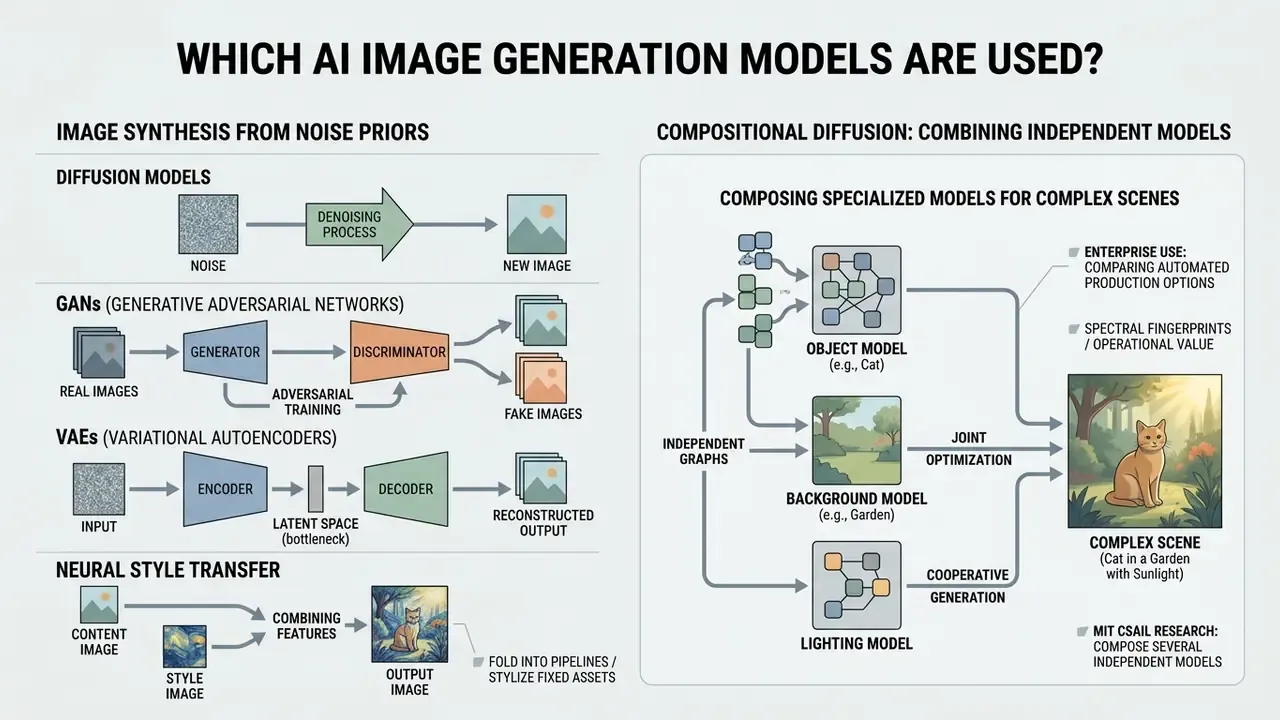
Industrial visual content workflows draw on several generative architectures. Each strikes its own balance between generation speed, visual realism, training stability, and controllability.
Matching Gram matrix feature statistics between content and style
Fast
N/A (Style modification, not generation)
Content bleed, texture over-application
Applying artistic textures to pre-existing input graphics
«Synthetic images from GANs and diffusion models show anomalous frequency-domain patterns and significant high-frequency differences from real photographs.»
Those spectral fingerprints have operational value. They are the signal most automated verification systems exploit, which explains why detection accuracy varies sharply by generator family. Governance teams building verification gates can review capabilities across AI image detectors.
Diffusion Models, GANs, VAEs and Neural Style Transfer
Diffusion models, GANs, and VAEs synthesize completely new images from noise priors. Neural Style Transfer works on a different premise. NST needs a pre-existing content image plus a style reference, then optimizes pixel values to match feature correlations extracted by deep convolutional layers. The output target differs fundamentally: generation builds an entire image from scratch, style transfer preserves scene structure and changes only appearance.
Enterprise teams often fold style transfer into pipelines that stylize fixed video assets or convert static brand photography into motion. The same conditioning logic sits underneath image-to-image generation, where an existing asset replaces pure noise as the diffusion starting point. Creative teams that want to make ai video from a single approved brand photograph are using exactly that mechanism, with temporal consistency layers added on top.
Compositional Diffusion: Combining Multiple Models for Complex Scenes
A single diffusion model has a fixed computational graph. It allocates the same amount of computation per image regardless of how complex the prompt is. Give a human illustrator a 100-line scene brief and they will spend proportionally more time than on a one-liner. A monolithic model cannot.
MIT CSAIL research tackles this by composing several independent specialized models, where each model represents one portion of a scene and the composed system jointly satisfies all constraints. The approach improves scene understanding on long, multi-object prompts. It also generalizes past images, into robot trajectory planning, 3D asset design, and protein specification, each expressed as a set of composable, language-like conditions.
In a hypothetical commercial media audit, a digital agency compared automated production options for a brand client. The technical team pitted a GAN-based model against a latent diffusion pipeline. The GAN returned single-pass outputs in under 200 milliseconds, then fell apart on complex multi-subject prompts. The team chose diffusion, accepting a 3-second latency trade-off to secure higher composition fidelity across multi-channel campaigns. Illustrative scenario, not a client case study.
How to Choose an AI Image Generator for Your Task
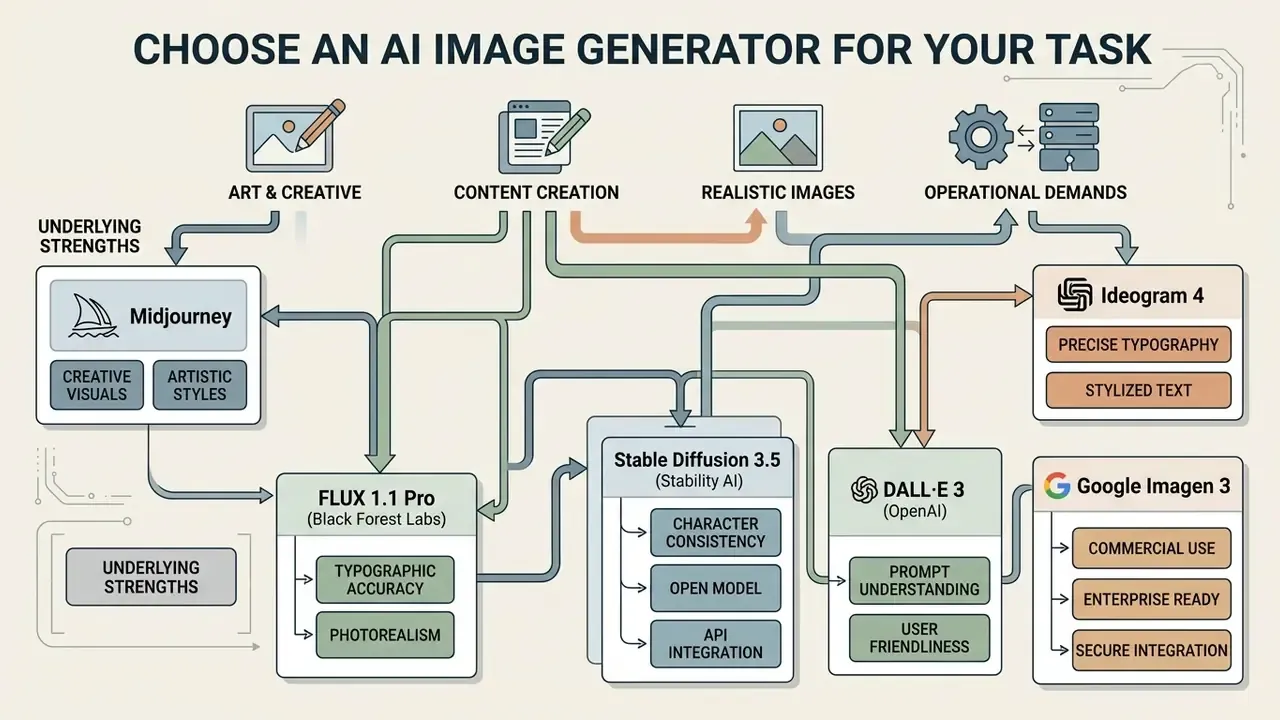
Choosing an AI image generator means matching operational demands, typographic accuracy, photorealism, character consistency, API integration, against the underlying strengths of commercial and open-weight models. Start from the constraint that cannot move: data residency, brand consistency, or rendered text.
Matching Models and Tools to Art, Content and Realistic Images
Leading AI image generator tools offer specialized capabilities for distinct enterprise visual content tasks.
MidjourneyExceptionally strong for artistic stylization, aesthetic composition, and creative concept exploration. Operates through specialized parameters like --stylize, --chaos, --cref (character reference), --sref (style reference), --oref (omni reference), --quality, and --seed. Detailed benchmark results appear in our Midjourney image generation evaluation.
FLUX 1.1 Pro (Black Forest Labs)Built on a 12-billion-parameter rectified flow transformer, delivering top-tier photorealism, human anatomical detail, pose and composition control, and fast API inference (roughly 4.5 seconds).
Ideogram 4Specializes in precise typography, graphic layout design, brand-trained custom style models, and complex text rendering inside synthetic images using structured JSON prompt inputs.
Stable Diffusion 3.5 (Stability AI)An open-weight family (2.5B-parameter Medium model on an improved MMDiT-X architecture) designed for custom fine-tuning, local deployment on consumer hardware, and data privacy compliance.
DALL·E 3 (OpenAI)Integrated into ChatGPT and the OpenAI API, with strong prompt adherence and conversational refinement. See our comparison of ChatGPT image generation against standalone tools.
Google Imagen 3Google's proprietary latent diffusion model, tuned for photorealistic compositions and long descriptive prompts inside Google Cloud infrastructure.
Quantitative benchmarks separate marketing claims from measured quality. On MS-COCO, published Fréchet Inception Distance scores put diffusion architectures well ahead of earlier autoregressive systems: Imagen 7.27, DALL·E 2 10.39, Stable Diffusion 12.63, versus 17.89 for the original autoregressive DALL·E (lower is better). Source: Text-to-image diffusion model survey, arXiv (2023).
One caveat worth stating plainly. FID measures distributional similarity, not brand fit, and it says nothing about typography accuracy or hand anatomy. Treat it as a screening metric, then validate on your own prompt set.
Organizations comparing tools for broader media creation usually examine how image generators feed animation and video pipelines built on the same conditioning principles. Teams that need to make photo animation online free for internal comms, or later merge video online into a single approved cut, should map those handoffs before signing anything. Detailed evaluation metrics live in our AI Media Comparison Matrices.
Pricing and Commercial Use: What to Check Before Using AI-Generated Images
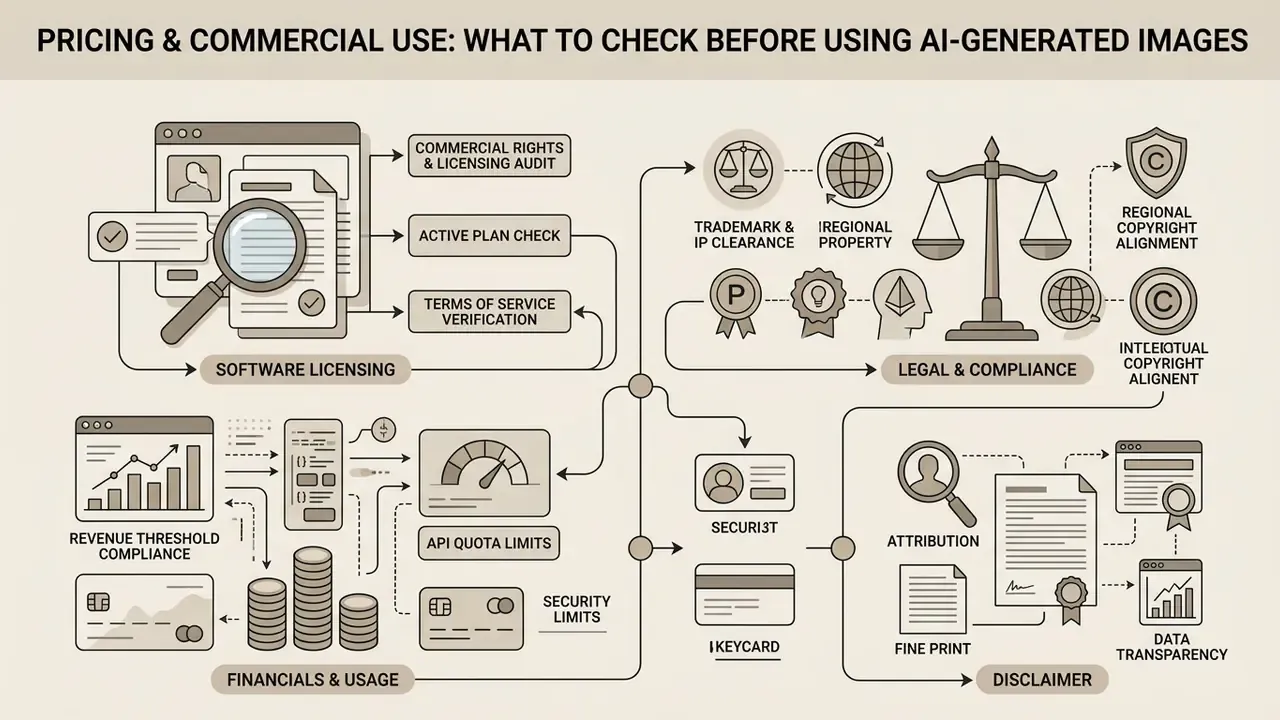
Deploying AI-generated visual content inside commercial products requires review of software licensing, intellectual property law, platform terms of service, and API usage pricing. Enterprise teams should audit usage rights before publishing synthetic assets across marketing or product surfaces, and the sequence matters: rights first, spend second.
Commercial Rights & Licensing Audit
Checklist0 / 8
Unit economics start to bite once generation moves from experimentation to production volume. Published API rates show the order of magnitude: DALL·E 3 standard quality at 1024×1024 costs $0.040 per image, while HD quality at the same resolution costs $0.080 per image. Source: OpenAI API Pricing Documentation, OpenAI (2024). https://openai.com/api/pricing/
At those rates, a campaign needing 25,000 HD renders equals roughly $2,000 in direct inference spend, before human review, retouching, or storage. That figure belongs in every build-versus-license comparison against self-hosted open-weight inference, alongside GPU amortization and the staff hours your governance controls consume. Control cost is still the line most ROI decks quietly omit.
Official Commercial and Pricing Resources (Primary Sources)
NIST AI RMF Generative AI Profile plus the 2025 GenAI Pilot Evaluation Plan for image generators, currently the official baseline for evaluating image models and managing synthetic-content risk.
Questions to Ask About Plans, Terms and Generated Content
Before committing to a commercial deployment, procurement and legal risk teams should settle three questions.
Rights inheritance when plans change: Do commercial rights to previously generated images stay with the enterprise if the tier is downgraded, canceled, or transferred? Does the provider keep any residual reuse license over inputs or outputs after termination?
«The Stability AI Community License permits free commercial use of Stable Diffusion for organizations with annual revenue under $1 million.»
Public versus private asset visibilityAre generated images and prompt histories organization-private by default, or does the platform reserve rights to publish user generations to community feeds and use inputs for retraining? Confirm whether Team and Enterprise visibility settings differ from individual plans, because they frequently do.
API rate limits and usage escalationHow are request quotas structured across enterprise tiers, requests per minute, token quotas, concurrency caps, and what overage rates apply during high-volume runs? Teams benchmarking entry-level options can start with free AI image generators without sign-up before negotiating enterprise contracts, then compare licensing patterns across our wider commercial use library.
To model expected API operating expense across scaling workloads, teams can use our interactive AI Media Calculators and review breakdowns in our AI Media Pricing Guides. Pipelines that generate at lower base resolution and finish with AI image upscaling often cut per-asset inference cost materially, sometimes by half. Organizations facing unresolved legal questions or shifting platform policy should review our AI Litigation and Case Timelines or reach the team through AI Media Support and Troubleshooting. Developers building custom workflows can consult our AI Media API Guides for integration endpoints.
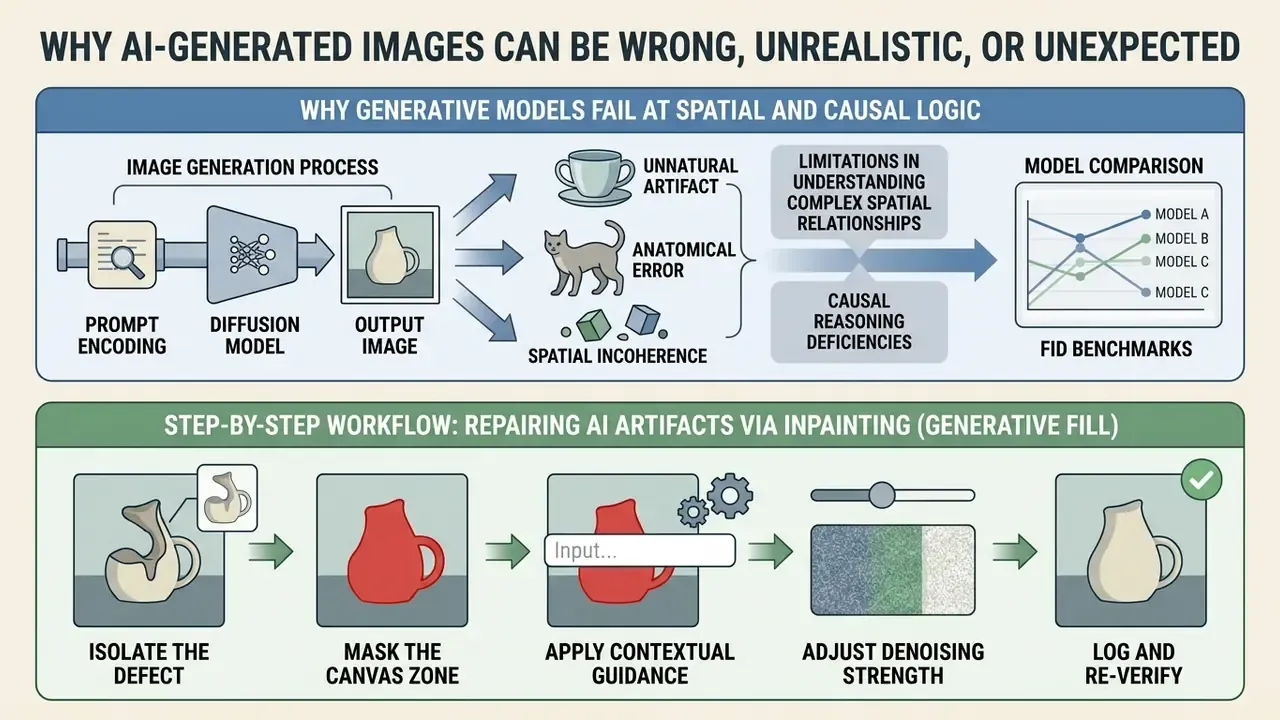
Why AI-Generated Images Can Be Wrong, Unrealistic or Unexpected
AI-generated images carry visual artifacts, anatomical distortions, and logical errors because generative models hold no physical understanding and no spatial reasoning. They operate on statistical probabilities learned from web datasets. That produces image hallucinations whenever prompts demand complex geometry, precise hand anatomy, or physically consistent lighting.
Research characterizing photorealism and artifacts in diffusion-generated images of humans, based on 749,828 annotations collected from 50,444 participants, sorted generative failures into five dimensions (Characterizing Photorealism and Artifacts in Diffusion Model-Generated Images of Humans, arXiv preprint, 2025):
Functional implausibilitiesTools, mechanisms, or everyday objects rendered without working parts, for example scissors without blades or clock faces with scrambled numerals.
Peer-reviewed work focused specifically on hands (HanDiffuser, CVPR 2024) confirms that irregular poses and wrong finger counts are systematic, measurable failures rather than random noise, and that region-conditioned regeneration is the effective remedy.
Why Generative Models Fail at Spatial and Causal Logic
Generative architectures lean on statistical co-occurrence, not deterministic spatial physics. Prompt a common visual pair, "a fork on top of a plate", and the model succeeds because millions of training examples reinforce that layout.
Invert the relationship, "a plate on top of a fork" or "a horse riding an astronaut", and the network usually reverts to the statistical majority: a fork on a plate, an astronaut on a horse. Lacking any 3D causal world representation, it cannot separate spatial prepositions from object semantics. Structural compositional failure follows.
«It seems like these models are capturing a lot of correlations in the datasets they're trained on, but they're not actually capturing the underlying causal mechanisms of the world.»
The same limitation explains degradation on long, multi-object prompts. Describe one object to the right of another, a third in the foreground, and a fourth airborne, and a single fixed-compute model typically satisfies one or two constraints at best. Splitting such prompts across composed specialized models, or decomposing them into staged generation plus inpainting passes, is the practical mitigation.
Step-by-Step Workflow: Repairing AI Artifacts via Inpainting (Generative Fill)
When an inference pass produces minor anatomical errors, a six-fingered hand, mismatched earrings, a garbled sign, regenerating the whole image destroys the composition you already liked. Use targeted repair instead.
Isolate the defect Load the synthetic asset into an editor that supports localized inpainting, for example Photoshop Generative Fill, Midjourney Vary Region, Canva Magic Eraser, or Stable Diffusion Inpainting. Lightweight desktop options such as microsoft photo editor tools handle simpler cleanup passes.
Mask the canvas zone Draw a tight boundary around only the distorted pixels, for instance the hand array, leaving surrounding lighting, skin tone, and background untouched.
Apply contextual guidance Give a minimal localized prompt describing only the masked element, such as "a human hand with five anatomical fingers, realistic knuckles, matching skin tone".
Adjust denoising strength Set strength between 0.6 and 0.85. Lower values preserve structural geometry. Higher values let the U-Net or DiT synthesize fresh anatomy.
Log and re-verify Record the mask coordinates, localized prompt, and denoising value in the reproducibility audit trail, then inspect edge blending at 100% zoom before approval.
For mission-critical applications, teams mitigate errors through regional inpainting, higher sampling step counts, negative prompt filtering, and iterative refinement passes. Two-stage "diagnose then treat" pipelines published in 2025 formalize the pattern. An inspection model first classifies shape distortions, implausible content, and stray watermarks or text. A second pass then regenerates only the flagged regions. Verification gates should pair this with automated AI image detection tools, while cosmetic recovery of weak source assets belongs in AI image enhancement workflows. Where the corrected still later becomes motion content, keep the same audit fields flowing through your microsoft video editor or equivalent finishing stage.
In specialized fields such as medical imaging, models trained on small datasets carry elevated memorization risk. Comparative research on curated corpora, including BRATS20/21 MRI volumes and chest X-ray datasets, found diffusion models reproducing training scans with higher correlation than StyleGAN. Deduplication, dataset-scale checks, and rigorous validation are not optional there.
Mitigation should tie to explicit risk-acceptance thresholds. Define the maximum tolerable artifact rate per asset class, sample outputs at that rate during validation, and escalate when observed defect frequency breaches the limit. One honest caveat: there is no industry consensus yet on what that tolerable rate should be for customer-facing financial communications. Set it internally, document the reasoning, and revisit quarterly.
FAQ: How AI Generates Images
Does an AI image generator copy pictures from the internet?
No. It samples new pixel arrays from a learned probability distribution. Individual training images are usually not recoverable from web-scale models, though memorization risk climbs sharply on small or heavily duplicated datasets.
How does AI create an image from just a sentence?
The sentence becomes a numerical conditioning vector. Cross-attention layers then use that vector to guide iterative denoising, so how AI makes images comes down to steering noise removal with encoded text.
Can I own the copyright to an AI-generated image?
In the United States, the Copyright Office protects original human authorship and excludes more-than-de-minimis AI-generated material from registration. Ownership of the file under a platform's terms is a separate question from copyrightability under statute. Verify both.
Why does the same prompt produce different images each time?
Because the initial noise tensor xT is randomly sampled. Fixing the seed pins that starting noise and makes the run reproducible.
How do AI models generate images differently from one another?
Diffusion and flow-matching models denoise iteratively. GANs generate in a single adversarial pass. VAEs decode from compressed latents. Those mechanics explain most quality and speed differences.
Which architecture should regulated teams prefer?
Diffusion or flow-matching models for quality, deployed as open weights where data residency and zero retention are mandatory, with a full reproducibility log per generation.
How many sampling steps are enough?
Typically 20 to 50 for modern schedulers. Past the scheduler's saturation point, added steps raise cost without measurable detail gain.
Additional Media Production Guides and Comparative Benchmarks
This guide is maintained by our AI Media Governance & Model Risk editorial group. Technical explanations cite primary research and official vendor documentation, linked inline. The validation reviews, agency audit, and campaign scenarios described here are composite, hypothetical illustrations built for risk-management education. They do not describe a specific named client engagement and should not be read as performance guarantees. Marcus Hale, author. Pricing, licensing, and regulatory statements reflect publicly available documentation as of the last update and need independent verification before commercial reliance.
Hub Navigation
Explore technical terminology, model validation frameworks, and enterprise AI compliance terms in our central glossary.