Commercial generative AI workflows need one distinction up front: unregulated artistic rendering on one side, risk-managed synthetic media on the other. Evaluating a deepfake AI image generator for enterprise deployment therefore depends on four things at once, which are visual fidelity, auditability, license transparency, and explicit data governance. Miss any one of them and the asset becomes a liability the week after launch.
Executive Summary for CRO, CCO and Model Risk Leaders
- Definition drives obligation.A tool becomes a "deepfake system" the moment output appreciably resembles a real, identifiable person, not when it produces art. Four cumulative conditions apply: AI-created, image/audio/video format, visible resemblance to real entities, and perceived authenticity. Classification determines whether EU AI Act Article 50 labeling duties and biometric consent rules attach.
- Free tiers are a governance liability, not a cost saving.Non-commercial licenses, forced public galleries, watermarks, default training on uploads, and absent data-retention guarantees make zero-cost tiers unsuitable for regulated campaigns. Paid enterprise tiers buy indemnification, opt-out of training, SOC 2 controls, and machine-readable provenance.
- Detection is unreliable in both directions.Humans classify AI imagery correctly only ~63% of the time, and open-source detectors catch modern commercial generators in only 18–30% of zero-shot cases. Provenance (C2PA / SynthID) and internal logging, not detection, are the defensible controls.
- Audit trail is the deliverable.Every production run should log prompt text, seed, model version, reference-image consent artifact, editing steps, and export hash into the corporate AI model inventory. Without that record, a compliant image is indistinguishable from an unauthorized one.
- Disclosure has a measurable commercial cost, so plan for it.AI-generated display creative can beat stock photography on click-through rate, but explicit AI disclosure reduced CTR by 31.5% in field testing. Budget for disclosure as a fixed condition, not an optional variable.
Where This Decision Sits in Your Control Stack
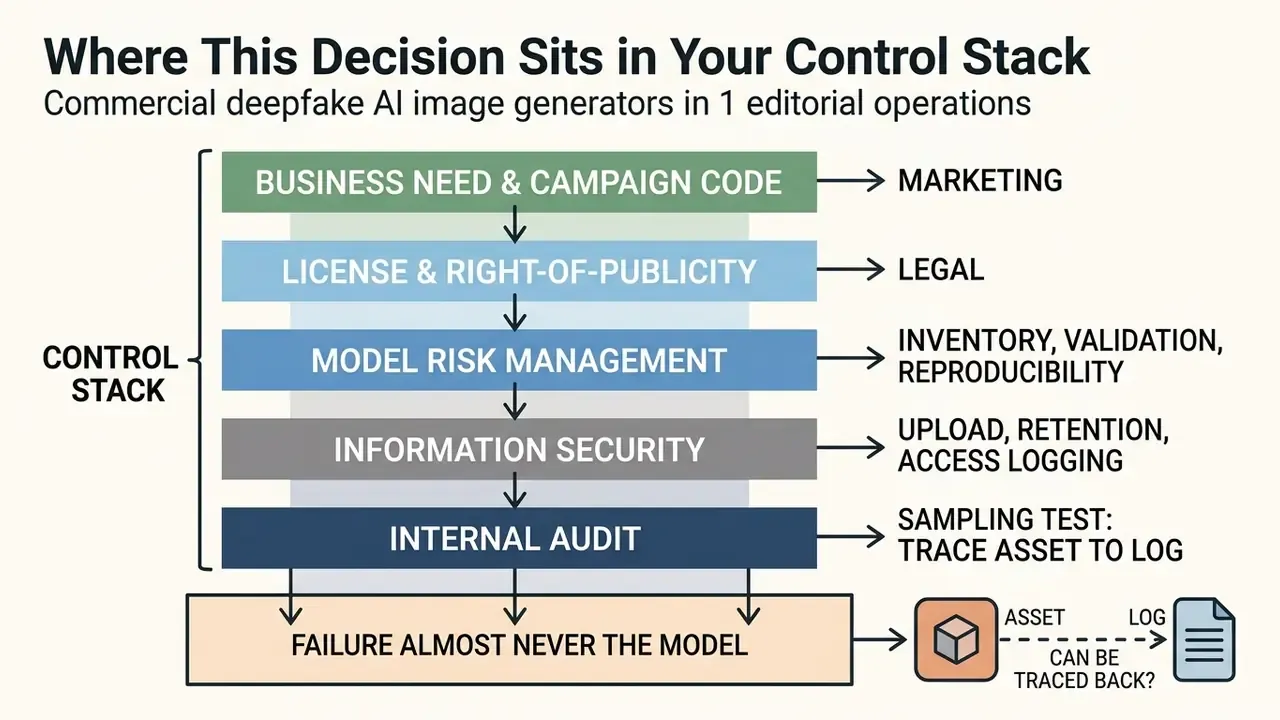
Before the tooling debate starts, settle ownership. A deepfake image pipeline touches at least five functions, and in most institutions nobody has written down who signs off.
- Marketing or communications owns the business need and the campaign code.
- Legal owns the license read, right-of-publicity exposure, and disclosure wording.
- Model risk management owns inventory entry, validation scope, and reproducibility evidence.
- Information security owns upload paths, retention terms, and access logging for biometric-adjacent files.
- Internal audit owns the sampling test: can a published asset be traced back to a logged run?
One practical note from reviewing these workflows: the failure is almost never the model. It is the missing consent file, or a seed nobody recorded. Small gaps, expensive consequences.
What a Deepfake AI Image Generator Is and What Images It Produces
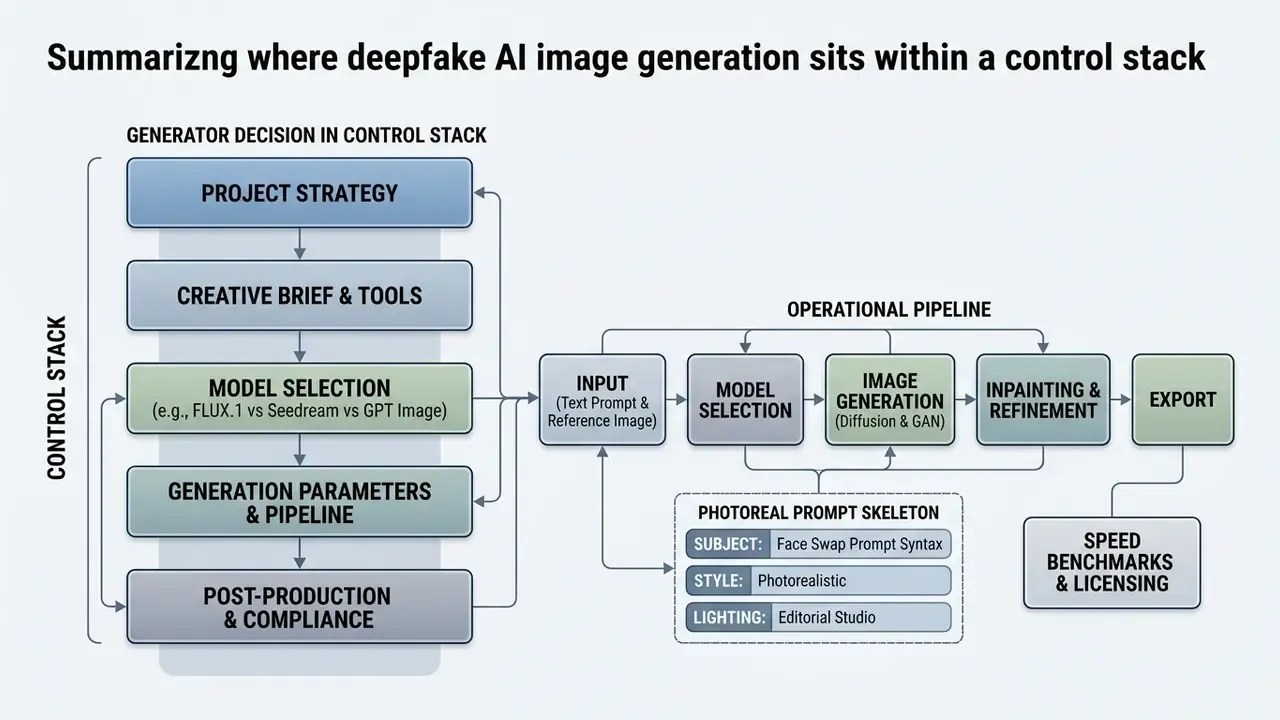
These systems operate across two primary modes: text-to-image synthesis from scratch, and image-to-image transformation of uploaded files. INTERPOL's 2024 assessment describes diffusion models as gradually transitioning between data distributions, which is precisely what enables picture-to-picture transformation at photographic quality. Pure visual art or imaginary concept images fall outside strict impersonation rules. But any AI image generator output depicting identifiable human traits triggers heightened model risk and compliance oversight (EU AI Act Recital 134, 2025).
Research literature classifies the visual output of these pipelines into three operational buckets rather than one undifferentiated "deepfake" class: fully AI-generated imagery (GAN or diffusion), face-swapped deepfakes built on a real target frame, and unmodified real photographs. That taxonomy matters for governance. A synthetic stock-style model face and a swapped executive portrait carry entirely different consent requirements, even when both come out of the same interface, on the same afternoon, from the same operator.
Figure 1. How the generator works: operational pipeline of a deepfake AI image generator
Text recap for accessibility: data moves from input, through model and style selection, into generation, then local editing, and finally into a compliant file export carrying provenance metadata.
- Input
- text prompt or reference image.
- Model selection
- choose AI models and image style (diffusion, GAN, or hybrid).
- Generation
- processing the text description through conditioned latent diffusion.
- Editing and refinement
- prompt embedding tweaks plus identity retention passes.
- Export
- aspect ratio adjustment, higher resolution scaling, watermark and provenance embedding.
Text-to-Image Generation from a Text Description
Text-to-image generation translates a text prompt into visual output by conditioning latent diffusion models through multimodal embeddings. Formulating precise simple text prompts or complex text description blocks requires structured parameters, placing subject, environment, camera angle, and lighting in explicit sequence. Current vendor prompting documentation specifies a stable order (background/scene → subject → key details → constraints) and notes that photography language such as lens, framing, pores, fabric wear and imperfections steers realism more reliably than generic quality tags like "8K" or "ultra-detailed" (OpenAI image prompting guide, current edition, 2026).
Selecting an appropriate image style or distinct art styles lets teams direct the model toward photorealism, vector design, or synthetic ai art without rebuilding the core prompt architecture.
"Direct manipulation of the prompt embedding lets users optimize style metrics and navigate image space without manual text editing; participants preferred this to traditional prompt engineering."
Reusable photoreal prompt skeleton:
[Scene] Sunlit corporate atrium, glass and pale concrete, shallow depth of field.
[Subject] A 40-year-old female analyst in a navy blazer, seated, three-quarter view.
[Detail] 85mm lens, f/2.0, soft window light from camera left, visible skin pores,
slight fabric creases, natural catchlights in both eyes.
[Constraints] No text overlays, no logos, no extra hands, aspect ratio 3:2, neutral color grade.
Keep that skeleton in a versioned prompt library rather than in a designer's notes app. Prompts drift, and undocumented drift is the quiet start of an audit finding.
Photo Transformation and Working with a Reference Image
Image-to-image synthesis uses a reference image or reference photo to guide composition, lighting, and facial geometry. In a swap operation, the reference supplies identity features while the target frame supplies structure, meaning pose, expression, background, and scene context. Success is measured as identity retention plus artifact-free output. When executing identity preservation, specialized loss functions maintain key facial traits from the ai photo while adapting background context and pose (DiffSwap, CVPR 2023, which frames face swapping as a masked diffusion/inpainting task).
Newer methods encode reference faces as multi-level feature maps rather than single embeddings, which is what preserves fine identity markers such as scars, tattoos, and jawline geometry. Enterprise operators must ensure that uploading a reference photo maintains strict data lineage, so source pixels stay protected against unauthorized training reuse. Teams comparing dedicated transformation engines can review specialized image-to-image generators before standardizing a pipeline.
Step-by-Step Face Swap Syntax (Image-to-Image)
Most commercial interfaces now accept a natural-language swap instruction across two uploaded slots. The syntax below is the minimum viable command structure. The second template adds the invariant list that prevents drift across iterations.
- Upload the base scene as
Image_1. This frame defines pose, lighting and background. - Upload the donor portrait as
Image_2: neutral lighting, front-facing, high eye-to-eye resolution. - Enter the transformation command.
Template A, minimal swap:
[Mode: Face Swap] Replace the face in Image_1 with the person in Image_2.
Keep the original lighting, head yaw/pitch and background environment of Image_1.
Carry over skin texture and facial expression from Image_2.
Template B, controlled swap with invariants (recommended for production):
[Mode: Face Swap] Replace only the facial region in Image_1 with the identity in Image_2.
Preserve: camera angle, focal length look, hairline, neck and ear geometry, garment,
shadow direction, background objects, color grade.
Change: facial identity only.
Reject: warped ears, mismatched skin tone at the jaw seam, duplicated eyebrows,
plastic skin smoothing.
Reference strength: 0.75. Seed: 4417 (fixed for reproducibility).
Repeating the "Preserve" list on every iteration is the documented method for reducing identity and layout drift during multi-pass editing. Log the seed value with the run. Without it, a swap cannot be reproduced for audit, and an irreproducible swap is, in practice, an undocumented one.
What Teams Use an AI Deepfake Picture Generator For
| Production stage | Traditional photoshoot | Generative AI pipeline | Governance overhead introduced by AI |
|---|---|---|---|
| Concepting / moodboard | 2–5 business days, agency briefing | 15–60 minutes, prompt iteration | Prompt library versioning |
| Talent & rights clearance | 3–10 business days, model release | Minutes (synthetic) or consent capture (real likeness) | Consent artifact storage, right-of-publicity check |
| Shoot / render | 1–2 days on set, crew and location | 8–15 seconds per batch of 4 frames | Seed and model-version logging |
| Retouch / variants | 2–4 days per variant set | Minutes per variant via inpainting | Edit-step log, denoising parameters |
| Localization variants | New shoot or heavy retouch | Same prompt, new aspect ratio and text layer | Per-market disclosure labeling |
| Compliance review | Standard ad clearance | Standard clearance plus AI Act Art. 50 labeling, biometric review | Additional legal review cycle |
The bottom-right column is the part most ROI models omit. Model governance overhead, meaning consent files, provenance verification, labeling QA and inventory entries, is a recurring operating cost that partially offsets the production saving. It also scales with the number of real identities involved, which is the variable finance teams tend to discover late.
Creative Projects, AI Art and Concept Imagery
Capabilities of an AI Deepfake Photo Generator: Models, Styles and Editing
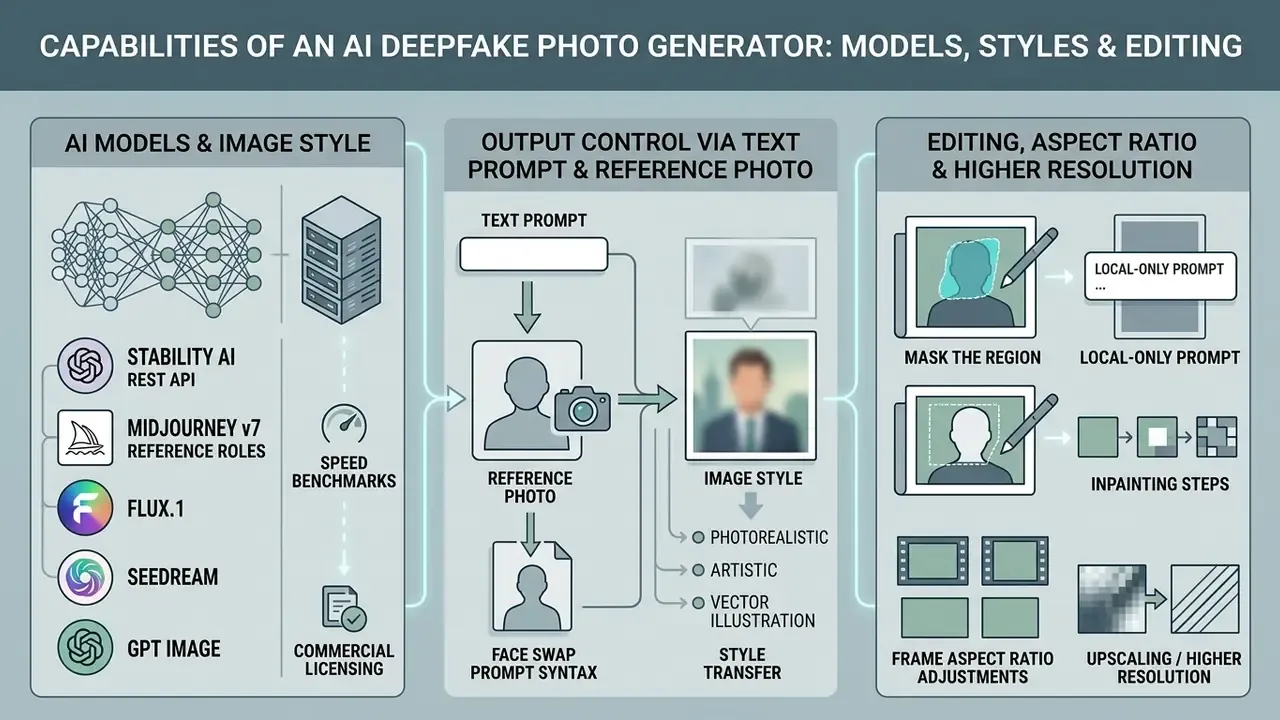
An ai deepfake photo generator offers advanced control mechanisms, including specialized generative architectures, frame aspect ratio adjustments, and granular inpainting options. Understanding these technical controls is essential for brand safety and visual fidelity. For risk functions, it is also how you know which parameters must be captured in an audit record.
Choosing AI Models and Image Style
Selecting between various ai models and underlying generation models directly influences photorealism, face retention, and rendering speed. Open-weight models like FLUX.1 emphasize texture detail and lighting precision, whereas specialized GAN architectures excel at localized facial attribute edits (Black Forest Labs documentation, current edition; StyleGAN3 review).
"Würstchen required 24,602 A100 GPU hours versus 200,000 for Stable Diffusion 2.1 and runs roughly twice as fast at comparable image quality."
That gap is the real procurement variable. Architecture choice changes inference cost per asset by an order of magnitude, not just aesthetics.
Commercial model map, 2025–2026
| Model / engine | Strengths | Commercial-use constraints | Recommended intent |
|---|---|---|---|
| FLUX.1 (Black Forest Labs) | Superior skin texture, accurate lighting transport, strong open-weight control | Needs dedicated GPU infrastructure; license varies by variant (Schnell/Dev/Pro) | Product and commercial-grade photography |
| Seedream 4.5 / 5.0 Pro | High facial detail, built-in interactive inpainting, fast iteration | Credit-metered access, closed weights, resolution caps on lower tiers | Rapid prototyping, ad creative variants |
| Nano Banana (Gemini 2.5 Flash Image) | Strong multi-component prompt comprehension, broad aspect-ratio support | Access via Google Cloud / partner integrations; provenance marking applied | Complex compositional scenes, editing chains |
| GPT Image 2.5 / DALL·E lineage | Best-in-class in-image text rendering, arbitrary WIDTHxHEIGHT output | Strict content filters; sizes must be divisible by 16 | Marketing banners with typography |
| StyleGAN3 and face-specific GANs | Precise localized facial attribute edits, low-latency inference | Narrow domain, requires trained checkpoints per identity class | Attribute-level portrait editing |
| Stable Diffusion 3.5 family | Mature tooling, strength control for image-to-image, self-host option | Self-hosting shifts full compliance burden in-house | Controlled on-premise pipelines |
Teams must match the desired image style, whether hyper-realistic photography or stylized graphics, with the strengths of the specific model family. For portrait-specific workloads, review dedicated AI headshot generators rather than forcing a general-purpose engine into identity work. Compare hosted options such as Google's image generation stack and the ChatGPT picture generator on licensing terms, not only on output samples.
A note on platform independence, since it shapes risk appetite. Standardizing on a single closed engine is fast, but it concentrates exposure: one terms-of-service change can strand a campaign library. Two approved engines, one hosted and one self-hosted, tends to be the pragmatic compromise.
Controlling Output via Text Prompt and Reference Photo
Combining a structured text prompt with a high-resolution reference photo gives tight control over scene composition and subject identity. System parameters like reference strength dictate how strongly the output follows the uploaded image versus the text guidance.
Concrete parameter anchors from current vendor documentation:
Using fixed prompt ordering, defining background, subject, lighting and invariants in sequence, prevents identity drift across iterative generation runs.
- Stability AI REST API
- image-to-image
strengthruns 0–1, where 0 returns the input unchanged and 1 ignores it; the documented default is 0.35, with SD 3.5 Flash performing best at 0.94–0.97. - Midjourney v7
- images default to 1:1;
--arsets the frame, style reference weight--swaccepts 0–1000 (default 100), and omni reference--owaccepts 1–1000 (default 100), with values above 400 documented as unpredictable unless stylize is very high. Parameter behavior differs from diffusion APIs, which is why cross-tool comparisons should run on the same brief. See the Midjourney generator evaluation. - Reference roles
- composition reference defines layout and spatial arrangement, style reference governs visual treatment, and the text prompt should carry subject matter. Mixing these roles in one field is the most common cause of unstable output.
Editing, Aspect Ratio and Higher Resolution
Post-generation editing relies on mask-based inpainting, pixel-level refinement, and latent upscaling to deliver commercial-grade files. Teams that finish assets outside the generator should pair the pipeline with a dedicated AI photo editor or a conventional online photo editor for typography and layout passes.
Interactive inpainting algorithm (local defect repair, garment swap, artifact removal):
Example: Anatomically correct human hand, five fingers, relaxed pose, natural skin texture, soft directional light matching the scene.
Research supports the layered approach. ICCV 2025 work on ultra-high-resolution inpainting uses patch-based content consistency to hold local detail during fill-in, and NeurIPS 2025 "PixPerfect" reports pixel-level refinement for seamless local editing across inpainting, removal and insertion.
Operators can adjust the aspect ratio to match destination platform requirements without cropping key subjects. Gemini image generation documents support for 1:1, 3:2, 2:3, 3:4, 4:3, 4:5, 5:4, 9:16, 16:9 and 21:9, and can default to the input image's dimensions. OpenAI's gpt-image-2 editing endpoint accepts arbitrary WIDTHxHEIGHT values provided both sides are divisible by 16, alongside auto, 1024x1024, 1536x1024 and 1024x1536. Together AI documents model-dependent behavior: FLUX Schnell and Kontext take aspect_ratio, while FLUX.1 Pro/Dev take explicit width and height.
Latent diffusion upscaling produces a higher resolution export, preserving fine skin textures, edge sharpness, and overall visual fidelity. Adobe's documented path is three steps: open the file, run Generative Upscale at 2x or 4x (or Super Resolution in Lightroom/Camera Raw, which yields 2x width and 2x height for 4x total pixels), then save the result as a new document or DNG. A 2025 review notes that diffusion methods now outperform specialized GAN and regression techniques on both inpainting and upsampling, but warns that latent inpainting must project back to pixel space, which itself introduces a resolution step that can alter source pixels.
For deeper technical reviews of image manipulation systems, open the hub to review standard feature sets, or read ai image tools news to monitor recent vendor updates.
How to Choose the Best Deepfake AI Image Generator
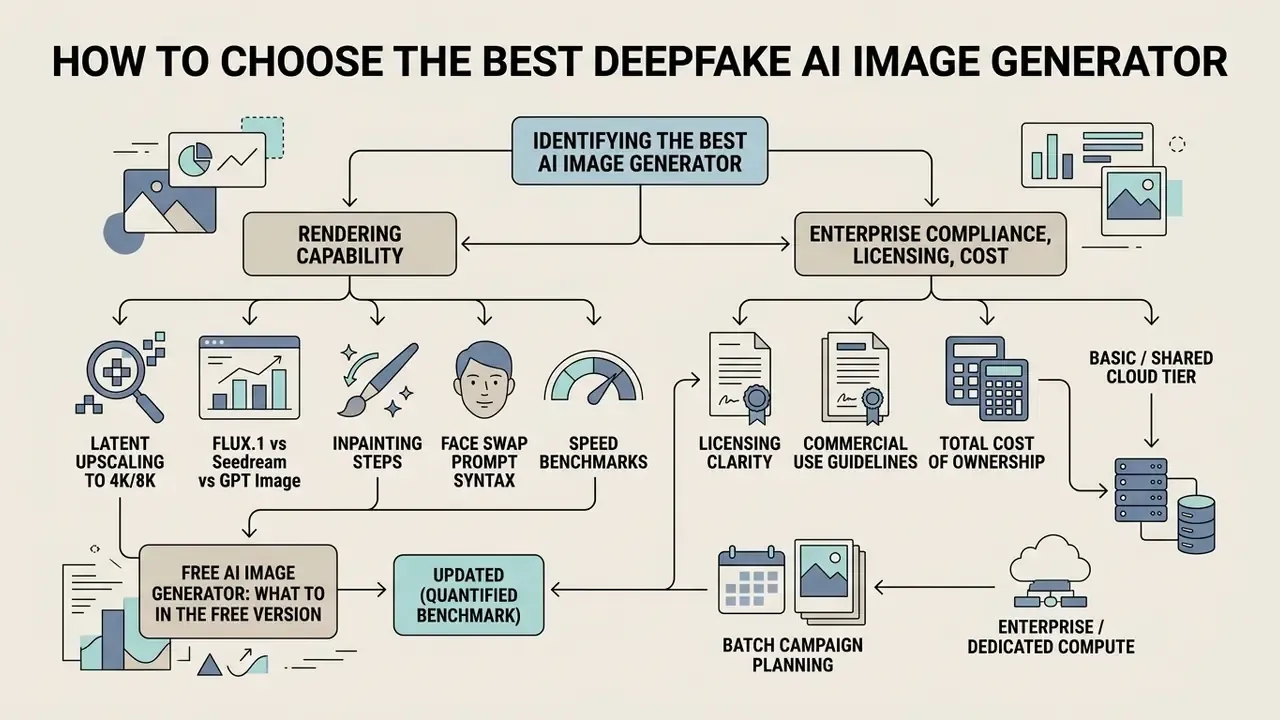
Identifying the best ai image generator means weighing rendering capability against enterprise compliance, licensing clarity, and total cost of ownership. Organizations must audit candidate ai tools for model transparency, data retention policies, and commercial usage rights.
Naming in this market is messy, which matters for procurement searches. The same class of product is sold as an ai deepfake generator photo feature, a deep fake ai photo generator, an ai image deepfake generator, an ai image generator deepfake mode, an ai deep fake photo generator, or a deepfake ai art generator module inside a broader creative suite. Feature parity varies far more than the labels suggest, so compare documented controls rather than product names.
| Evaluation criterion | Free option / basic tier | Commercial / enterprise tier | Model risk & governance requirement |
|---|---|---|---|
| Text prompt & style control | Basic text parsing, standard presets | Custom prompt embeddings, advanced style tuning | Reproducible seed logging and prompt versioning |
| Reference image handling | Public gallery storage, transient cache | Private storage, zero training retention | Explicit consent documentation and data lineage |
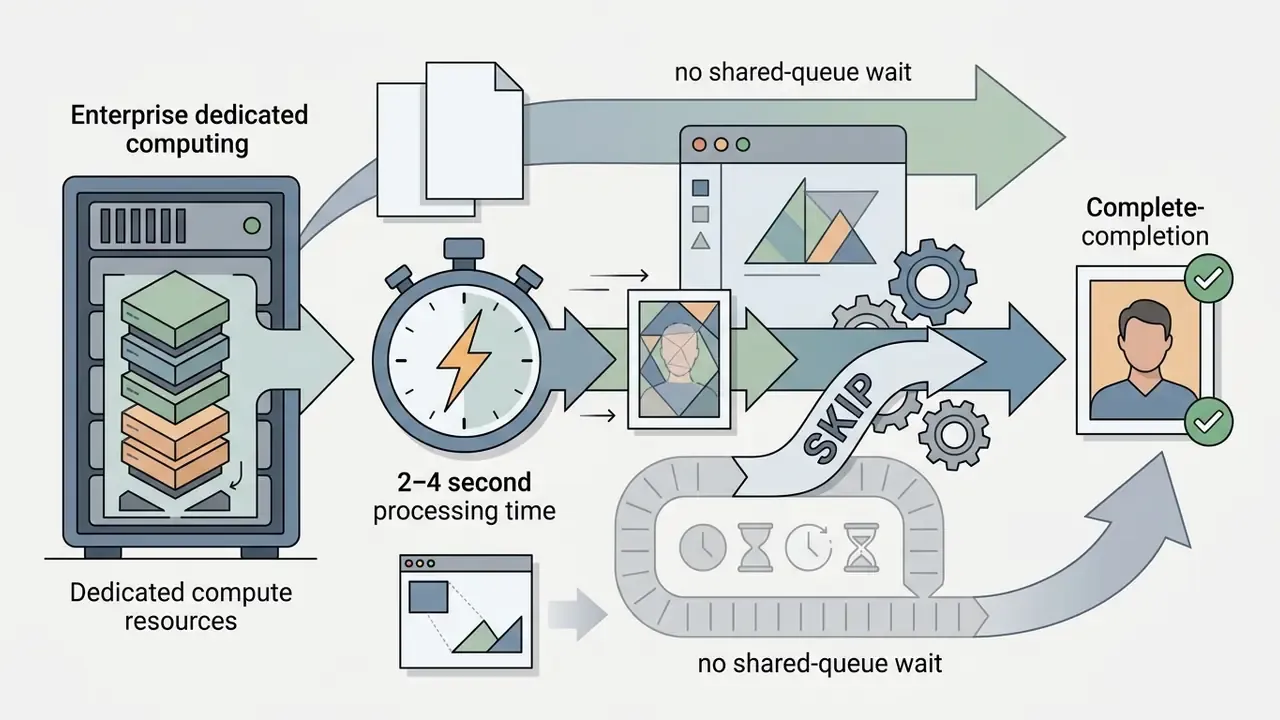
| AI models & generation | Shared public queue, standard diffusion | Dedicated compute, choice of FLUX / GPT Image / Seedream / GAN | Model inventory tracking and vulnerability checks |
| Resolution & higher res | Capped at 1024×1024, visible watermark | Uncapped 4K/8K upscale, clean exports | Machine-readable provenance (C2PA / SynthID) |
| Commercial use rights | Personal / non-commercial only | Full commercial exploitation rights | Verified IP indemnity and indemnification terms |
| Privacy & security | Default data scraping enabled | Opt-out of model training, SOC 2 certified | Encryption at rest/in transit, strict access control |
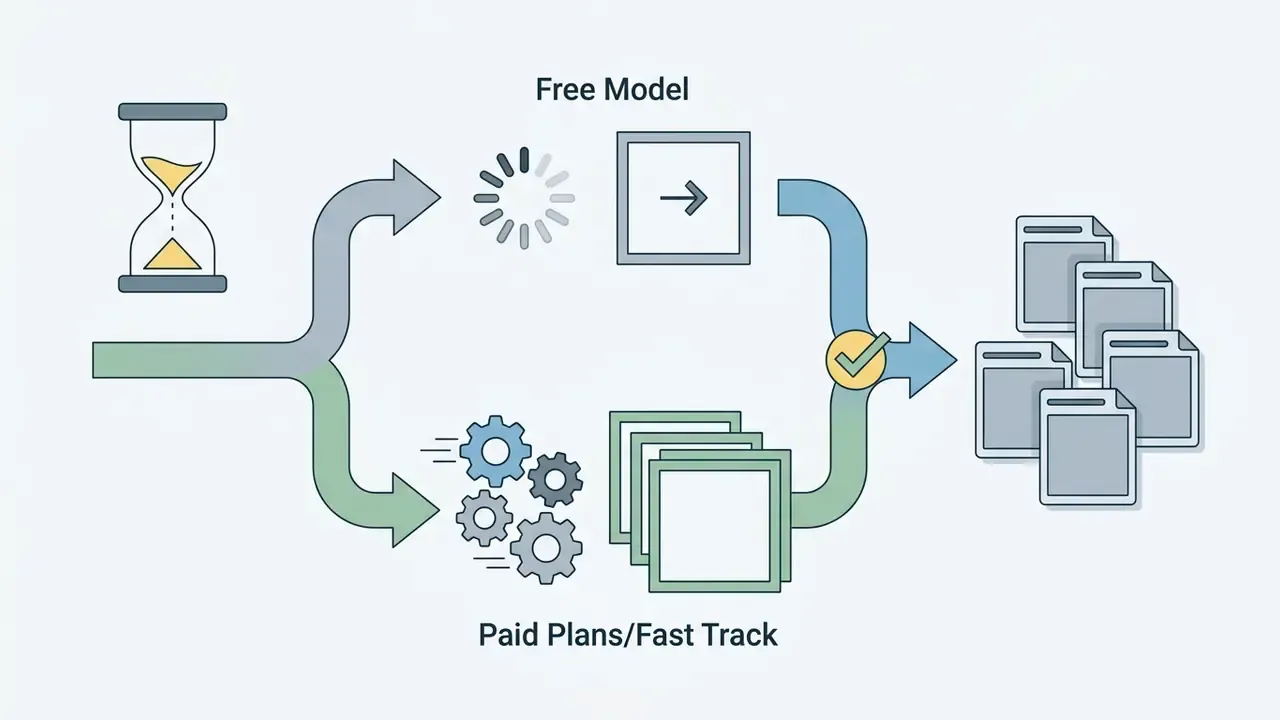
| Latency & throughput | Shared queue, throttling on anonymous tiers | Priority or dedicated inference | Capacity planning and campaign SLA evidence |
No matching rows Clear one or more filters to restore the matrix.
Audience perception belongs in the selection matrix as much as feature depth:
"Across 287,000 ratings from 12,500 participants, people correctly classified AI-generated images only 63% of the time, marginally above chance."
Two consequences follow. First, realism is no longer a differentiator worth a premium at the top of the market, since most frontier models clear the human-perception threshold. Second, because the audience cannot reliably tell, the burden shifts entirely to the disclosure and provenance controls the buyer configures. Teams that want a broader shortlist can compare options across the site before narrowing to two engines.
Free AI Image Generator: What to Check in the Free Version
Evaluating a free ai image generator or an ai deepfake image generator free offering requires scrutiny of the underlying service terms. Many zero-cost tiers impose restrictive non-commercial licenses, enforce forced public gallery publishing, or inject visible watermarks. Documented examples: Craiyon's free tier caps output at 256 px and adds a visible watermark; Leonardo AI's free generations are publicly visible in the community gallery, with private generation reserved for paid plans; Recraft's free plan is explicitly non-commercial while paid plans grant commercial rights; ZSky's free tier stamps a "MADE WITH zsky.ai" wordmark removed only on paid plans.
Organizations hunting for a deepfake ai image generator free solution, or a deepfake ai generator photo free option, must verify whether uploaded reference assets are retained for public model re-training. Anonymous access also carries throughput penalties. One 2025 survey documented guest-use caps on Bing Image Creator and 15-second throttling on an anonymous tier; see the Bing AI image access and terms guide for current conditions, and the overview of free AI image generators without sign-up for tools that publish their limits openly.
Audience trust is a second, less visible cost of free-tier output:
"Skepticism drives ambivalence more strongly for commercial advertising than for non-commercial AI art; perceived appropriateness and novelty reduce skepticism."
Watermarked, low-resolution, publicly galleried output amplifies exactly the cues that trigger that skepticism in a paid-media context. Free is rarely free.
Quality, Speed and Output Control
"Contemporary commercial generators, Flux Dev, Firefly v4 and Midjourney v7, are caught by open-source detectors at only 18–30% mean accuracy in zero-shot settings."
Inference speed benchmarks (planning reference):
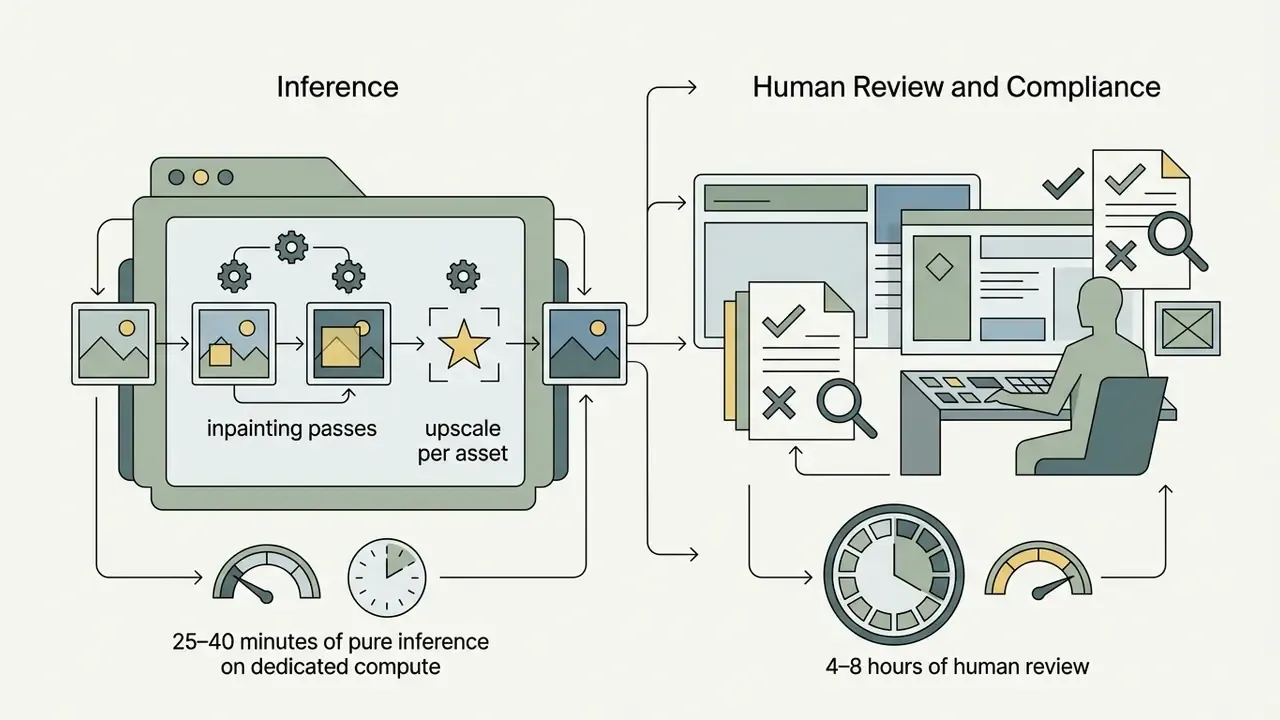
That last ratio deserves a second read. Compute is no longer the bottleneck; review capacity is.
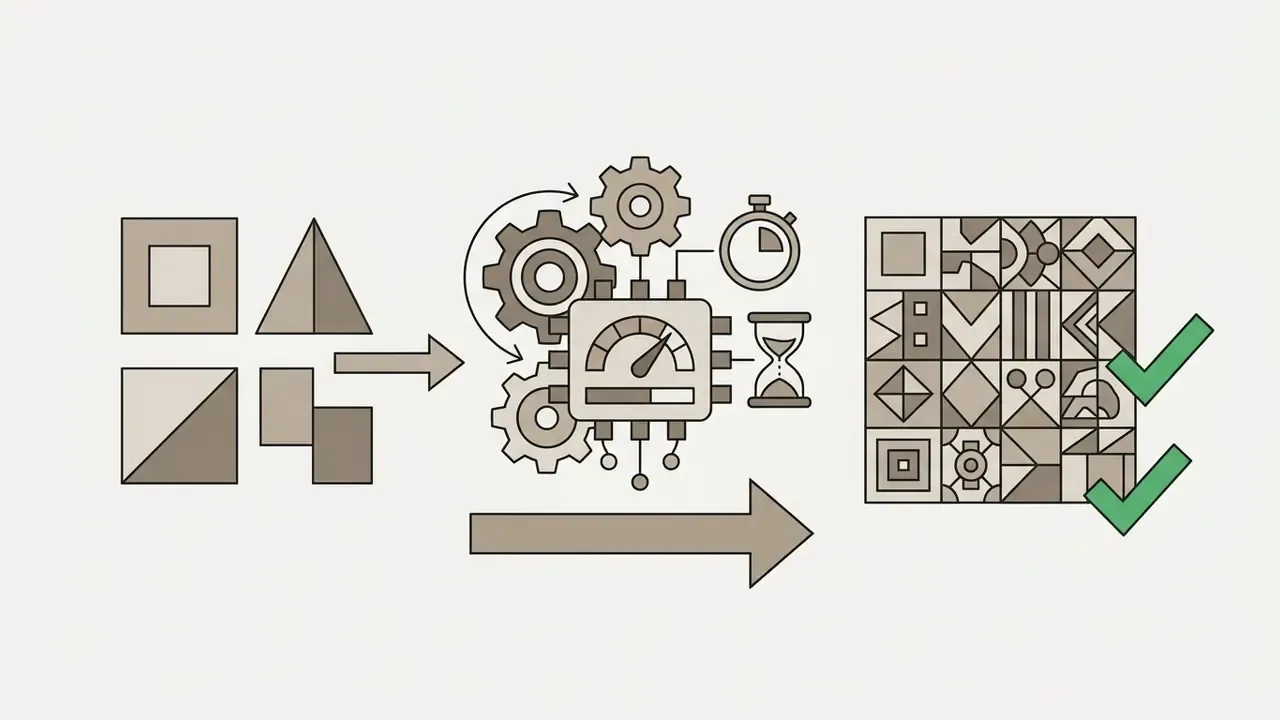
Combining advanced ai rendering with fast inference latency lets creative teams generate and refine high-volume assets efficiently, and the pipeline uses advanced diffusion sampling to keep texture intact under batch load. Because detection is weak, verification workflows should rely on provenance metadata first and statistical AI image detectors only as a secondary signal.
When comparing enterprise platform choices, teams can compare options across generative suites, or examine ai image upscaler tools to enhance legacy asset resolution.
How to Create an Image in an AI Deepfake Generator
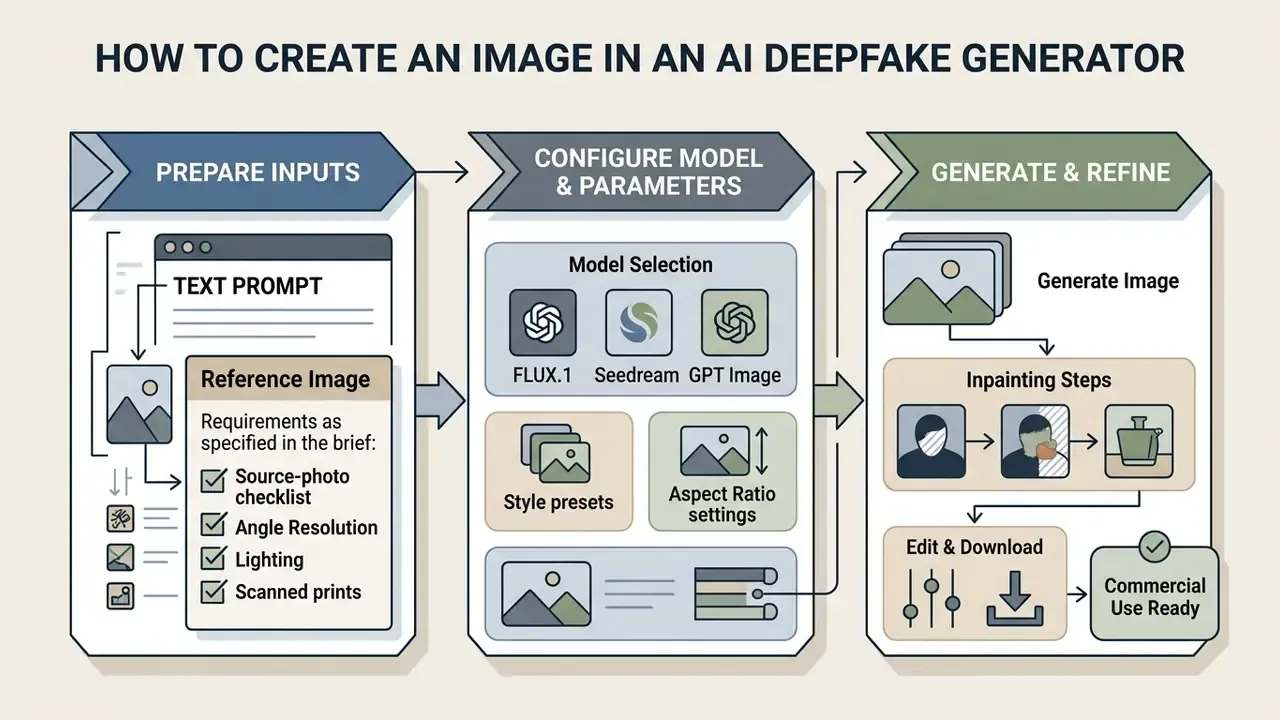
Executing a controlled run inside an ai deepfake generator image interface follows a standardized, auditable sequence. Sticking to the workflow minimizes operational drift and keeps output quality inside enterprise benchmarks.
Prepare the Text Prompt or Reference Image
Define the visual goal by drafting a detailed text description, or by selecting a clean, well-lit reference photo.
Updated (specified source-photo checklist). Reference portraits should meet documented facial-image capture standards rather than an unnamed guideline:
Before generation, confirm the labeling obligation attached to the output:
- Angle
- front-facing, within ±5° of roll, pitch and yaw (ICAO portrait guidance limits the camera-to-face-center line to ±5° horizontally; NIST and FISWG guidance apply the same tolerance to all three axes).
- Resolution
- at least 60 pixels between the eye centers (ISO/IEC-derived guidance cited by ENFSI), with the face clearly visible and in focus.
- Lighting
- evenly distributed, no cast shadows, no glare or flash reflection, particularly on eyewear (GOV.UK and Dutch passport-photo specifications).
- Scanned prints
- 600 DPI at 1:1 for forensic-grade reference scans; 400 DPI minimum per Dutch photo specification.
"Article 50(4) of the EU AI Act requires disclosure of artificial origin where content constitutes a deepfake, while Article 50(2) requires machine-readable marking of all generative output."
Configure Model, Style and Aspect Ratio
Select the generation model calibrated for your target medium, such as a photorealistic diffusion checkpoint or an artistic GAN module. Configure the aspect ratio parameter (for example --ar 16:9) and calibrate the reference influence slider to balance text prompt instructions against source image structure. For risk functions these are not cosmetic settings: model identifier, checkpoint version, aspect ratio, reference strength and seed are the five fields that make a run reproducible during an audit. Design-suite pipelines behave differently from raw APIs, so compare the constraints documented for the Canva AI generator before assuming parameter parity.
Generate, Edit and Download the Image
Click generate to process the latent diffusion run, then inspect the raw output for structural anomalies. Apply localized inpainting or ai image replacer workflows to correct minor defects, run a generative upscale step to increase image resolution to target dimensions, and download the finalized file with embedded provenance metadata. Where the destination canvas differs from the render ratio, expand rather than crop: AI outpainting tools preserve subject framing while filling new background area.
Archive the Audit Trail
The final step is evidentiary, not creative. Before the asset enters a campaign queue, write the following record into the corporate AI model inventory or asset register:
Store this bundle in a system with immutable logging. Reconstructing it after publication is materially harder than capturing it at generation time, and an unreconstructable asset is, from a model-risk perspective, an unapproved asset. The same register is the primary defense against shadow AI, meaning employees generating identity-bearing imagery on personal accounts outside any governance perimeter. Practical controls are network-level blocking of unapproved generators, a published approved-tools list, and periodic sampling of published creative against inventory records.
Generation checklist (each step must be visible in the run record):
- Run identity timestamp, requesting user ID, business owner, campaign code.
- Model provenance platform, model name and version, hosting mode (shared / dedicated / self-hosted).
- Reproducibility set full prompt text, negative prompt, seed, reference strength, aspect ratio, denoising values for each inpainting pass.
- Consent artifact signed release or licensing document for any identifiable likeness, with expiry date and permitted-territory scope.
- Provenance markers confirmation that C2PA Content Credentials or SynthID-class marking survived the export, plus the applied disclosure label text.
- Export integrity final file hash, dimensions, and storage location, retained per the organization's records schedule.
- Input prep format the text prompt or upload a high-resolution reference photo with verified consent.
- Parameter config select the generative model, visual style preset, aspect ratio, and reference strength.
- Render run initiate generation and review initial output against quality and artifact benchmarks.
- Local edit apply localized inpainting or style refinement using an ai image style tool.
- Upscale and export execute higher resolution scaling, confirm C2PA or watermark metadata, export the file.
- Audit entry log prompt, seed, model version, consent artifact and file hash in the AI asset inventory.
- Disclosure check apply the market-specific AI disclosure label before release.
For specialized modifications, teams can use an ai image replacer for targeted object swaps, apply an ai image style transformer, adjust canvas dimensions with an ai image resizer, or translate embedded text via an ai image translator.
Commercial Use: Image Rights and Generator Terms
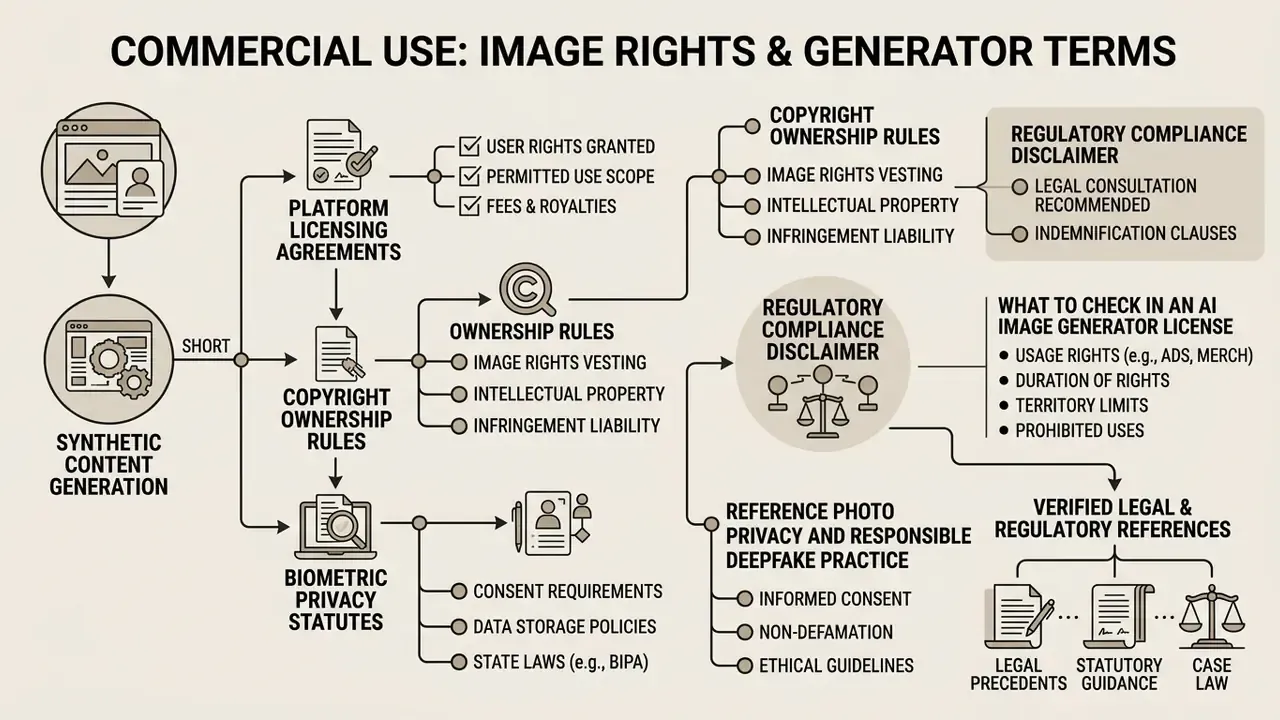
Deploying synthetic media for commercial use requires verifying platform licensing agreements, copyright ownership rules, and biometric privacy statutes. In many jurisdictions, pure AI-generated outputs lacking human creative authoring do not receive copyright protection (US Copyright Office Guidance, 2024).
What to Check in an AI Image Generator License
Review vendor Terms of Service to determine whether output rights differ between free and paid subscription tiers. Paid plans typically grant commercial usage rights, yet platforms such as Microsoft's image generation products explicitly restrict outputs to "personal use only and not for use in the course of trade or commerce." Midjourney grants general commercial usage rights on paid plans with no permanent free tier; Adobe Firefly ties commercial usage to subscription terms and markets training on licensed Adobe Stock and public-domain content; OpenAI's DALL·E terms state that users own generated images and may reprint, sell and merchandise them, including outputs produced with free credits.
Copyright status of the output is a separate question from license permission:
"Most generative AI output is not protected by copyright for lack of human authorship; textual inversion makes it possible to measure a specific image's originality relative to the model's training data."
Enterprise contracts must include explicit intellectual property indemnification clauses to protect against third-party copyright claims about model training data. Note the jurisdictional spread as well: EU rules emphasize disclosure; UK ASA guidance (2026) confirms AI-made ads remain subject to ordinary misleadingness and social-responsibility rules and must not imply real endorsement through celebrity-like depictions; 2026 judicial guidance in China treats unauthorized AI replicas of a person's face or voice as grounds for liability.
Reference Photo Privacy and Responsible Deepfake Practice
"Many generative models are trained on web-scraped data, creating exposure to copyright, database-right and privacy violations when uploaded reference photos are reused."
Australia's OAIC advises against entering personal or sensitive information into publicly available generative AI tools at all, noting that such inputs may be retained, used or disclosed. Reporting from 2026 on public chatbot products documents default retention of uploaded files and images. Treat any public-tier upload of a real person's face as a disclosure event, not a transient input.
Deployers must ensure cloud platforms provide zero-data-retention guarantees and maintain strict access logging for all uploaded source files. Where the business need is correction rather than identity synthesis, safer alternatives exist: non-generative AI image enhancement tools and conventional free photo editors resolve many briefs without processing biometric data at all.
Verified legal and regulatory references:
- European Union AI Act (Regulation 2024/1689), Article 3(60) and Article 50 transparency obligations: https://eur-lex.europa.eu/legal-content/EN/TXT/?uri=CELEX:32024R1689
- Federal Trade Commission, Policy Statement on Biometric Information and Misuse (2023): https://www.ftc.gov/legal-library/browse/ftc-policy-statement-biometric-information
- Stability AI, Terms of Use and commercial licensing framework (2025): https://stability.ai/terms-of-use · 2025 Privacy Policy: https://stability.ai/2025-privacy-policy
- OpenAI policies and governance, enterprise privacy and terms of service: https://openai.com/policies/row-privacy-policy/
- Midjourney Privacy Policy (2026): https://docs.midjourney.com/hc/en-us/articles/32083472637453-Privacy-Policy
Organizations reviewing legal risk exposure across synthetic media deployments can analyze regulatory precedents in our litigation overview section.
FAQ About Deepfake AI Image Generators
The frequently asked questions below cover the access, device and modality issues that come up most often once a shortlist exists. Start with the three-question self-assessment, since it decides whether the rest even applies.
Compliance Self-Assessment: Three Questions Before Commercial Deployment
Frequently Asked Questions
Q1. Does your intended output depict a real, identifiable person?
- (a) No, fully synthetic subject. Standard advertising rules apply; labeling obligations still attach to machine-readable provenance.
- (b) Yes: employee, customer or public figure. Stop. You need a documented consent artifact with territory and expiry scope, a right-of-publicity review, and an Article 50(4) disclosure label.
- (c) Unsure. Treat as (b) until the identity question is resolved in writing.
Q2. Does your licence tier grant commercial exploitation rights in writing?
- (a) Yes, paid tier with explicit commercial grant and IP indemnity. Proceed, and attach the licence version to the asset record.
- (b) Free tier or unspecified. Do not publish in paid media. Free tiers frequently carry non-commercial-only terms, watermarks and public-gallery exposure.
- (c) Self-hosted open weights. Check the specific variant licence. Open weights do not automatically mean commercial permission, and hosting shifts the entire compliance burden in-house.
Q3. Can you reproduce this exact asset in six months for an audit?
- (a) Yes: prompt, seed, model version, edits and consent file are all logged. Governance-ready.
- (b) Partially, output saved but parameters lost. Remediate: re-run with logging enabled before release.
- (c) No. Treat the asset as unapproved and withhold it from publication.
Do You Need to Register for Free Online Generation?
Many basic web interfaces offer free online generation with no sign up required, which lowers onboarding friction. Anonymous guest access, though, usually comes with hard functional limits: lower resolution caps, public queue delays, visible watermarks, and zero data privacy guarantees. Prompts and uploaded images submitted without an account are frequently retained in public logs, which makes unauthenticated platforms unsuitable for confidential corporate workflows. "No sign-up" describes the access barrier only. It says nothing about retention, commercial rights, deletion paths, or whether outputs land in a public gallery.
Can You Use an AI Image Generator on a Mobile Device?
Most cloud-based AI image generators work inside mobile web browsers (Chrome, Safari, Edge) and dedicated native apps. A 2026 system report on a browser-based deepfake review tool documented a no-install frontend with drag-and-drop upload and cross-browser compatibility across Chrome, Firefox, Safari and Edge, which confirms that core upload-and-review tasks function on mobile. Heavy diffusion compute stays in the cloud for good reason: a 2025 survey states that deepfake generation models remain "mostly unsuited for mobile platforms" due to parameter size and computational cost.
Two cautions for enterprise deployment. First, verify that mobile upload pipelines maintain secure encryption when transferring reference photos. Second, app-store face-swap products are not equivalent to governed platforms. A 2026 arXiv study found that 70% of sampled face-swap apps lacked technical safeguards against generating nude imagery. Mobile workflows suit prompt iteration, asset review and light inpainting as an image tool; they are not an appropriate channel for processing employee or customer likenesses.
How Does an AI Image Generator Differ from AI Video Tools?
An AI image generator produces static 2D spatial frames conditioned on text or reference images, optimizing single-frame resolution and detail. AI video tools render temporal sequences across multiple frames, which requires motion consistency layers, temporal attention mechanisms, and much higher compute (Stable Video Diffusion technical report). Video systems additionally chain cascaded spatial and temporal super-resolution stages, with Imagen Video interleaving both, and they target deliverables defined by duration and frame rate rather than a single frame, for example 512×896 at 8 fps.
Static image tools focus on spatial fidelity; video platforms prioritize frame-to-frame coherence and motion trajectories. Teams extending a pipeline into motion should compare AI video generators on duration limits and licensing, review free AI video generators for pilot work, and check Google Veo implementation economics before committing to an API.
Detection capability also diverges sharply between modalities, and adaptive systems are closing part of the gap:
"BitMind Forensics, a dynamically evolving system trained through an adversarial platform, reaches 0.915 ROC-AUC and 86.9% balanced accuracy on in-the-wild 2024 social-media images."
How Do You Turn a Generated Deepfake Image into Video?
To convert a static frame into motion, use image-to-video architectures such as Stable Video Diffusion, Runway Gen-3 or Luma Dream Machine. Load the generated frame as the first keyframe, define a camera motion vector (pan, push-in, orbit), and describe the physics in text, for example "the subject slowly turns their head toward camera and smiles, hair moves naturally, background stays static". Three governance notes apply. First, motion amplifies identity exposure: a moving likeness is far more persuasive, and therefore higher-risk, than a still. Second, consent artifacts collected for a still image do not automatically cover animated use, so confirm scope. Third, provenance markers embedded in the still may not survive the video render, which means labeling and Content Credentials must be re-applied at video export. Creators publishing the result can plan the finishing pass with a YouTube editing workflow, an animation maker for graphic overlays, an AI voice generator for narration (noting the documented advantage of human voice-over on purchase intention), and a video compressor for delivery-size control.
Appendix A: Superseded Claims and Editorial Corrections
For transparency, the following formulations appeared in earlier editions of this guide and have been replaced in the main text with verifiable sources. They are retained here so readers can trace the correction.
| Superseded formulation | Reason for replacement | Replacement in main text |
|---|---|---|
| "…deepfake systems specifically cover content that appreciably resembles real entities (European Parliament, 2024)" | Citation lacked the operative test and conditions | Four cumulative conditions quoted from the arXiv definitional study (2024–2025) |
| "…identity preservation (DiffSwap, CVPR 2023)" as the sole reference | Single reference without method or results | Retained plus "The Chosen One" consistency-representation findings |
| "AI-generated display ads can match or exceed stock photography CTR (Marketing Science Study, 2025)" | Unverifiable source, no methodology or figures | 2025 field experiment, 173,000+ impressions, up to +50% CTR, −31.5% with disclosure |
| "FID and LPIPS quantify visual realism (CVPR Benchmark Studies, 2024)" | Vague collective citation, no figures | Detector-accuracy benchmark of 18–30% zero-shot (arXiv, 2026), plus named metric set |
| "Organizations… reduce photoshoot costs (Layer AI Report, 2025)" | Vendor claim outside the verified source set | Reframed as vendor claim plus 2025 game-development review; ROI to be validated on internal pilot data |
| "…concept stills in minutes (Game Design Review, 2025)" | Non-verifiable citation | 2025 game-design prototyping pipeline paper and AI-in-gamedev review |
| "…front-facing angles within ±5° (NIST / ISO Facial Guidance)" | No specific document or locator | ICAO ±5° horizontal, NIST/FISWG roll-pitch-yaw tolerance, ENFSI 60 px eye distance, 400–600 DPI scan specs |
| "OpenAI Prompting Guide, 2026 / Black Forest Labs, 2026" | Forward-dated documentation references | Cited as "current edition" vendor documentation without asserting a future publication year |
Open questions we have not resolved. Three gaps remain, and we would rather name them than paper over them. There is still no independent, audited cost-per-asset dataset for enterprise creative departments. Provenance durability through third-party ad platforms is inconsistently documented, so C2PA survival should be tested per channel. And the interaction between disclosure wording and brand trust over multiple campaign cycles has only short-horizon evidence behind it.