Why should a risk or finance leader care about a marketing tool? Because the same generators that produce a convincing product teaser also produce convincing synthetic identity evidence, and both land inside your control perimeter.
Executive Summary: What Decision-Makers Need First
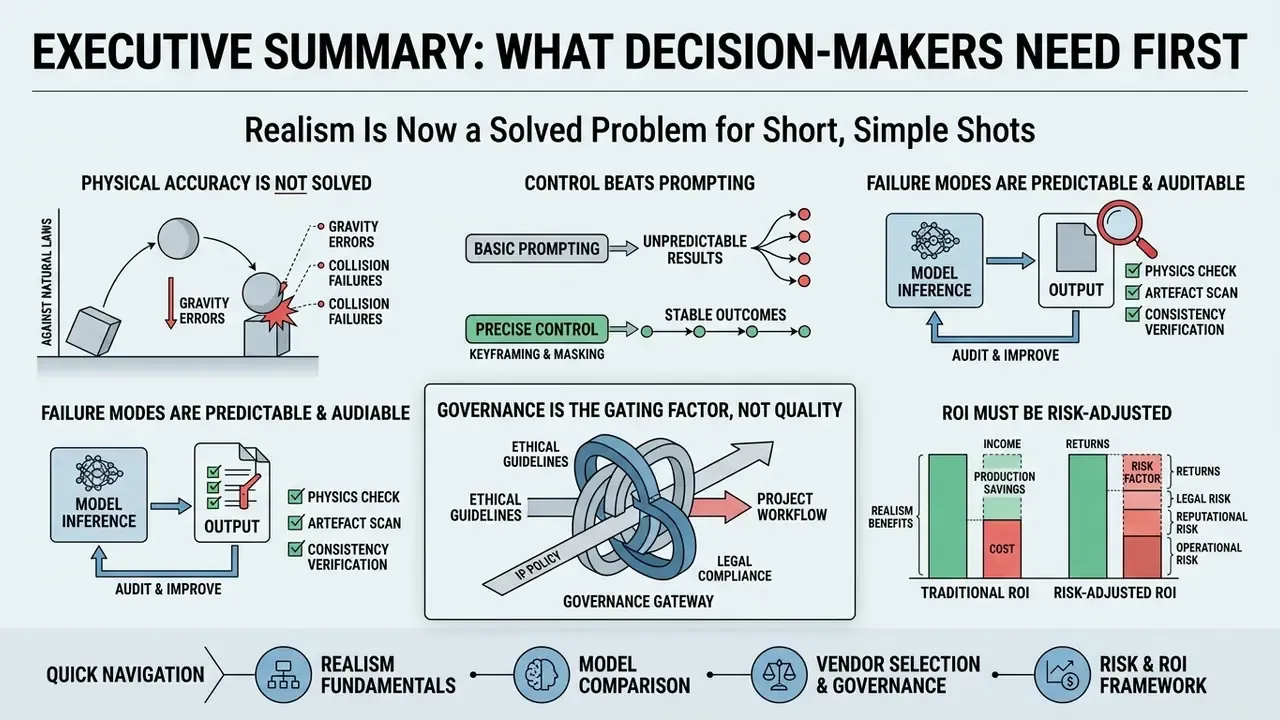
- Realism is now a solved problem for short, simple shots. Clips of 4 to 8 seconds from Google Veo 3.1, OpenAI Sora 2, Kling AI 3.0, Runway Gen-4.5, Wan 3.0 and Luma Ray3 regularly pass casual human inspection. Broadcast deployments, including Channel 4's synthetic Dispatches presenter, confirm mainstream viability.
- Physical accuracy is not solved. Physics-IQ, PhyWorldBench, PhyGenBench and Morpheus all report that aesthetically convincing clips still violate gravity, collision, fluid and conservation constraints.
- Control beats prompting. Image-to-Video anchoring and start/end keyframe interpolation reduce drift far more effectively than longer text prompts. Prompt length is not a control.
- Failure modes are predictable and auditable. Hands, legible small text, multi-object contact, and identity drift beyond 15 seconds account for most rejected takes.
- Governance is the gating factor, not quality. Data-retention terms, opt-outs from model training, C2PA and watermarking support, seed and version logging, plus human-in-the-loop review decide whether a tool is deployable in a regulated environment.
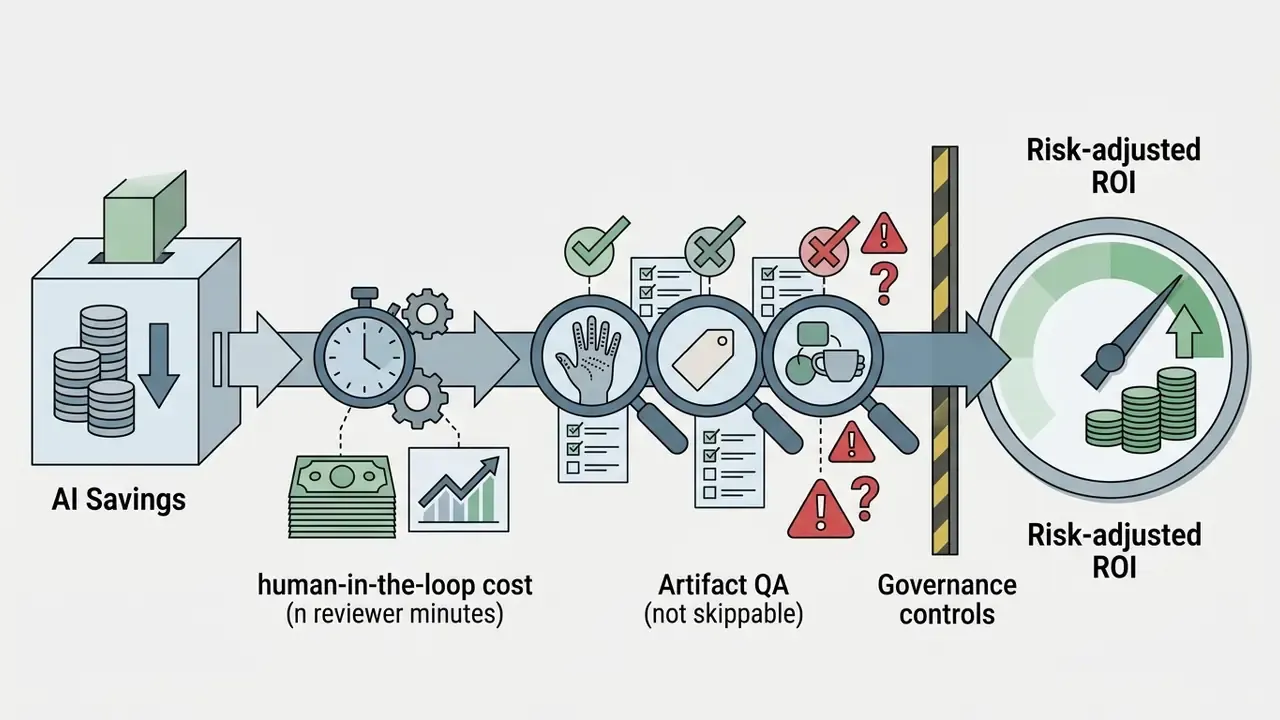
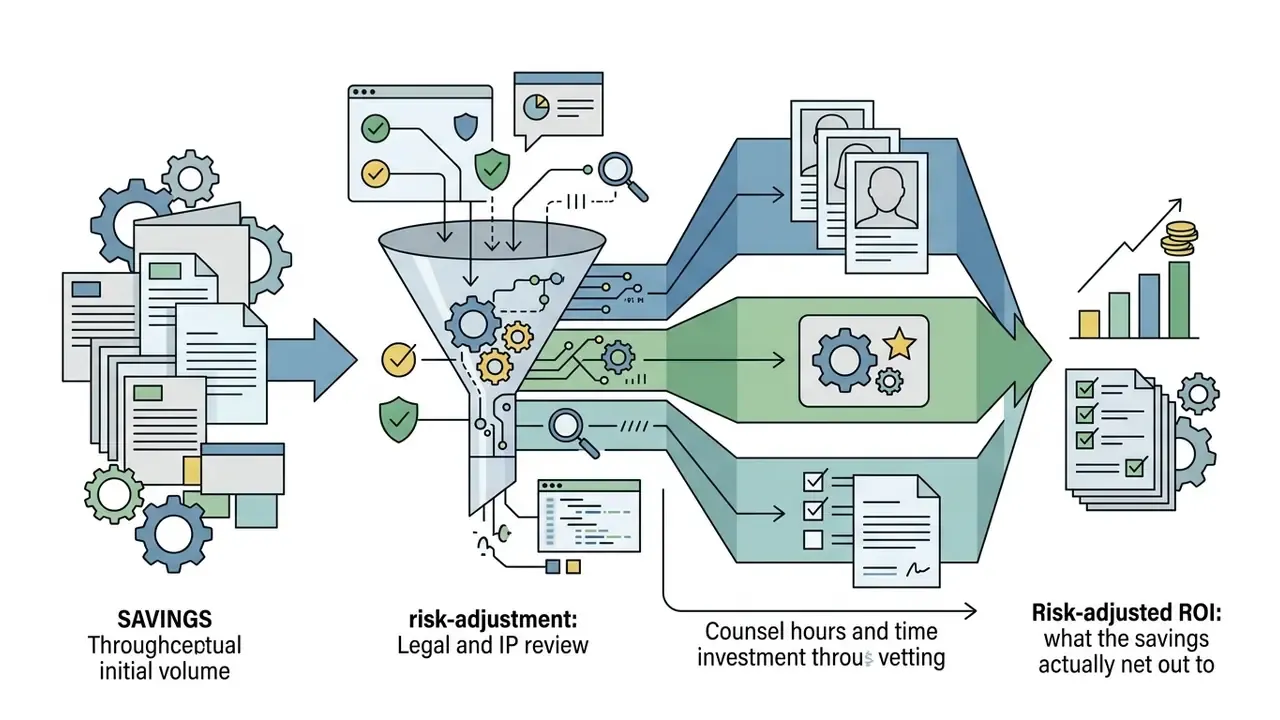
- ROI must be risk-adjusted. Raw generation savings look large. Validation labour, legal review of IP exposure, and residual risk controls consume a material share of them.
Quick navigation: realism fundamentals, then model comparison, vendor selection and governance, the enterprise checklist, production workflow, prompt library, use-case templates, known limitations, and a strategic summary.
Can AI Generate Videos That Look Real?
Modern generative video models synthesize clips that human viewers frequently rate as photorealistic in short, well-constrained scenarios. According to empirical studies such as Deepfake-Eval-2024 (arXiv:2503.02857), visual realism in synthetic footage depends on consistent spatial detail, coherent illumination, and natural temporal transitions across frames. Academic evaluations, however, keep landing on the same caveat: high visual quality does not guarantee physical accuracy.
«All tested models display a severely limited understanding of physics despite visually compelling, aesthetically convincing output.»
The evolution of visual realism: from cursed artifacts to seamless production
To understand today's photorealism, operators should look at how quickly generative video corrected its earliest structural flaws:
- 2023, the uncanny phase. Early text-to-video benchmarks were defined by viral experiments such as Synthetic Summer (Privateisland.tv), a fully prompt-generated beer commercial, and Pepperoni Hug Spot, a fake pizza spot assembled from early ChatGPT, Midjourney and Runway Gen-2 outputs. Both circulated because of melting anatomical geometry, fluid-physics breakdown and unnatural facial morphing. Memorable ideas rendered by unreliable models.
- 2024 to 2025, the coherence breakthrough. Demonstrations such as OpenAI Sora's Tokyo street walk established multi-frame scene persistence, proving that generative systems could sustain complex camera movement past the old 5-second ceiling while preserving subject identity.
- 2026, commercial invisibility. Synthetic media has reached mainstream broadcast integration. Channel 4's Dispatches episode "Will AI Take My Job?" was fronted by a fully synthetic presenter who closed the programme by revealing "I don't exist. My image and voice were generated using AI." Studio-backed digital performers such as Tilly Norwood entered commercial casting conversations. Synthetic footage now crosses human realism thresholds inside regulated broadcast environments.
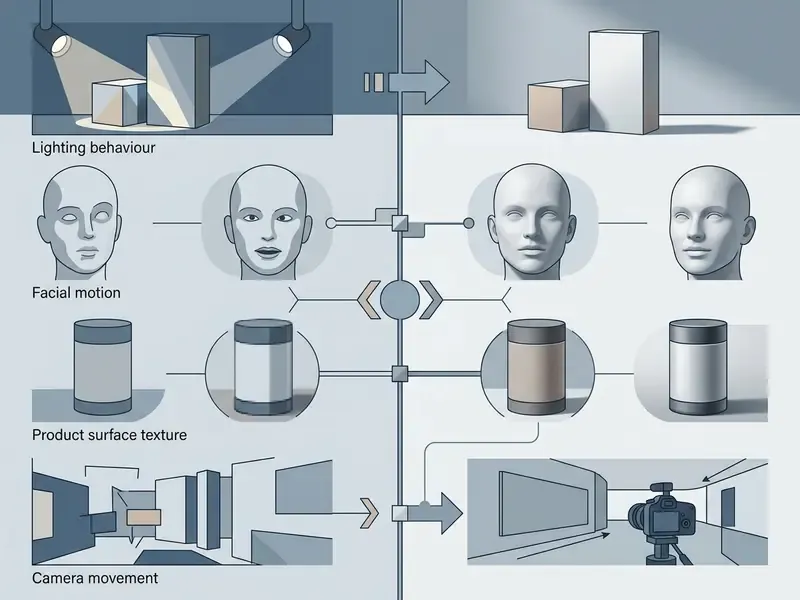
When analyzing ai videos that look real, decision-makers must separate superficial visual fidelity, such as crisp 1080p or 4K per-frame detail, from structural realism. Research evaluating generative physical understanding, such as Physics-IQ (arXiv:2501.09038), confirms that state-of-the-art models frequently produce clips that look convincing at first glance yet violate real-world dynamics during continuous actions. Evaluating synthetic media therefore means auditing specific visual cues across lighting, motion, and material interactions.
Visual signals that make an AI video look realistic
An AI video looks realistic when it holds spatial coherence, stable colour, and plausible motion vectors across consecutive frames. Human observers lean on subtle cues to verify authenticity: micro-expressions on facial features, consistent background geometry, and natural changes in depth of field.
«Successful recognition of authentic video frequently combines visual, vocal and intuitive cues simultaneously; mean accuracy for real content reached M=0.79.»
When generating ai generated videos that look real, natural camera imperfections help bridge the uncanny valley: subtle handheld movement, optical lens distortion, a touch of grain. Synthetic tells usually show up as sudden spatial warping, unnatural limb transitions, or mismatched background parallax during camera pans. Teams new to the category can review capability baselines across AI video generators before committing to an evaluation shortlist.
One small observation from review sessions: reviewers spot bad parallax faster than bad skin. Backgrounds betray a model sooner than faces do.
Lighting, shadows and material textures
Photorealistic AI videos require physically plausible light behaviour, including accurate soft shadows, specular highlights, and ambient inter-reflections.
«Stylistic artifacts, unnatural blur, texture and lighting, rank among the key forensic markers of AI manipulation in video.»
Physics-correct motion and temporal consistency
Temporal consistency is a model's capacity to preserve character geometry, environmental features, and physical continuity over time. Recent physics-focused research such as Phys4D (arXiv:2603.03485) highlights that appearance-driven video diffusion models frequently break down during complex physical events like fluid motion, collisions, or structural state changes. The same work applies physics-grounded supervised fine-tuning on simulation-generated data to enforce temporally consistent 4D dynamics.
«Morpheus models generated over 9,000 synthetic videos: even aesthetically convincing clips systematically violated physical invariants and conservation laws.»
To reach ai video realistic standards, production pipelines must enforce frame-to-frame continuity. Synthetic video models use temporal cross-attention mechanisms and causal keyframe guidance to stabilise object trajectories, which reduces the warping and flickering common in unconstrained generations. The training-free CausalMotion method (arXiv:2606.14317, 2026) uses causally consistent keyframes plus predicted object trajectories to steer diffusion updates, reporting a temporal-consistency score improvement from 3.89 to 4.58. Readers building a technical foundation can start with the mechanics of text-to-video generation before auditing vendor claims.
Why photorealism is not proof of authenticity: fraud and identity risk
For risk functions, the operational corollary of photorealistic generation is adversarial. The same models that render a convincing product teaser render convincing synthetic identity evidence. A clip that looks real to a human reviewer on a feed is not equivalent to footage that survives liveness detection, challenge-response prompts, depth sensing, or forensic motion analysis. Detection research documents that trajectory statistics diverge from real capture across a full action even when individual frame spans look plausible. The weakness that makes generated video fail physics benchmarks is the same weakness that makes it detectable under structured verification.
Practical implication for onboarding, KYC refresh and claims workflows: never treat submitted video as primary evidence without an active liveness challenge and a provenance check, meaning C2PA manifests, capture metadata and device attestation. Teams building verification stacks can evaluate complementary AI image detectors for static asset triage.
Which AI models create the most realistic video?
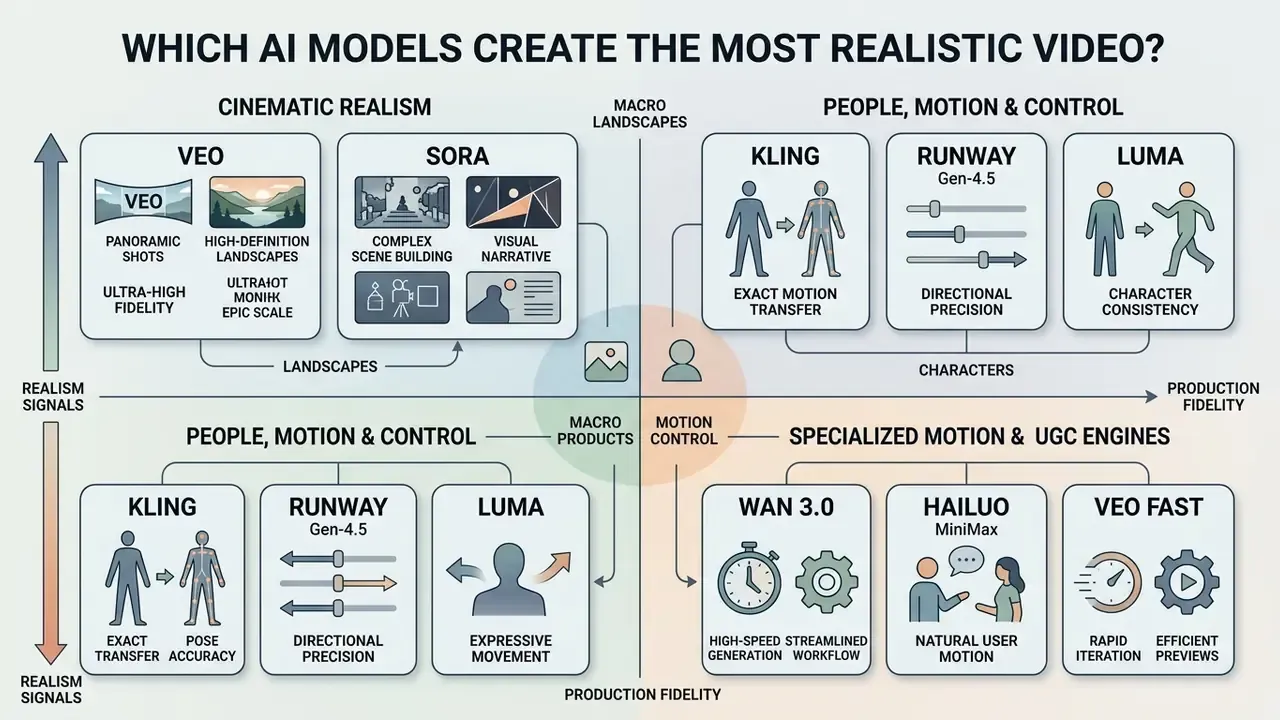
Selecting the most realistic ai video generator means matching model architectures to production objectives: cinematic landscapes, character consistency, or macro product shots. Leading platforms in 2026, including Google Veo, OpenAI Sora, Kling AI, Runway, Wan, Hailuo and Luma Dream Machine, show distinct trade-offs between aesthetic fidelity, camera control, and physical consistency.
| AI Model | Photorealism Strength | Camera Control | Image-to-Video Fidelity | Max Length (Single Pass) | Data & Governance Notes | Primary Enterprise Use Case |
|---|---|---|---|---|---|---|
| Google Veo 3.1 | High (cinematic 4K, lighting) | Advanced (prompt & reference) | High (anchor frame preservation) | Up to 141s via Gemini API (extended context, multi-shot pipeline) | Google Cloud enterprise data-processing terms; 720p/1080p/4K tiers; commercial rights on paid API | Commercial advertising & product promos |
| Veo 3.1 Fast variant | Medium-high (draft fidelity) | Advanced (inherits Veo controls) | High | 4s to 8s | Same enterprise terms as Veo 3.1 | Rapid prototyping & internal review cuts |
| OpenAI Sora 2 | High (temporal coherence) | Medium (prompt-directed framing) | High (first-frame conditioning) | 16s to 20s (API generations) | Invite-based, staged access; OpenAI Business Terms; upload restrictions on photoreal persons | High-concept cinematic creative assets |
| Kling AI 3.0 | High (human and facial fidelity) | High (motion control & trajectory) | High (multi-image subject binding, 1 to 4 refs) | 5s to 10s base clips | Verify watermark and export tier before client delivery | UGC, avatars, character-driven clips |
| Runway Gen-4 | High (stylistic flexibility) | High (director mode, keyframes) | High (structure & style controls) | 5s to 16s | Help Center confirms no non-commercial restrictions on paid plans | VFX pre-visualization & commercial video |
| Runway Gen-4.5 | Ultra-high (cinematic control) | Advanced (keyframe & camera rigs) | Very high (structure retention) | 5s to 10s | Same commercial posture as Gen-4; confirm tier | High-end VFX & broadcast advertising |
| Luma Ray3 | Medium-high (smooth motion) | Medium (camera movement presets) | High (start/end frame interpolation) | 5s base, SDR extend to ~30s | Commercial terms not fully published; request written confirmation | Fast-turnaround social assets & B-roll |
| Wan 3.0 | High (UGC & avatar naturalism) | Medium (prompt-directed) | High (single or multi-frame) | 5s to 10s | Confirm training opt-out for uploaded brand assets | Scalable UGC video ads & viral short-form |
| Hailuo / MiniMax | High (rapid motion dynamics) | Medium (preset paths) | Medium-high (base frame) | ~6s | Confirm regional data residency before enterprise use | High-action footage & rapid motion clips |
Read in plain text, the table says three things. Veo and Runway lead on controllable camera work and commercial clarity. Kling and Wan lead on people. Luma and Hailuo are situational specialists for interpolated B-roll and fast action. Every governance column still ends with the same instruction: verify the tier in writing.
«Among ten tested models Pika 2.0 achieved the best overall physical-commonsense result, yet all models fell substantially short of prior benchmarks.»
Under benchmark testing on PhyWorldBench across 12,600 generated outputs, systems vary widely when handling real-world physics. Proprietary vendors highlight promotional demos of real ai videos, yet independent evaluations show rankings shift depending on whether the test prioritises per-frame image quality or multi-object physical collision. Procurement teams comparing shortlists on price-per-second and licence tiers can cross-check our AI video generator comparison.
Veo and Sora for cinematic realism
Google Veo 3.1 and OpenAI Sora 2 sit at the leading edge of cinematic text-to-video and image-to-video generation. Veo 3.1 supports up to 4K output via Google AI Studio and Gemini API endpoints, with volumetric lighting controls and cinematic presets such as Rembrandt lighting, film noir, backlighting or golden hour. Vertex AI documentation lists preview specifications of 4, 6 or 8-second clips at 24 FPS with up to four outputs per prompt, which is exactly why long-form deliverables get assembled from multiple passes rather than one continuous render. Operators implementing pipelines can reference our developer breakdown on the Google Veo implementation guide to analyse frame-rate constraints and cost structures, and browse the wider api documentation hub for endpoint-level limits.
OpenAI Sora 2 emphasises deep temporal coherence and integrated audio-video synthesis. OpenAI positions it as "more physically accurate, realistic, and more controllable than prior systems." According to the Sora 2 System Card (OpenAI, 2025/2026), the model uses prompt directives for camera distance, focal depth, and action beats, and early access rolled out through limited invitations with restrictions on photorealistic person uploads. It produces some of the most realistic ai videos for atmospheric environmental shots, though precise framing control remains less granular than dedicated keyframe-driven tools.
«Physics-IQ Verified audited six image-to-video models including Sora 2: ranking shifted moderately (Kendall τ=0.46) and physical realism stayed limited across all systems.»
Kling, Runway and Luma for people, motion and control
For character-centric content and strict control over camera motion, Kling AI, Runway Gen-4 and Gen-4.5, plus Luma Ray3, offer specialised feature sets. Kling AI 3.0 provides subject-binding capabilities, letting creators upload multiple reference images (documented at one to four references, with a "Bind Subject to Enhance Consistency" toggle) to hold facial geometry across varying camera angles. Teams anchoring characters and products should compare capabilities across image-to-video tools before standardising a pipeline.
Runway Gen-4 provides advanced camera director controls, enabling pan, tilt, zoom, and orbital tracks over synthetic environments. Its official prompt template, covering shot size, angle, movement plus direction and speed, subject action, lens look and lighting mood, maps prompt writing directly onto cinematography language. When teams need alternative tools for static asset preparation prior to video generation, reviewing our AI Media Comparison Matrices helps map workflow integrations across design suites. Luma Ray3 excels at motion interpolation between designated keyframes and documents a Modify-with-Start-Frame method for holding character identity, which makes it viable for fluid B-roll and fast-turnaround commercial creative.
Specialised motion and UGC engines: Wan 3.0, Hailuo and the Veo Fast variant
Beyond the primary enterprise platforms, specialised models cover specific execution gaps:
- Wan 3.0 is tuned for authentic UGC performance, rendering natural human micro-expressions and everyday handheld camera motion with minimal synthetic smoothness. Useful where "shot on a phone" credibility outperforms cinematic polish.
- Runway Gen-4.5 and the Veo 3.1 Fast variant streamline rapid prototyping. Where standard Veo 3.1 prioritises maximum 4K render quality for hero assets, the Fast variant and Gen-4.5 produce production-ready draft iterations in seconds for creative-director review, which cuts compute spend during concept selection.
- Hailuo (MiniMax) shows high dynamic stability during fast-action sequences such as running, vehicle movement or fluid splashing, reducing the structural tearing where standard diffusion models collapse. Hands and faces still need inspection at high motion velocity.
How to choose a realistic AI video generator for commercial use
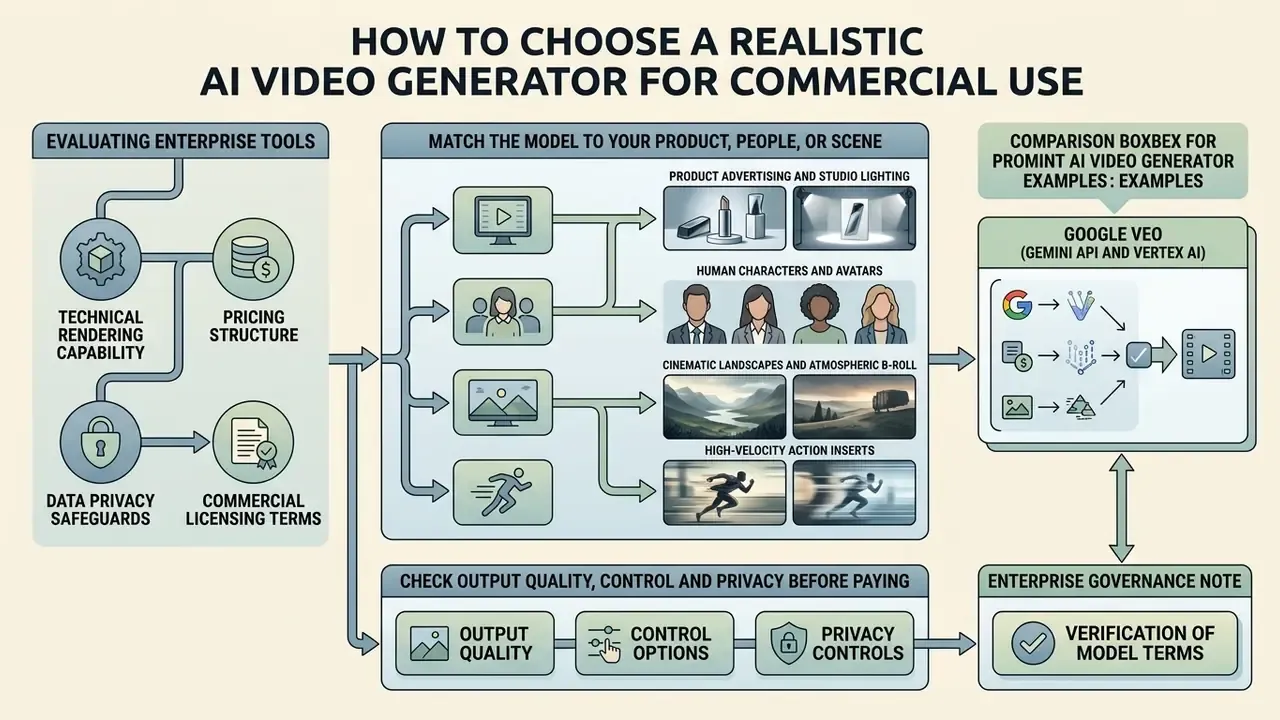
Evaluating enterprise video tools means analysing technical rendering capability, pricing structure, data privacy safeguards, and commercial licensing terms. Unverified providers should be audited before they touch a production environment. No exceptions.
Match the model to your product, people or scene
No single AI model excels across all commercial requirements. Production leads should select architectures aligned with specific asset types:
- Product advertising and studio lighting models with strong image-to-video anchoring and explicit light control, for example Google Veo 3.1 or Runway Gen-4.5.
- Human characters and avatars platforms offering multi-image subject binding and facial consistency features, for example Kling AI 3.0 or Wan 3.0.
- Cinematic landscapes and atmospheric B-roll extended temporal coherence models such as OpenAI Sora 2 or Luma Ray3.
- High-velocity action inserts engines validated for dynamic stability, such as Hailuo and MiniMax.
For teams combining pre-edited graphics or stylised vector animation with synthetic clips, an animated explainer video tool suite provides structured templates for hybrid commercial assets.
Check output quality, control and privacy before paying
This section covers legal, licensing and compliance considerations. The information is general and does not replace advice from qualified legal or compliance counsel for your jurisdiction.
Before signing enterprise licensing agreements, model risk managers and IT procurement should evaluate security and legal parameters. Verification of synthetic output belongs in the control inventory as a dynamic check, not a one-time gate:
«Static detectors lose 45 to 50% AUC on in-the-wild content; the dynamic BMF system reaches ROC-AUC 0.915 and 86.9% accuracy on Deepfake-Eval-2024 imagery.»
Enterprise governance note: verification of model terms. The vendor posture below should be re-validated at each contract renewal, because access tiers and data terms change by surface (consumer app, API, cloud tenancy):
- Google Veo (Gemini API and Vertex AI)
- data handling governed by Google Cloud enterprise terms; 720p, 1080p and 4K availability differs across AI Studio, Gemini API and Vertex AI; commercial rights granted on paid API access.
- OpenAI Sora 2
- access remained staged and invitation-based into 2026, with regional exclusions and stricter moderation rules; commercial use governed by OpenAI Business Terms.
- Runway Gen-4 and Gen-4.5
- official help documentation confirms content created on paid plans carries no non-commercial restrictions.
- Kling AI, Luma, Wan, Hailuo
- commercial terms and watermark policy vary by tier and region; obtain written confirmation of export rights and data-retention behaviour before client delivery.
Enterprise teams must verify whether vendor terms permit model training on customer uploads. Under frameworks like the NIST AI Risk Management Framework (NIST AI 100-1), organisations handling proprietary product CAD files or sensitive visual assets need contractually enforced opt-outs, not a settings toggle. NIST guidance also notes that generative outputs may expose personal data or memorised copyrighted material, which turns privacy and IP monitoring into a standing control rather than a launch checklist item.
«The DREAM benchmark collected 140,000 realism ratings from 3,500 annotators: no automated assessment method fully reproduces human judgement.»
Four further governance dimensions belong in the vendor questionnaire:
Model validation for generative video. Where an organisation already runs a model-risk framework, generative video should enter it as a lower-tier but registered model. That means documented intended use, an inventory entry, defined performance criteria (artifact rejection rate, identity-drift threshold, provenance coverage), named human reviewers, an escalation path for failed reviews, and periodic re-validation when the vendor version changes. GRC integration matters more than tooling sophistication. An unlogged clip that reaches paid media is an audit finding, no matter how good it looks.
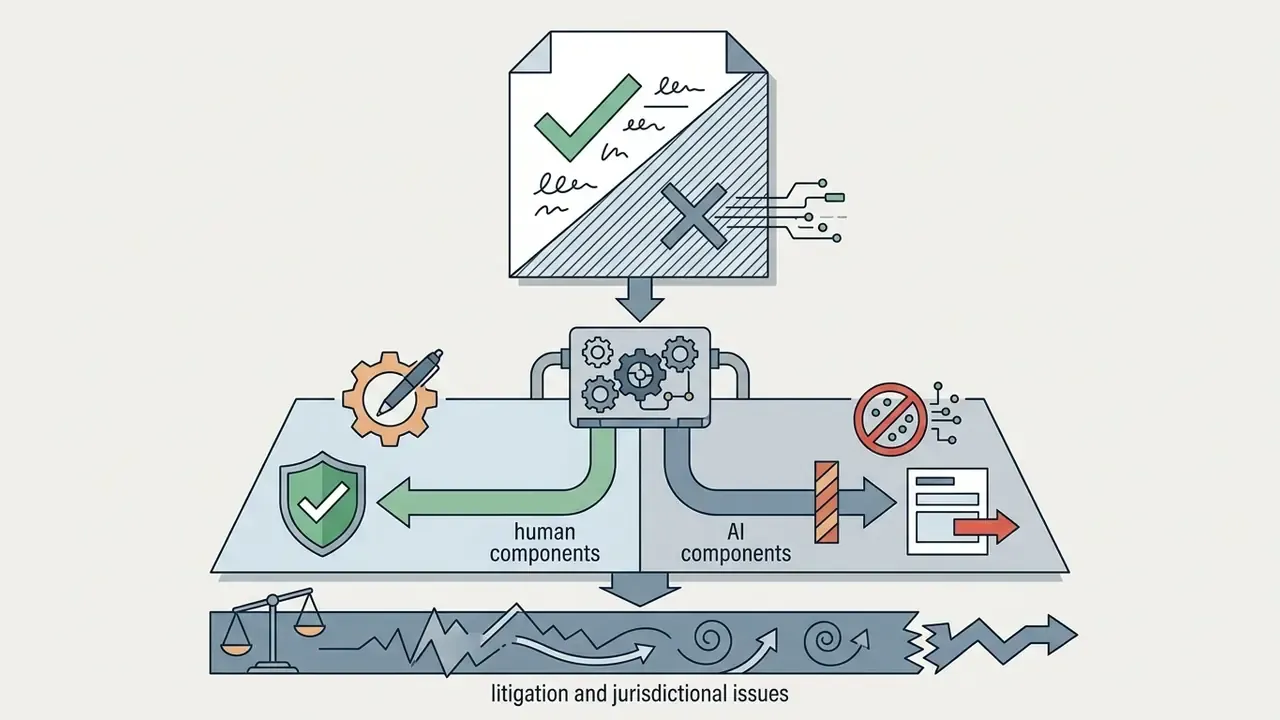
When building ROI models and calculating operational overheads across generative software suites, operators use our dedicated AI Media Calculators to project compute costs against output volume. Tracking legal developments on generated IP stays critical too; compliance teams monitor updates via our AI Litigation and Case Timelines database.

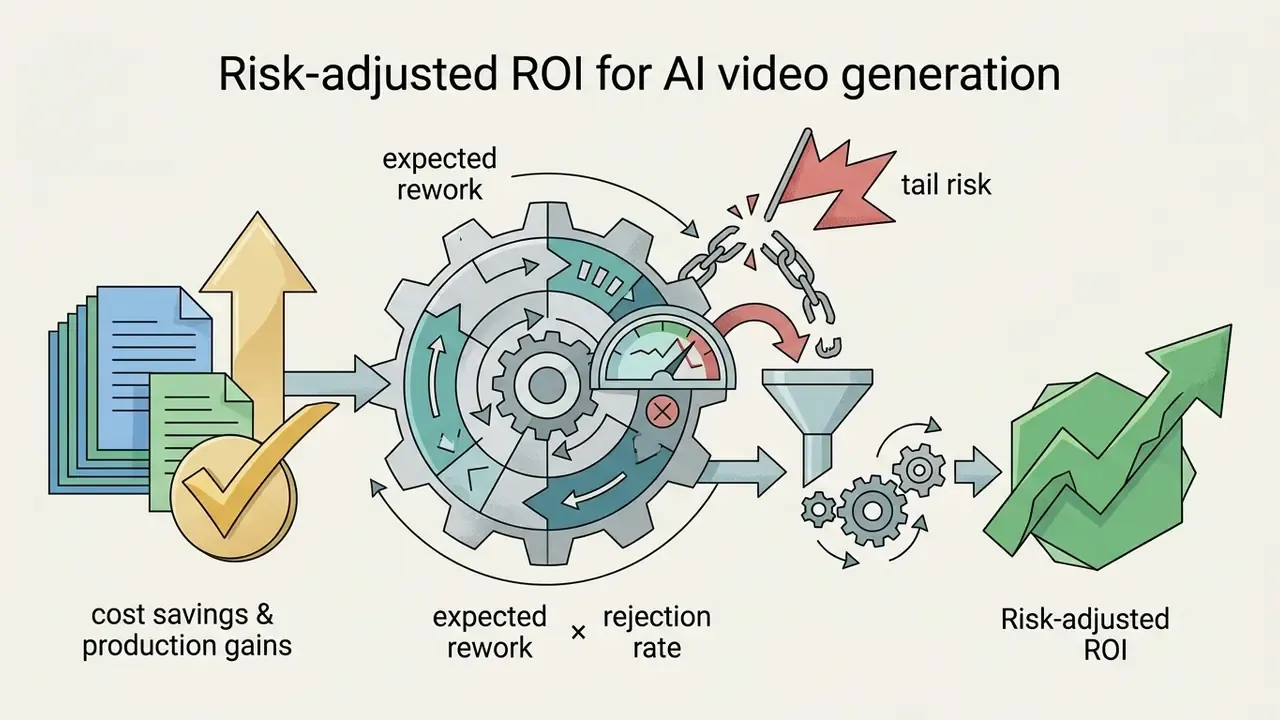
Risk-adjusted ROI: what the savings actually net out to
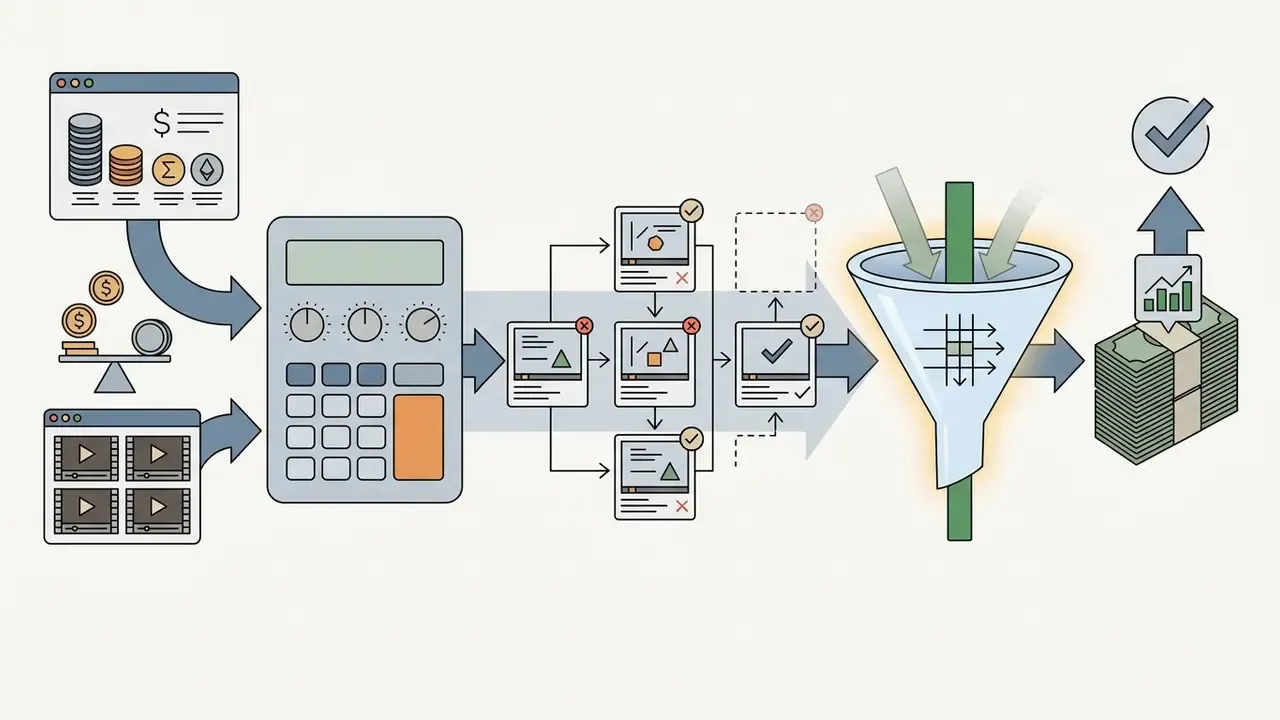
Headline savings from synthetic production are real but gross. A defensible business case computes:
Risk-adjusted ROI = (Baseline production cost − Generation cost − Human-in-the-loop review cost − Legal and IP review cost − Provenance and logging infrastructure cost − Expected rework cost) ÷ (Generation cost + Control costs)
Practical inputs to collect before signing:
Reported production savings in the 60 to 80% range are plausible for high-variation, low-physics asset families: macro product pans, background plates, format variants. They compress sharply for scenes with hands, legible packaging copy, liquid pours, or continuous takes beyond 15 seconds. Those are precisely the categories where benchmark literature reports systematic failure.

Enterprise Decision Checklist: AI Video Generators
To streamline tool selection, model risk officers and creative directors should apply this verification checklist before deploying synthetic video tools:
- Model governance and IP privacyconfirm the vendor does not train base models on uploaded enterprise reference images or prompt inputs, and that the opt-out is contractual.
- Workflow anchoringprioritise tools supporting robust Image-to-Video (I2V) reference framing and start/end keyframe control over unconstrained Text-to-Video generation. Reference frames themselves are often produced with AI image generators, so licensing must be traced upstream as well.
- Artifact quality assuranceestablish mandatory human review passes for hand geometry, product label legibility, and realistic physical collisions.
«VBench++ extends evaluation to 16 dimensions including content trustworthiness, confirming motion smoothness and identity consistency as leading predictors of human preference.»
- Licensing transparency
- verify that commercial rights are explicitly granted under paid enterprise API tiers, and that watermark and export behaviour matches the delivery channel.
- Provenance coverage
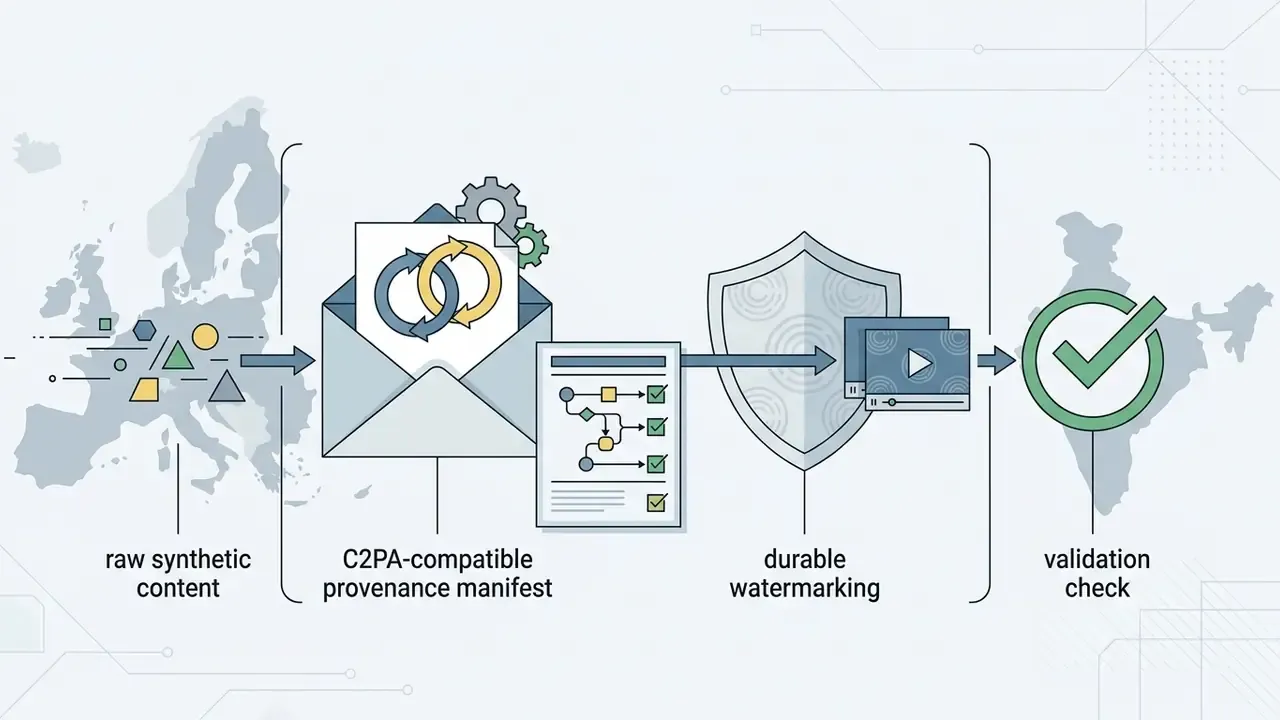
- require C2PA manifests or equivalent durable metadata on every asset entering paid distribution.
- Reproducibility
- require seed, model version, prompt text and reference-asset hash to be captured automatically for every approved clip.
- Shadow AI controls
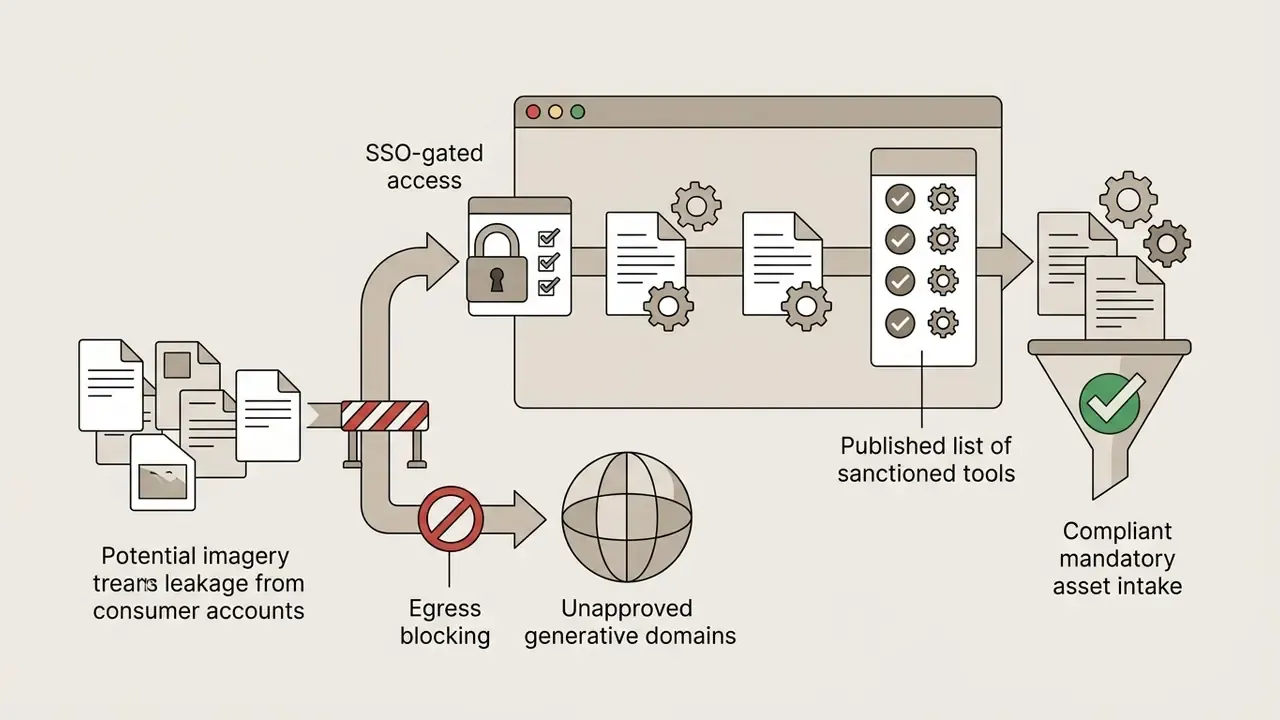
- publish the sanctioned tool list, gate access through SSO, and monitor egress to unapproved generative endpoints.
- Re-validation trigger
- define a mandatory re-test when a vendor ships a new model version, since ranking and failure modes shift between releases.
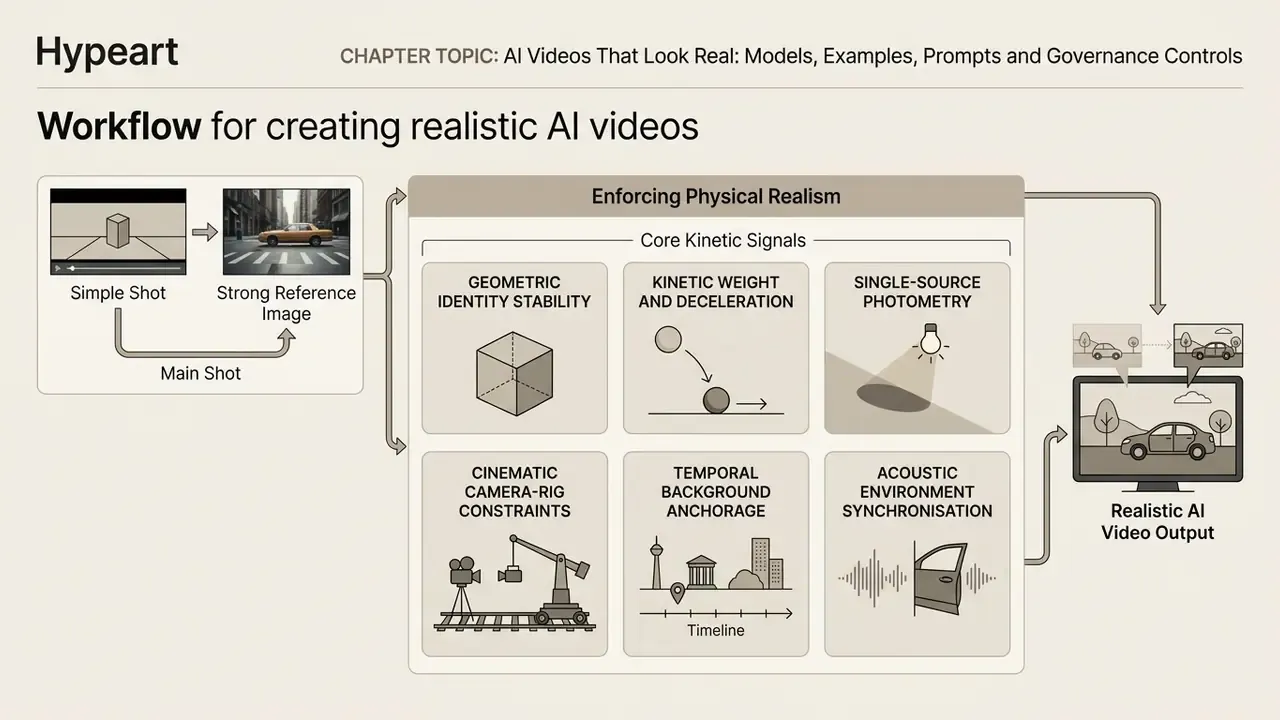
Workflow for creating realistic AI videos
Achieving a very realistic ai video requires an iterative, controlled workflow, not longer text prompts. Professional creators follow a structured pipeline: establish reference assets, write camera-centric prompts, generate short takes, then assemble clips in post-production.
Workflow steps:
- Select a single-hero reference frame, or a start and end frame pair.
- Draft a camera-oriented prompt in director terminology.
- Generate short iterations of 4 to 8 seconds.
- Perform artifact QA against the six kinetic signals.
- Log seed, model version and prompt for reproducibility.
- Assemble, grade and finish in an NLE editor.
Start with one simple shot and a strong reference image
Text-to-video output often suffers from random background generation and spatial drift. The most reliable route to realistic ai videos is the Image-to-Video (I2V) approach, anchoring generation to a single high-quality reference photograph.
A pre-rendered image locks the subject's identity, colour palette, aspect ratio, and lighting setup. The hero frame should already fix silhouette, aspect ratio, lighting direction and available motion space. One to three supplementary views (side, 45-degree, rear) help the model reason about the subject in three dimensions. Avoid tight crops, skip exotic fantasy lighting that reads as synthetic, and keep poses simple. A plain standing pose survives generation far better than a complex one. When converting single-frame graphics into dynamic clips, operators frequently use specialised tools like akool image to video processing to maintain character stability during motion transitions.
A second discipline matters as much as asset quality: choose one shot, not a whole story. "Make a realistic ad for my skincare brand" is not a prompt. The model must invent product, room, person, lighting, angle and action at once, and it will fail at several. "A glass serum bottle on a marble bathroom counter, morning light hitting the label, a hand enters frame and lifts it" is a shot a model can execute and a reviewer can judge.
Enforcing physical realism: the six core kinetic signals
Before approving a generated clip for production, QA reviewers should audit the frame sequence against six physical signals:
- Geometric identity stabilitysecondary elements such as clothing weaves, logo typography, product edges and facial architecture must not morph or change volume across consecutive frames.
- Kinetic weight and decelerationmoving limbs and dynamic objects must display mass, with natural acceleration and deceleration curves rather than uniform machine-linear speed.
- Single-source photometryhighlights, subsurface scattering, ambient occlusion and shadows must resolve dynamically from one fixed, logical lighting origin.
- Cinematic camera-rig constraintsvirtual camera trajectories must mimic physical optical equipment, including dolly weight, handheld micro-vibration and crane arc limits.
- Temporal background anchoragearchitecture, foliage and distant backgrounds must stay static without melting or warping while the foreground subject moves.
- Acoustic environment synchronisationgenerated ambience and SFX must match visual spatial framing, with room reverberation consistent with room size.
Any single failure is grounds for regeneration rather than post-production repair. Artifacts in categories 1, 2 and 5 are the ones viewers detect fastest.
Advanced technique: keyframe interpolation with start and end framing
Single-image conditioning controls scene initiation. Complex camera moves are more stable when both ends of the motion are defined:
- Step 1: render or photograph Frame A (initial state) and Frame B (final state), for example a product isolated on a matte surface, then a 45-degree macro on its metallic edge.
- Step 2: upload Frame A as
Start_Frameand Frame B asEnd_Framein engines supporting keyframe control (PixelBin, Luma Ray3, Runway Gen-4 and Gen-4.5). - Step 3: prompt purely for transition mechanics: "Slow horizontal camera dolly between Frame A and Frame B, maintaining focal length and subject lighting."
This locks spatial geometry, removes the model's freedom to reinvent the scene mid-shot, and materially reduces drift across 5 to 8 second clips. A related continuation method feeds the last frame of an approved clip as the start frame of the next generation, preserving physical continuity across a multi-shot sequence.
Write prompts as camera directions
Prompts designed for photorealism should borrow the vocabulary of cinematography and lighting design. Instead of generic adjectives like "hyperrealistic," "cinematic" or "ethereal," specify exact lenses, movement vectors, lighting conditions, and environment acoustics. Write as though briefing a camera operator on set.
An effective prompt structure follows a standard hierarchy:
- Shot type and lensExtreme close-up macro, 85mm lens, shallow depth of field.
- Subject and actionA frosted glass perfume bottle resting on black polished marble, subtle condensation droplets trickling down the side.
- Camera movementSlow, steady horizontal tracking shot from left to right.
- Lighting and environmentSoft diffused studio side lighting, 5500K key light, subtle volumetric reflections.
Add a fifth line for constraints when identity matters: keep the label text and the subject's wardrobe unchanged for the full duration.
Generate short takes and edit the best output
Current video diffusion architectures hold high fidelity mainly over short durations of 4 to 8 seconds. Attempting continuous 30-second shots in a single pass raises artifact rates sharply. Industry workflow reporting (InVideo AI engineering notes, 2025) describes the same pattern, though it publishes no methodology or sample size and should be treated as anecdotal rather than evidentiary.
«VBench documents flicker and identity inconsistency as key measurable defects, correlating with human preference across 16 dimensions of video quality.»
Creators should generate multiple short iterations of the same prompt, extract the top 3 to 5 seconds of artifact-free movement from each generation, then edit them together inside a non-linear editor (NLE). A 15-second generation typically contains four to seven usable candidate moments. Hide the joins on motion, a whip or an action beat, then run a consistency pass with matched grade, light blur and film grain. Teams validating this loop cheaply can iterate on free AI video generators before committing enterprise credits. When building interactive learning modules or asset decks around synthetic media, production leads also use an ai worksheet generator to structure training documentation for their teams.
Logging, seed locking and reproducibility
Realistic AI video prompt examples
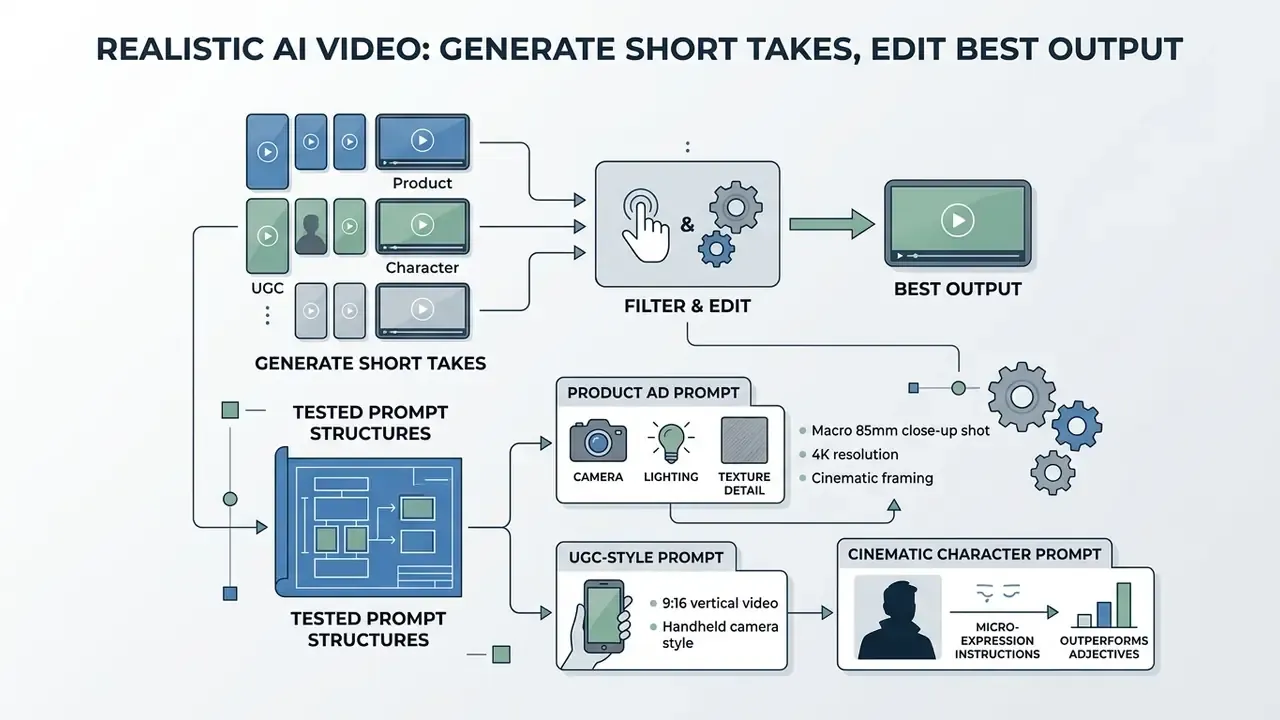
Product ad prompt with camera, lighting and texture detail
[Shot Type]: Macro 85mm close-up shot, 4K resolution, cinematic framing.
[Subject]: A matte black wireless headphone sitting on a brushed aluminum surface.
[Motion]: Slow smooth push-in camera move towards the ear cup texture.
[Lighting]: High-contrast rim lighting, soft fill light, key light at 45 degrees, realistic specular highlights on metallic edges.
[Style & Physics]: Natural material textures, no motion blur drift, stable product geometry, 24fps.
UGC-style and cinematic character prompts
[Format]: 9:16 vertical video, handheld smartphone camera style.
[Subject]: A 30-year-old female creator with natural skin texture and subtle freckles, wearing a plain grey cotton t-shirt.
[Action]: Looking directly into the camera lens, smiling softly, subtle natural blinking and breathing motion.
[Setting & Lighting]: Bright daylight streaming through an apartment window in the background, soft natural shadows, slight authentic camera shake.
For character work, micro-expression instructions outperform adjectives. Slow blink, subtle eyebrow lift, soft shift in smile, gentle gaze change, natural breathing produces more believable faces than "expressive" or "lifelike." When producing explainer assets for corporate initiatives, brands often partner with an animated explainer video company or use automated generation suites to combine 2D graphic overlays with realistic AI B-roll.
Realistic AI video examples by use case
Reviewing ai generated realistic video examples across actual commercial workflows shows where synthetic video currently delivers measurable savings against physical shoots. Enterprise adoption clusters around product visualisation, social media creative, real estate walkthroughs, and stock footage replacement.
«Automated VideoScore metrics reach Spearman correlation 0.771 with human ratings across 37,600 synthetic videos from 11 models.»

Product ads and commercial creative
Product advertising is one of the highest-ROI applications for realistic ai video generation. Instead of scheduling physical studio shoots with expensive lighting setups, creative teams use high-resolution studio photographs as reference anchor frames for image-to-video diffusion. The reliable pattern documented in vendor lighting guidance is two-stage: lock a static master image that fixes the key, fill and rim schema plus colour temperature (5500K daylight key, 3200K warm accent), then reuse that master as the I2V reference so every variant inherits identical illumination.
In an illustrative asset pipeline for a consumer brand, an agency needed 30 unique video variations of a luxury watch under dynamic studio lighting. By establishing a single high-resolution product photography shot and running controlled pan and lighting prompts through image-to-video tools, the team produced 30 broadcast-ready 6-second clips in hours. Updated note on the economics: the frequently cited "over 70% saving" figure is directional rather than verified. It reflects generation cost against a traditional macro-videography quote and excludes reviewer hours, legal review and provenance tooling. Apply the risk-adjusted ROI formula above before presenting any savings number to finance.
UGC-style, travel and real estate clips
Social media and real estate marketing increasingly rely on synthetic media for rapid content scaling. Updated and sourced: the Miami Realtors 2024 AI guidance for brokers explicitly lists "creation of marketing videos for listings" and "simulated drone video from still images," and a 2024 peer-reviewed study of real-estate social media marketing found AI video functions can process footage and generate promotional videos, including automatic script generation from text. So converting high-resolution architectural stills into simulated drone walkthroughs and interior tours without commissioning flight operators is a documented workflow, not a vendor claim. That said, a 2024 to 2025 study of AI in creative industries also found the work shifted toward curation and editing rather than disappearing, so budget for human finishing.
Travel and property clips carry one more obligation: disclosure. Partnership on AI's synthetic-media framework requires labelling synthetic elements and recommends C2PA provenance, and India's 2025 rules mandate durable metadata or prominent labels on synthetic audiovisual content. A simulated walkthrough presented as a real capture is a compliance exposure regardless of how good it looks.
For creators producing high-volume instructional or marketing copy alongside synthetic clips, an ai writing generator helps align voiceover scripts with visual pacing. Automated UGC workflows likewise pair synthetic human avatars with natural camera shake and soft daylight prompts to mimic authentic handheld mobile footage.
Standardised production templates for commercial and UGC formats
The six templates below are reproducible shot maps with fixed durations and anchoring methods. Swap in your own product and reference frame; keep the timings.
Template A: Skincare before-and-after reveal (UGC / beauty)
- Duration: 10 seconds | Anchor method: Image-to-Video (first frame)
- Shot breakdown:
- 00:00 to 00:04: medium close-up of a model applying serum to the cheekbone in natural 5500K window light, soft handheld movement.
- 00:04 to 00:10: smooth pan to a static macro of hydrated skin texture with natural specular highlights.
- Prompt spec:
Vertical 9:16 format, handheld smartphone lens, 30yo woman applying clear face serum, soft morning sunlight through sheer curtains, ultra-realistic skin pores, subtle micro-expressions, 4K 30fps. - QA focus: finger geometry during application, label legibility, skin texture stability across the pan.
Template B: High-impact tech product reveal (e-commerce)
- Duration: 6 seconds | Anchor method: start and end frame interpolation
- Shot breakdown:
- Start frame: product isolated on a matte dark surface.
- End frame: 45-degree macro close-up on the metallic edge and logo.
- Prompt spec:
Cinematic 16:9, 85mm macro lens, mechanical wireless keyboard on dark walnut desk, slow orbital camera pan from left to right, soft studio rim lighting highlighting keycap texture, continuous velocity. - QA focus: keycap glyph stability, reflection consistency, no geometry swelling mid-move.
Template C: Six-second surface cleaning proof (household / physical goods)
- Duration: 6 seconds | Anchor method: Image-to-Video
- Shot breakdown:
- 00:00 to 00:06: high-angle tracking shot; a mop or sponge wipes across a stained hardwood floor leaving a clean, wet-reflective streak.
- Prompt spec:
High-angle static tracking shot, hand holding ergonomic cleaning tool, wiping dirt off oak floorboard, realistic liquid sheen and wet surface reflection, natural deceleration, clean edge definition. - QA focus: dirt-to-clean transition edge, liquid physics, no reappearing stains.
Template D: Talking-head first-person review (UGC / beverage)
- Duration: 15 seconds | Anchor method: multi-image subject binding (Kling AI 3.0 or Wan 3.0)
- Shot breakdown:
- 00:00 to 00:05: creator holds a beverage tumbler at arm's length, takes a drink, natural facial expression.
- 00:05 to 00:15: speaks directly to the lens with natural blinking and subtle room-light reflections in the eyes.
- Prompt spec:
First-person selfie view, young male creator holding stainless steel tumbler, taking a sip, genuine smile, subtle background bokeh of modern kitchen, authentic mobile camera vibration. - QA focus: lip-sync alignment, identity drift after second 8, hand-to-mouth contact.
Template E: GRWM outfit transformation reel (fashion)
- Duration: 15 seconds | Anchor method: Image-to-Video (keyframe sequence)
- Shot breakdown:
- 00:00 to 00:07: model steps toward camera adjusting a leather jacket.
- 00:07 to 00:15: full-body pan showing fabric movement and folds under ambient daylight.
- Prompt spec:
Full-body 9:16 vertical shot, female model wearing dark leather jacket and denim, walking toward lens in city street, natural fabric sway, cinematic golden hour lighting, 24fps. - QA focus: fabric weave stability, footfall weight, background architecture anchorage.
Where realistic AI video still falls short
Despite rapid model advances through 2026, synthetic video generators show predictable technical failure modes. Benchmark evaluations confirm that physical dynamics, human anatomical detail, and legibility of written text remain persistent problems.
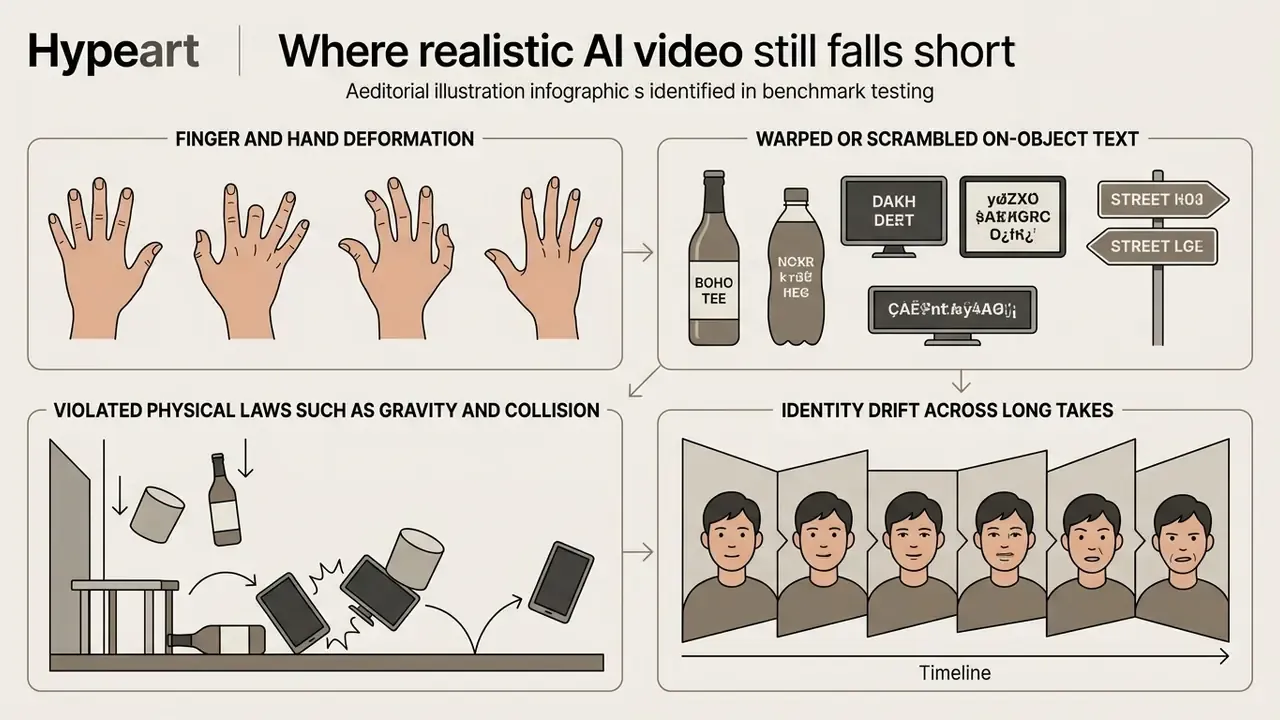
Hands, text and complex physical interactions
The most visible failures in modern AI video involve human hands, fine text rendering, and multi-object contact. Academic benchmarks like PhyGenBench (arXiv:2410.05363) report incorrect finger counts, impossible joint bending, and object clipping during hand-to-object interaction.
«PhyGenBench tested 160 prompts across 27 physical laws: neither model scaling nor prompt engineering removes systematic physical errors.»
«Visual realism does not imply physical understanding. Across tested state-of-the-art models, physical accuracy scores on conservation laws and rigid-body mechanics lag significantly behind per-frame aesthetic ratings.» Physics-IQ Benchmark Study, arXiv:2501.09038 (2025). https://arxiv.org/abs/2501.09038
Rendering readable, persistent text on moving objects, such as product labels or street signs, is likewise unstable. Generative networks treat text as visual pixel patterns rather than symbolic glyphs, so words warp, scramble, or drift across consecutive frames. Where a claim, price, dosage or legal line must be legible, composite it in post-production instead of asking the model to render it.
Hand-object failure has a mechanical explanation as well as a data one. Contact modelling, friction and penetration handling are weakly represented in appearance-driven training objectives, so fingers pass through surfaces or lose grip under occlusion. Practical mitigations: keep hands in frame for fewer than three seconds, prefer partial hand entry over full manipulation, and never stage card shuffling, instrument playing or keyboard typing as a hero action.
Long scenes and character consistency across frames
Continuous clips longer than 15 to 30 seconds degrade badly. Long-context generative research, including LCG: Long-Context Consistent Image Generation with Sparse Relational Attention (2026), which states that existing models "often fail to maintain consistency across sequential outputs," and StoryMaker (2024), which adds identity and segmentation constraints to hold face, hairstyle, clothing and body consistent, documents temporal drift leading to character identity degradation, morphing clothing patterns, and background geometry shifts over extended spans. Autoregressive video work on lookahead anchoring attributes the effect to small errors compounding across long temporal spans. Earlier circulating preprint identifiers for the LCG line of work are unverified; the finding itself is corroborated across multiple 2024 to 2026 papers.
For mobile-first pipelines where stills need pre-processing before generation, editors rely on retouching suites such as an Android photo editor or specialised web tools to clean up backgrounds before the frame becomes an I2V anchor. Assembly of short takes into a delivered sequence then happens in dedicated video editing tools. When reviewing licensing, tool access rights, or policy restrictions across enterprise media software, teams check our centralised AI Media Commercial-Use compliance resource.
Strategic Summary for Enterprise Adoption
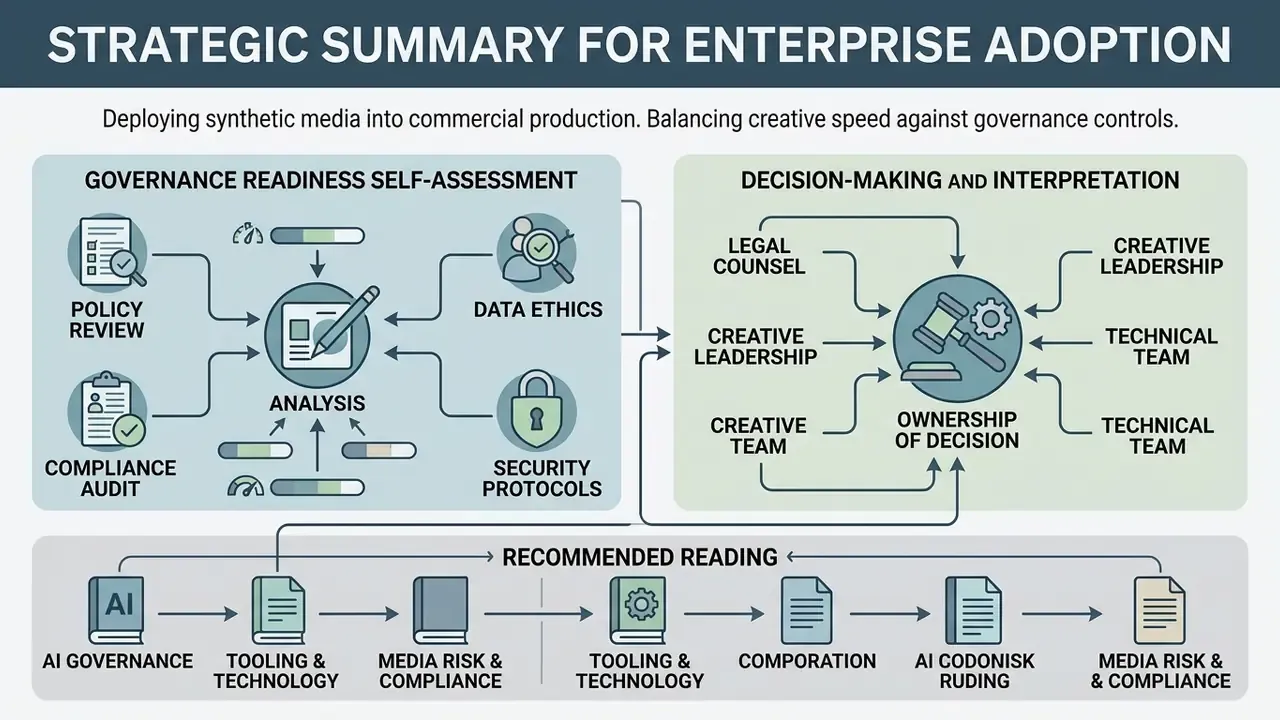
Deploying synthetic media into commercial production means balancing creative speed against governance controls. Ai videos that look real offer real cost efficiency for product teasers and social creative, yet decision-makers still need human-in-the-loop oversight to filter physical anomalies and protect brand integrity.
«Across five pre-registered experiments with 2,215 participants, deepfake detection accuracy reached 82% with video plus audio but fell to 74% in other conditions.»
Recommended reading: AI governance, tooling and media risk
- Explore comprehensive terminology definitions in the AI Media Glossary.
- Access detailed software guides, including our Guide to online photo editors, Guide to video compressors, Guide to AI voice generators, and Guide to free photo editors.
- Review commercial licensing evaluations for Ghibli-style AI image generators, Bing AI image creation, AI outpainting tools, Canva AI Generator, Microsoft AI Image Generator, Google AI Image Generator, and AI reverse-image-search tools.
- Compare top visual platforms using our analysis of best AI art generators, free AI art generators, free AI video generators, ChatGPT vs alternatives, and Midjourney vs competing tools.
- Review creator implementation workflows in our Guide to animation makers, Guide to AI headshot generators, and Guide to YouTube video editors.